The atmosphere as a dynamic system at Higher Level: This statement is Higher Level only. It explains why the atmosphere has layers and why it keeps changing: the physical processes (heating, rising air, winds, global warming) and the chemical one (making ozone from oxygen).
Practise this as you read
- Explain each layer by the process that heats or cools it.
- Outline how ozone is made from oxygen, and why the amount stays steady.
Free preview
This is the free notes preview
You're reading the free notes. Aimnova Pro unlocks the full study experience — and you can try it with your first topic free to keep:
- FlashcardsLock in vocabulary and key terms with spaced repetition.
- Practice questionsAnswer exam-style questions and get instant AI marking.
- Mock exams & past-paper vaultSit full mocks and see exactly how examiners award marks.
- Personalised study planA daily plan built around your exam date and weak areas.
Never still, always balanced: The atmosphere looks the same from day to day, but it is a dynamic system. Gases come and go, air moves and energy flows through it all the time. Its layers and its mix of gases are the result.
The points to remember
- The atmosphere is a system: it has storages (gases in each layer) and flows of matter and energy.
- Its gases are always being added and removed: by plants, volcanoes, the oceans, rain and people.
- Energy flows in as sunlight and out as infrared, and drives every movement of the air.
- So the atmosphere is dynamic: what we see today is a balance, kept by processes that never stop.
- The processes are physical (heating, rising air, winds, global warming) and chemical (making ozone).
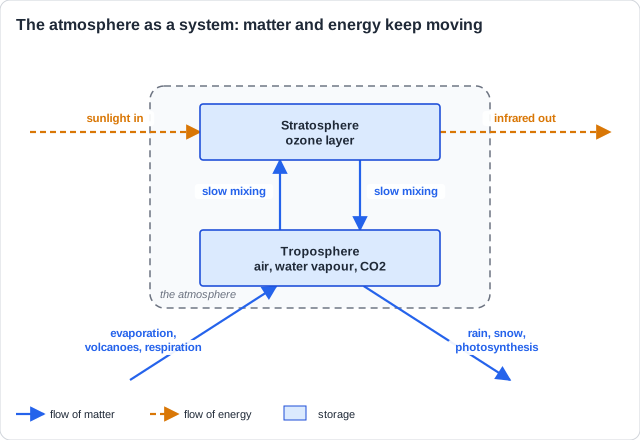
Real example: at Mauna Loa in Hawaii, carbon dioxide rises and falls by about 6 ppm every year. It falls each northern summer as forests photosynthesise, and rises each winter as they rest. When Mount Pinatubo in the Philippines erupted in 1991, it put about 15 million tonnes of sulfur dioxide into the stratosphere and cooled the whole planet by about 0.5°C the next year.
See how examiners mark answers
Answer exam-style questions with model answers. Learn exactly what earns marks and what doesn't.
The layers are not walls. Each layer exists because a different process heats or cools it. Read the temperature line from the ground up: every time it changes direction, a new layer begins.
Why each layer exists
- Troposphere: heated from the ground below; rising air expands and cools, so it gets colder with height.
- Warm air under cold air rises: the troposphere is always mixing, which makes our weather.
- Stratosphere: ozone absorbs ultraviolet light, so it gets warmer with height.
- Warm air on top of cold air does not rise, so the stratosphere is calm and layered.
- Mesosphere: almost no ozone, so it cools with height; thermosphere: thin gas absorbs X-rays, so it heats up.
- Each boundary is where a process changes, so the layers are the result of processes.
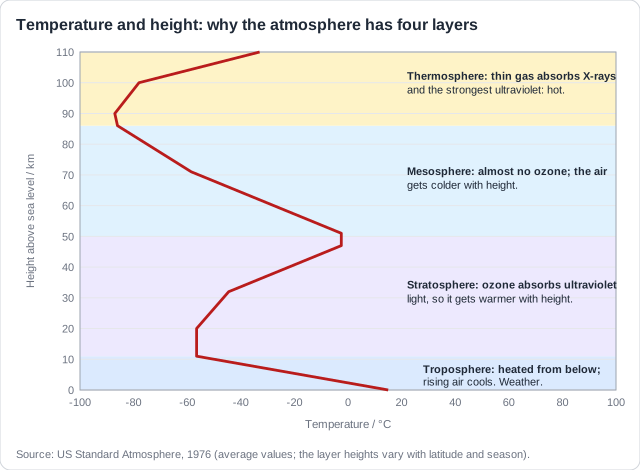
Remember it as: Heated from below, then by ozone, then by X-rays: three heaters, four layers.
Real example: the tropopause is about 16 km up over Singapore but only about 8 km over the North Pole. Over the hot equator, rising air pushes the top of the troposphere much higher. The layers are drawn by the processes, so they move when the processes change.
The Sun heats the Earth unevenly. Those temperature differences make pressure differences, and the air moves to even them out. This is the main physical process that keeps the troposphere mixing.
How temperature and pressure move the air
- Uneven heating makes temperature differences: land, sea, equator and poles heat differently.
- Warm air expands and rises, leaving low pressure at the surface.
- Cool air sinks, making high pressure at the surface.
- Air moves from high to low pressure: this is wind.
- Winds carry heat, water vapour and gases around the planet, so the mix of gases stays even.
Heat
- In May the land of northern India heats to over 40°C; the Indian Ocean stays cooler
Rise
- Hot air over the land rises, leaving low pressure at the surface
Wind
- Moist air flows in from the high pressure over the ocean towards the low over the land
Rain
- The monsoon reaches Kerala around 1 June and brings about three-quarters of India's yearly rain
Say both halves: A temperature difference alone is not the answer. Link it to pressure: warm air rises (low pressure), cool air sinks (high pressure), and air flows from high to low.
Study smarter, not longer
Most students waste 40% of study time on topics they already know. Our AI tracks your progress and optimizes every minute.
Global warming is a physical process too, and it is reshaping the layers. Greenhouse gases trap more heat near the ground, so the bottom of the atmosphere warms while the layer above cools.
How global warming changes the layers
- Global warming is a physical process that is changing the layers now.
- More greenhouse gases trap heat low down: the troposphere warms.
- Less heat reaches the air above, and CO2 there gives off more heat to space: the stratosphere cools.
- A warmer troposphere expands, so the tropopause rises.
- This pattern (warm below, cool above) is a fingerprint of greenhouse gases, not of a brighter Sun.
| Layer | What is happening | Why |
|---|---|---|
| Troposphere | warming | more greenhouse gases trap infrared heat near the ground |
| Tropopause | rising | warmer air expands, so the troposphere gets taller |
| Stratosphere | cooling | less heat comes up; its CO2 sends more heat out to space |
Real example: weather balloons and satellites show that the tropopause rose by about 200 m between 1979 and 1999, while the stratosphere cooled (Santer and others, 2003). A brighter Sun would have warmed both layers. Warming below and cooling above points to greenhouse gases.
The ozone layer is made by a chemical process that never stops. Ultraviolet light both makes ozone and breaks it, so the amount stays steady: a dynamic equilibrium.
How ozone is made from oxygen
- High in the stratosphere, ultraviolet light splits oxygen molecules (O2) into single oxygen atoms (O).
- Each atom joins another O2 to make ozone (O3).
- Ozone absorbs ultraviolet light and splits back into O2 and O: this is what warms the stratosphere.
- Ozone is made and destroyed all the time, so the ozone layer is a dynamic equilibrium.
- Most ozone is made over the tropics, where sunlight is strongest, and winds carry it towards the poles.
Split
Strong ultraviolet light splits O2 into two oxygen atoms.
Join
Each atom joins an O2 molecule: O + O2 makes O3, ozone.
Absorb
Ozone absorbs ultraviolet and splits into O2 + O, turning the light into heat.
Repeat
The atoms join O2 again: made and destroyed all the time, so the amount stays steady.
Real example: at Arosa in the Swiss Alps, scientists have measured the ozone overhead every year since 1926, the longest record on Earth. It rises and falls with the seasons and the Sun's cycle around a steady level, the sign of a balance kept by ultraviolet light.
Not the same as ozone damage: Here ozone is made and broken naturally, in balance. Chemicals such as CFCs upset that balance by destroying ozone faster than it forms: that is ozone depletion, taught in 6.4.
Practice with exam-style questions
Answer exam-style questions and get AI feedback that shows you exactly what examiners want to see in a full-marks response.
How this comes up: Paper 2, Section A: a graph of temperature and height, with the layers to identify and explain. Section B: outline or explain the physical and chemical processes that keep the atmosphere changing.
A weather balloon launched from Nairobi, Kenya, records the air getting colder for the first 16 km of its climb, then getting warmer again up to about 50 km.
Explain how processes in the atmosphere cause this pattern of temperature.
Model answer plan
See the mark-by-mark plan — for / against / judgement, with marking guidance — in study mode.