How farming varies at Higher Level: Different examples from SL: Kano's savanna climate, Brazil's Cerrado soils, Mauritius from coast to plateau, and the diets of India and Argentina. At HL, go on to one pair of contrasting choices in a single biome (5.2.13).
Practise this as you read
- Describe how farming changes with altitude.
- Explain why a crop suits one zone and not another.
Free preview
This is the free notes preview
You're reading the free notes. Aimnova Pro unlocks the full study experience — and you can try it with your first topic free to keep:
- FlashcardsLock in vocabulary and key terms with spaced repetition.
- Practice questionsAnswer exam-style questions and get instant AI marking.
- Mock exams & past-paper vaultSit full mocks and see exactly how examiners award marks.
- Personalised study planA daily plan built around your exam date and weak areas.
Climate decides what can grow: Farming looks very different across the world because climates and soils differ. A crop can only grow where it gets the warmth, water and growing season it needs.
The points to remember
- Temperature: crops need warmth; frost kills many and ends the growing season.
- Rainfall: how much falls, and when: a long dry season limits crops.
- Sunlight: long summer days help crops grow fast in high latitudes.
- To read a climate table, find the hottest and coldest months.
- Temperature range = hottest month minus coldest month, with units (°C).
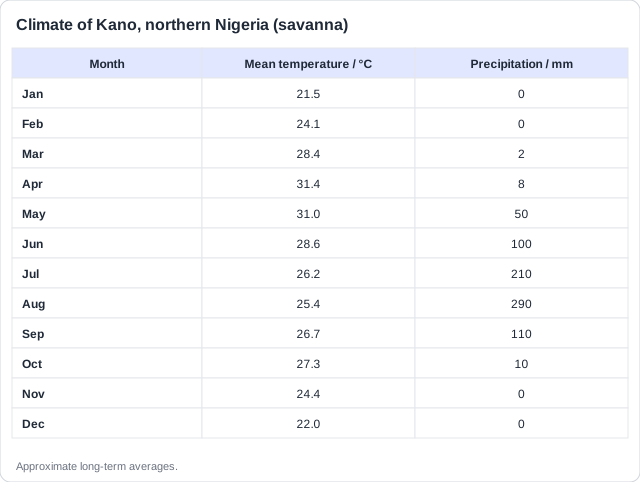
Example (HL): Kano, Nigeria. The range is 31.4 - 21.5 = 9.9 °C: warmth is never the limit, water is. Farmers grow millet and sorghum in the short rainy season, June to September, and Fulani herders move cattle south in the long dry season.
Learn what examiners really want
See exactly what to write to score full marks. Our AI shows you model answers and the key phrases examiners look for.
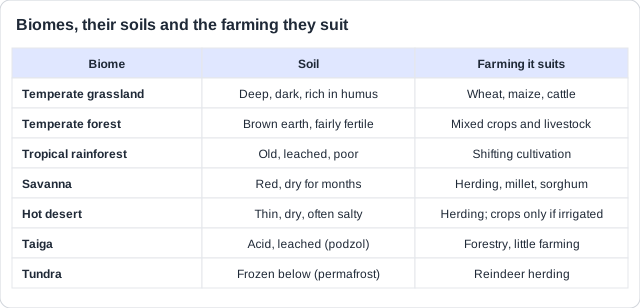
Each biome has its own kind of soil, and the soil decides which crops grow well and how much they yield.
The points to remember
- Temperate grasslands have the deepest, most fertile soils: the world's cereal belts.
- Rainforest soils are poor: most nutrients are in the trees, not the soil.
- Desert soils are thin and dry: crops need irrigation, otherwise herding.
- Taiga soils are acid and summers short: mostly forestry.
- Tundra is frozen below: reindeer herding, not crops.
Remember it as: Rich grassland, poor rainforest, dry desert, cold taiga.
Example (HL): Brazil's Cerrado. The savanna soils of the Cerrado are old, acid and poor. From the 1970s, scientists showed that adding lime and fertilizer made them farmable, and the Cerrado became one of the world's biggest soya regions.
Within one country, farming changes with height and slope. Air cools by about 6.5 °C for every 1,000 metres you climb, and steep slopes are hard to plough.
The points to remember
- Low, flat land: warm, easy to work: big plantations and arable fields.
- Higher land: cooler and often wetter: different crops, such as tea or coffee.
- Steep slopes: terraces or grazing, because ploughing causes erosion.
- Mountains: too cold and steep for most crops: forest or pasture.
- To describe a pattern, say where the crop is found and how it changes with altitude.
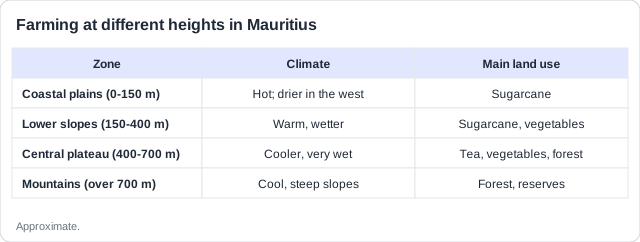
Example (HL): Mauritius. Sugarcane covers the hot, flat coastal plains and lower slopes. On the cooler, wetter central plateau around 600 metres, farmers grow tea, as at Bois Cheri, and vegetables instead.
Never wonder what to study next
Get a personalized daily plan based on your exam date, progress, and weak areas. We'll tell you exactly what to review each day.
Because farming varies, so do diets. What people eat depends on what their land and climate can grow, and on much more besides.
The points to remember
- Culture and religion: traditions and rules about food (no pork, no beef, vegetarian).
- Climate, relief and arable land: what the local land can grow.
- Water supply: rice needs a lot; dry lands rely on herds.
- Technology and know-how for certain ways of farming.
- Wealth and the cost of producing or buying food.
- Ideas of healthy eating, values about the environment, and whether food can be imported.
Example (HL): India and Argentina. Hindu and Jain beliefs make India home to hundreds of millions of vegetarians, who get protein from milk and lentils. Argentina's huge grassy pampas and ranching tradition make it one of the world's biggest beef eaters.
How this comes up: Paper 1 gives maps or tables of a place and asks you to describe how farming changes with altitude [1] or explain the pattern [2].
The table shows the main land use in four zones of Mauritius.
Explain why sugarcane is grown on the coastal plains but tea is grown on the central plateau.
Model answer plan
See the mark-by-mark plan — for / against / judgement, with marking guidance — in study mode.