Farmers' choices at Higher Level: Different examples from SL: a Canterbury dairy farm, a Malawi smallholding, Dutch glasshouses, and the pair Almeria v Anna Creek. At HL, weigh the economics of each choice (HL.b) and go on to alternative farming (5.2.14-5.2.16).
Practise this as you read
- Evaluate the sustainability of a farm system.
- Compare a pair of named contrasting systems.
Free preview
This is the free notes preview
You're reading the free notes. Aimnova Pro unlocks the full study experience — and you can try it with your first topic free to keep:
- FlashcardsLock in vocabulary and key terms with spaced repetition.
- Practice questionsAnswer exam-style questions and get instant AI marking.
- Mock exams & past-paper vaultSit full mocks and see exactly how examiners award marks.
- Personalised study planA daily plan built around your exam date and weak areas.
A farm is a system: A farm is a human-managed ecosystem built to produce as much food as possible. Farmers change its energy flows and nutrient cycles to send more of the productivity into food, and that has environmental costs.
Inputs
- Solar energy
- Seeds or young livestock
- Fertilizers (nitrogen, phosphorus, potassium)
- Pesticides and herbicides
- Water for irrigation
- Fossil fuels for machinery
- Labour
Outputs
- Food: crops, meat, milk
- Animal feed and biofuels
- Wastes: manure, crop residues
- Pollution: fertilizer runoff, greenhouse gases
- Soil lost by erosion
The points to remember
- Every farm has inputs, outputs, storages (soil, crops, animals) and flows.
- Some outputs are unwanted: runoff, greenhouse gases, eroded soil. Always name one.
- Farming uses about 70% of the world's fresh water withdrawals.
- It covers over a third of the land and gives about a quarter of greenhouse gases.
A dairy farm on the Canterbury Plains, New Zealand, keeps 800 cows on irrigated grass.
Outline the main inputs and outputs of this dairy farm.
Model answer plan
See the mark-by-mark plan — for / against / judgement, with marking guidance — in study mode.
Never wonder what to study next
Get a personalized daily plan based on your exam date, progress, and weak areas. We'll tell you exactly what to review each day.
Farms can be sorted by what they produce and why the farmer produces it.
| Basis | One type | The other type |
|---|---|---|
| Outputs | Arable: wheat, rice | Pastoral: cattle, sheep |
| Outputs | Mixed: crops and livestock on one farm | Agroforestry: trees with crops or animals |
| Variety | Monoculture: e.g. a plantation | Diverse (polyculture): many crops together |
| Reason | Commercial | Subsistence |
| Movement | Sedentary: the farm stays in one place | Nomadic: herders move with their animals |
The points to remember
- Arable, pastoral or mixed: what comes out of the farm.
- Monoculture gives big, cheap harvests but is open to pests and drains the soil.
- Commercial farms sell for profit; subsistence farms feed the family.
- Sedentary farms stay put; nomadic herders move with the seasons.
- Plantations are large commercial monocultures, such as oil palm or sugarcane.
Example (HL): a smallholding in Malawi. About one hectare grows maize, beans and pumpkins together, with a few goats and chickens. It is mixed, diverse, mostly subsistence and sedentary.
Farms can also be sorted by their inputs. The most important pair is intensive and extensive.
Intensive farming
- Intensive
- High yield per hectare
- Fertilizers, pesticides, irrigation, machinery
- Small area of land
- High energy use (fossil fuels)
- e.g. glasshouses, irrigated rice, indoor poultry
Extensive farming
- Extensive
- Low yield per hectare
- Natural rainfall and soil fertility
- Large area of land
- Low energy use
- e.g. ranching, shifting cultivation, dryland farming
The points to remember
- Irrigated or rain-fed: is water brought to the crop?
- Soil-based or hydroponic.
- Organic (manure, compost, no synthetic chemicals) or inorganic (synthetic fertilizer and pesticides).
- Compare intensive and extensive per hectare and per tonne of food.
Example (HL): Dutch glasshouses. In the Westland area of the Netherlands, tomatoes grow hydroponically in heated glasshouses under controlled light and carbon dioxide, giving yields many times higher per hectare than field tomatoes: very intensive.
Stop wasting time on topics you know
Our AI identifies your weak areas and focuses your study time where it matters. No more overstudying easy topics.
Why does one farmer choose cattle and another rice? Many factors combine.
The points to remember
- Environmental: climate, soils, relief, water, biome: they set the limits.
- Economic: prices, markets, costs of technology, subsidies, trade, cash crops, land tenure.
- Cultural: beliefs, traditions, food preferences, religion (no pork, no beef).
- Political: laws, subsidies, trade deals, food security plans, bans on GM crops.
- Social: labour, family size, education, population, who owns the land.
- Technological: machinery, seeds, irrigation and know-how available.
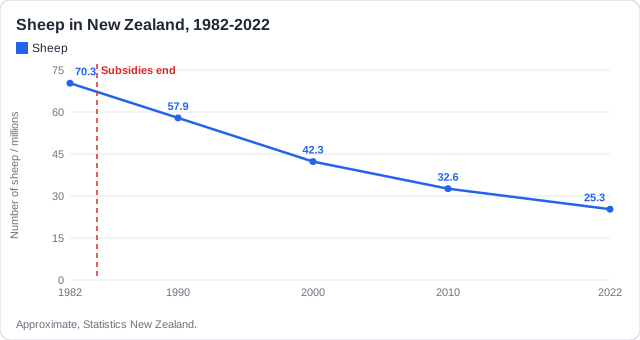
Example (HL): Canterbury's dairy boom. As milk powder sold well to China, Canterbury farmers turned dry sheep land into irrigated dairy pasture. An economic factor (price) and a technological one (irrigation) beat the environmental limit (low rainfall).
Factors in a [9]: Name a real place for each kind of factor, then weigh them. Environmental factors often set the limits; economic and political ones decide within them.
A pair of named contrasting systems: the greenhouses of Almeria, Spain, and Anna Creek station, South Australia, the world's largest cattle station (about 23,700 square kilometres).
| Almeria greenhouses (Spain) | Anna Creek station (Australia) | |
|---|---|---|
| Outputs | Arable: tomatoes, peppers, cucumbers | Pastoral: beef cattle |
| Reason | Commercial, for export | Commercial, for export |
| Inputs | Very intensive, irrigated, often hydroponic | Very extensive, rain-fed, few inputs |
| Yield | Very high per hectare | Very low per hectare: a few thousand cattle on huge land |
| Environment | Falling aquifers, plastic waste, fertilizer runoff | Overgrazing near water; little pollution |
| Society and economy | Many low-paid migrant jobs, high value | Few jobs, remote, drought risk |
The points to remember
- Learn one pair in detail: names, inputs, outputs, reasons, impacts.
- Almeria: intensive, irrigated, soil-less, inorganic, commercial.
- Anna Creek: extensive, rain-fed, pastoral, commercial.
- Compare on all three kinds of sustainability.
See how examiners mark answers
Answer exam-style questions with model answers. Learn exactly what earns marks and what doesn't.
Every choice has costs and benefits for the three kinds of sustainability: environmental, economic and social.
Intensive: impacts
- Water pollution from fertilizer and pesticide runoff
- Soil degraded: compaction, nutrients used up, salinization
- High greenhouse gases
- Biodiversity lost to monocultures
- But less land needed for the same food
Extensive: impacts
- Large areas of habitat cleared
- Overgrazing and desertification
- Less pollution per hectare
- More wildlife can live alongside
- But more land needed for the same food
The points to remember
- A monoculture like sugarcane drains the same nutrients every year.
- Machinery compacts the soil; over-irrigation can salinize it.
- Pesticides kill soil life; bare fields lose soil to erosion.
- Land sparing: high yields, more wild land kept.
- Land sharing: there is no single right answer.
- Productivity has risen hugely since the Green Revolution, but often at a cost to sustainability.
Remember it as: High input, high output, high impact per hectare.
Example (HL): Mauritius' sugarcane. The bagasse is burned to make electricity, supplying roughly a tenth of the island's power, and mill residues go back on the fields. But cane is trucked to the mills, using diesel.
Farming and climate work both ways: Climate shapes farming (drought, heat, shifting biomes), and farming changes climate (methane, cleared forest, fossil fuels, transport).
Adapt: drip irrigation, terracing, drought-tolerant crops, greenhouses. Mitigate: eat less meat, buy local, low-energy farming, feed additives that cut methane.
How this comes up: Paper 1 gives a fact file on a farm system and asks you to evaluate its sustainability [4]; Paper 2 Section B asks how far farming strategies raise productivity sustainably [9].
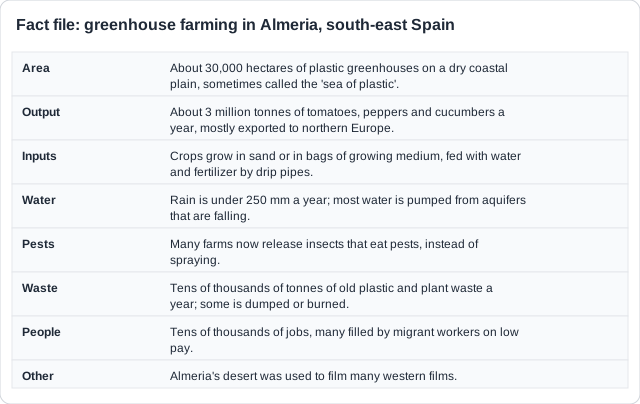
The fact file describes greenhouse farming in Almeria, Spain.
Evaluate the sustainability of greenhouse farming in Almeria.
Model answer plan
See the mark-by-mark plan — for / against / judgement, with marking guidance — in study mode.