Enough food, unevenly shared, at Higher Level: Different examples from SL: Brazil's soya, India's grain stores, Nigeria's tomatoes and South Korea's food-waste charges. At HL, ask who can pay for food (economics) and whether it is fair (ethics); food security itself is 5.2.12.
Practise this as you read
- Explain why hunger continues when there is enough food.
- Describe how food loss and waste differ between countries.
Free preview
This is the free notes preview
You're reading the free notes. Aimnova Pro unlocks the full study experience — and you can try it with your first topic free to keep:
- FlashcardsLock in vocabulary and key terms with spaced repetition.
- Practice questionsAnswer exam-style questions and get instant AI marking.
- Mock exams & past-paper vaultSit full mocks and see exactly how examiners award marks.
- Personalised study planA daily plan built around your exam date and weak areas.
Enough food, on paper: The world's farms grow enough food for all eight billion people. Hunger is not mainly a problem of too little food, but of who gets it and how much is lost or wasted.
The points to remember
- The world produces about 2,900 kcal per person per day; most people need about 2,100-2,500.
- So there is enough food for everyone, in total.
- But about a third of crops is fed to farm animals, and some becomes biofuel.
- At least one-third of all food is lost or wasted.
- And food goes to people who can pay for it, not always to those who need it.
Example (HL): soya from Brazil. Brazil is the world's biggest soya exporter. Most of the beans are shipped to China and Europe and fed to pigs and chickens, so the calories feed animals before they feed people.
Learn what examiners really want
See exactly what to write to score full marks. Our AI shows you model answers and the key phrases examiners look for.
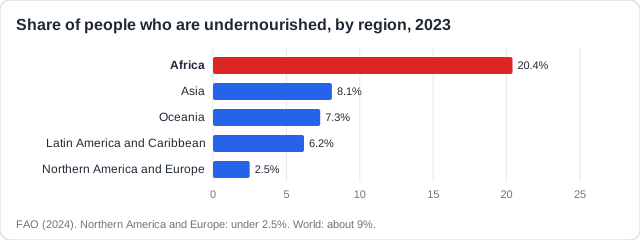
Food is not equitably distributed. In 2023 about 700 million people, about 1 in 11, were hungry, while over a billion were obese.
The points to remember
- Poverty: people who cannot afford food go hungry next to full shops.
- Conflict: war stops farming and blocks food deliveries.
- Poor roads and storage: food cannot reach the people who need it.
- Droughts and floods destroy harvests in the poorest places.
- Food for sale abroad: land grows crops for export, feed or fuel, not local meals.
Example (HL): India. India grows more grain than it eats and keeps huge stores, yet about 190 million people are undernourished. Since 2023 about 800 million people get free grain each month, because poverty, not a shortage, is the problem.
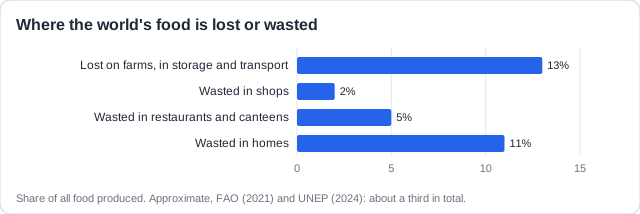
Food loss happens on farms, in storage and in transport. Food waste happens at the end of the chain.
The points to remember
- Poorer countries lose most food early: pests, no cold storage, heat, poor roads and machinery.
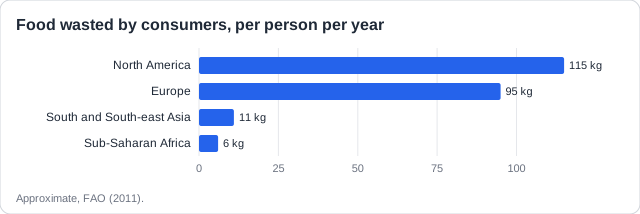
- Richer countries waste most food late: in shops and homes.
- Rich households buy too much, misread best-before dates and reject 'ugly' food.
- Poorer households waste less at home: they buy less, eat cheaper food and eat it all.
- So say more or less waste, at which stage, and why.
Example (HL): tomatoes in Nigeria. A large share of Nigeria's tomatoes, often put at about 40%, rot before they are eaten, because they are packed in heavy baskets, carried on hot, slow roads and sold without cold storage.
Never wonder what to study next
Get a personalized daily plan based on your exam date, progress, and weak areas. We'll tell you exactly what to review each day.
The UN's Sustainable Development Goals include a target on food waste.
The points to remember
- SDG 12.3: by 2030, halve food waste per person at shop and consumer level.
- It also aims to reduce food losses on farms and in the supply chain.
- Less waste means less land, water and energy used for food no one eats.
- Wasted food in landfill also releases methane, a greenhouse gas.
Remember it as: Halve the waste by 2030: SDG 12.3.
Example (HL): South Korea. Since 2013 households pay for food waste by weight, using bins that read a card, and almost all food waste is now collected and recycled into animal feed, compost or energy.
How this comes up: Paper 2 can give data on hunger or food waste and ask you to explain why hunger continues [3] or describe a difference between countries [2].
The world produces enough food to feed everyone. The bar chart shows the share of people who were undernourished in each region in 2023.
Explain why undernourishment continues in some regions although enough food is produced.
Model answer plan
See the mark-by-mark plan — for / against / judgement, with marking guidance — in study mode.