Land use and marginalized groups at Higher Level: Different examples from SL: women farmers, the Maasai of Loliondo, the Guarani-Kaiowa of Brazil and the Dongria Kondh of India. At HL, read this through the lenses: law (who holds a title), economics (who profits from the land) and ethics (whose needs count).
Practise this as you read
- Explain why a named group is vulnerable.
- Discuss how land rights can protect people and land.
Free preview
This is the free notes preview
You're reading the free notes. Aimnova Pro unlocks the full study experience — and you can try it with your first topic free to keep:
- FlashcardsLock in vocabulary and key terms with spaced repetition.
- Practice questionsAnswer exam-style questions and get instant AI marking.
- Mock exams & past-paper vaultSit full mocks and see exactly how examiners award marks.
- Personalised study planA daily plan built around your exam date and weak areas.
Who gets left out: A marginalized group has little say when land is shared out. Their needs are often ignored in land-use decisions.
The points to remember
- Indigenous peoples: the first peoples of a place, who often hold land by custom, not by title.
- Members of a low caste, such as Dalits in India.
- Women farmers, who do much of the farm work but own little of the land.
- People in low-income countries, where large companies or governments take land.
- What they share: low socio-economic status, so less power over land.
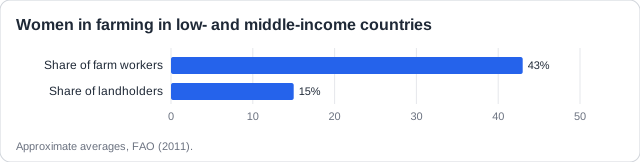
Example (HL): women farmers. Across low- and middle-income countries, women are about 43% of farm workers but only about 15% of landholders. The FAO estimates that if women had the same land, seed and credit as men, their yields could rise by 20-30%.
Practice with exam-style questions
Answer exam-style questions and get AI feedback that shows you exactly what examiners want to see in a full-marks response.
When a government, a company or a conservation project decides what land will be used for, the people with least power usually lose most.
The points to remember
- No written title: land held by custom can be taken without payment.
- Not consulted: decisions are made far away, without asking them.
- Little money or law: they cannot pay lawyers or go to court.
- Pushed onto marginal land: steep, dry or poor land that is easily degraded.
- They lose food, income, homes and culture tied to the land.
- So they become poorer and more vulnerable to drought or hunger.
Remember it as: No title, no voice, no land.
Example (HL): the Maasai of Loliondo, Tanzania. In 2022 the government marked out about 1,500 square kilometres of Loliondo as a game reserve. Maasai herders lost grazing land and water they had used for generations, and thousands fled across the border to Kenya.
Named case: the Guarani-Kaiowa of Mato Grosso do Sul, Brazil. About 50,000 Guarani-Kaiowa live in a state of cattle ranches, soya and sugarcane farms.
Their land
- They once lived across forests and grasslands, holding land by custom.
The decision
- During the 1900s the state sold or granted the land to ranchers and farmers; the Guarani-Kaiowa were moved into small reserves.
Crowding
- Today thousands live in crowded reserves or in camps beside roads, with too little land to grow their own food.
Today
- Families who return to old land are often evicted, and leaders have been killed. In 2023 the Supreme Court backed their land claims, but the dispute goes on.
The points to remember
- The Guarani-Kaiowa were deprived of land rights: their land was given to others.
- Commercial ranching, soya and sugarcane met others' needs, not theirs.
- Too little land means hunger, poverty and loss of culture.
- Use this case whenever a question asks for a named example.
Feeling unprepared for exams?
Get a clear study plan, practice with real questions, and know exactly where you stand before exam day. No more guessing.
Marginalized groups are less vulnerable when land-use decisions take their needs into account.
The points to remember
- Secure land titles: write customary land down so it cannot be taken without payment.
- Free, prior and informed consent: ask the people first, and let them say no.
- Equal rights for women to own and inherit land.
- Courts and laws that protect land rights, e.g. the UN Declaration on indigenous rights (2007).
- Indigenous-managed land often has less deforestation, so this helps sustainability too.
Remember it as: Write it down, ask first, share it fairly.
Example (HL): the Dongria Kondh, India. A company planned a bauxite mine on the Niyamgiri hills, sacred to the Dongria Kondh. In 2013 India's Supreme Court ruled that the local village councils must decide. All twelve voted no, and the mine was not built.
How this comes up: Paper 1 gives a fact file on a group and asks you to explain why it is vulnerable [3]; Paper 2 Section B can ask for a named example [4] or a discussion [9].
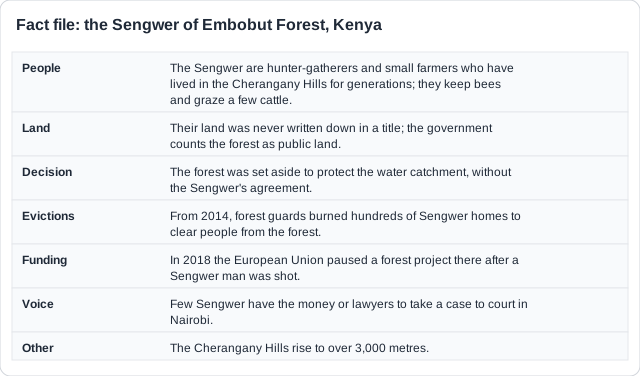
The fact file describes the Sengwer of Embobut Forest in Kenya.
Explain why the Sengwer are vulnerable when decisions are made about how the forest is used.
Model answer plan
See the mark-by-mark plan — for / against / judgement, with marking guidance — in study mode.