Land as a finite resource at Higher Level: Different examples from SL: Singapore, Peru's puna, Argentina's Gran Chaco and Brazil's cattle. At HL, link the shortage of land to the economics of who gets it (5.2.2) and to diets that use less land (5.2.17).
Practise this as you read
- Describe reasons why farm animals outweigh wild ones.
- Explain why some land is grazed, not ploughed.
Free preview
This is the free notes preview
You're reading the free notes. Aimnova Pro unlocks the full study experience — and you can try it with your first topic free to keep:
- FlashcardsLock in vocabulary and key terms with spaced repetition.
- Practice questionsAnswer exam-style questions and get instant AI marking.
- Mock exams & past-paper vaultSit full mocks and see exactly how examiners award marks.
- Personalised study planA daily plan built around your exam date and weak areas.
There is only so much land: Land is a finite resource. The amount of land on Earth does not grow, but the number of people who need feeding does.
The points to remember
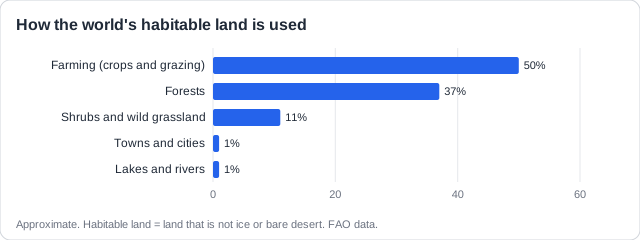
- About 70% of the world's ice-free land is already used for farming and forestry.
- About half of all habitable land is farmed.
- Only about one-eighth of the land surface grows crops; most farmland is grazing.
- The rest is forest, shrubs, wild grassland, towns, lakes and rivers.
- So new farmland can only come from natural ecosystems or from other uses.
Example (HL): Singapore. About 6 million people live on an island of about 730 square kilometres. There is so little land that Singapore grows less than a tenth of its food and buys the rest. Its '30 by 30' goal is to grow 30% of its food by 2030, mostly in tall indoor farms.
Never wonder what to study next
Get a personalized daily plan based on your exam date, progress, and weak areas. We'll tell you exactly what to review each day.
Not every piece of land can grow arable crops. Where crops fail, people usually keep livestock instead, because animals can eat grass on land that cannot be ploughed.
The points to remember
- Too steep: machines cannot work, and ploughed slopes lose their soil to erosion.
- Too nutrient-poor or thin: the soil cannot feed a crop.
- Too dry: no crops without water for irrigation.
- Too cold or too high: the growing season is too short.
- Waterlogged or salty: roots rot or cannot take up water.
- This land is often used for livestock, which graze it.
Remember it as: Steep, poor, dry, cold: graze it, don't plough it.
Example (HL): the puna of Peru. Above about 4,000 metres in the Andes, frost and a short growing season stop most crops. Families there keep herds of llamas and alpacas, which graze the tough grasses and give wool, meat and transport.
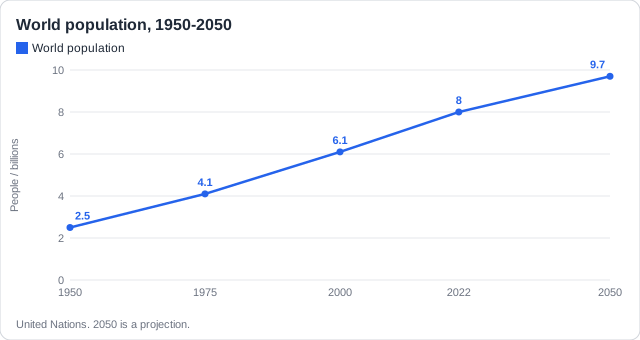
The world's population passed 8 billion in 2022 and is still growing. Every extra person needs food from a fixed amount of land.
The points to remember
- The population is expected to reach about 9.7 billion by 2050.
- Farmland per person has halved: about 0.37 hectares in 1961, under 0.2 now.
- Extra food comes from higher yields on the same land, or from new farmland.
- New cropland is usually taken from pasture, grassland or forest.
- Towns and roads also spread onto good farmland, so some is lost.
Example (HL): the Gran Chaco, Argentina. The dry forests of the Chaco have been cleared quickly since about 2000 for soya fields and cattle pasture. Cleared land is often grazed first and later ploughed for crops.
Stop wasting time on topics you know
Our AI identifies your weak areas and focuses your study time where it matters. No more overstudying easy topics.
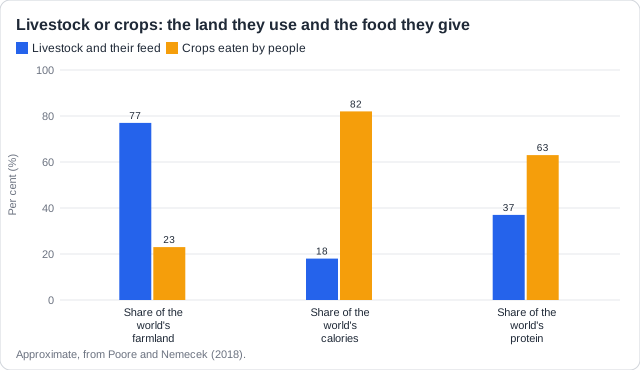
Most farmland feeds animals, not people directly. Livestock and the crops grown to feed them use about three-quarters of the world's farmland, but give much less of its food.
The points to remember
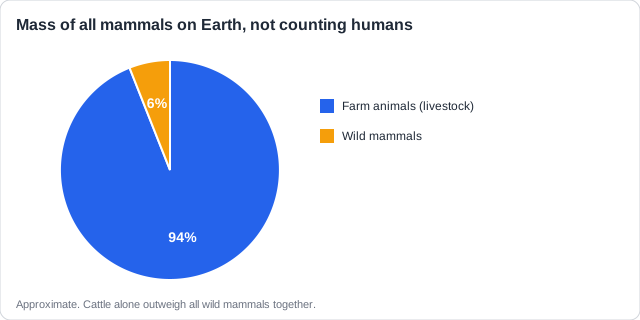
- Livestock's biomass is far bigger than wild mammals'.
- More meat is eaten as incomes rise and countries develop.
- Breeding and technology (feed, vaccines) make animals grow faster.
- Farmers invest in livestock: it is a big source of income.
- Wild habitat is turned into pasture, and wild animals are hunted.
- Population growth on its own is not a reason: say how it raises demand for meat.
Example (HL): Brazil. Brazil has over 230 million cattle, more cattle than people. Most graze pasture made by clearing forest and savanna, and the beef is sold in Brazil and abroad.
How this comes up: Paper 2 Section A gives a figure about farming's share of land or animals and asks you to describe reasons for a difference [2].
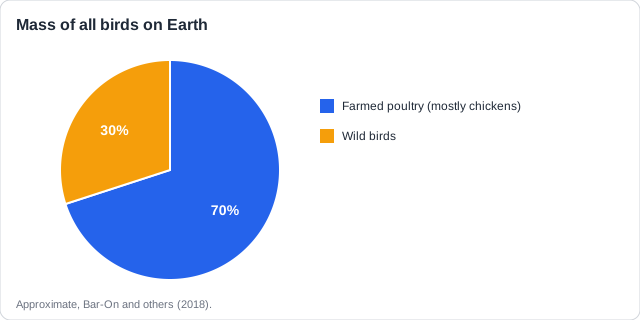
The pie chart shows the mass of all the birds on Earth.
Describe possible reasons for the difference between the mass of farmed poultry and the mass of wild birds.
Model answer plan
See the mark-by-mark plan — for / against / judgement, with marking guidance — in study mode.