Carbon from soils at Higher Level: This statement is Higher Level only. It explains why soils release carbon dioxide in some places and methane in others, how draining peat and thawing permafrost turn huge stores into sources, and why that could reach a tipping point.
Practise this as you read
- Outline a positive feedback loop for thawing permafrost.
- Explain why draining a peatland releases carbon dioxide.
Free preview
This is the free notes preview
You're reading the free notes. Aimnova Pro unlocks the full study experience — and you can try it with your first topic free to keep:
- FlashcardsLock in vocabulary and key terms with spaced repetition.
- Practice questionsAnswer exam-style questions and get instant AI marking.
- Mock exams & past-paper vaultSit full mocks and see exactly how examiners award marks.
- Personalised study planA daily plan built around your exam date and weak areas.
Oxygen decides the gas: When soil microbes break down dead matter, its carbon goes into the air. With oxygen, decomposition is aerobic and releases carbon dioxide. Without oxygen it is anaerobic, and methanogens release methane.
The points to remember
- Soil microbes decompose dead organic matter; its carbon goes into the air.
- In aerated soil (oxygen present), decomposition is aerobic: the carbon leaves as carbon dioxide.
- In waterlogged soil (no oxygen), decomposition is anaerobic: microbes release methane.
- Methane traps about 28 times as much heat as carbon dioxide over 100 years.
- But waterlogged soils decompose slowly, so they also store a lot of carbon.
Remember it as: Air in the soil: CO₂ out. Water in the soil: methane out.
Aerated soil
- Oxygen in the pores
- Fast, aerobic decomposition
- Carbon leaves as CO₂
- e.g. a ploughed wheat field
Waterlogged soil
- Water fills the pores: no oxygen
- Slow, anaerobic decomposition
- Carbon leaves as methane
- e.g. a flooded rice paddy
Real example: flooded rice paddies in Asia are one of the largest farm sources of methane. Some farmers now drain their fields for a few days in mid-season, which lets oxygen in and cuts the methane.
Feeling unprepared for exams?
Get a clear study plan, practice with real questions, and know exactly where you stand before exam day. No more guessing.
Peat is the biggest carbon store in any soil. Drain it, and a store becomes a source.
Peatlands and drainage
- Peat forms where waterlogging stops dead plants from rotting: carbon builds up for thousands of years.
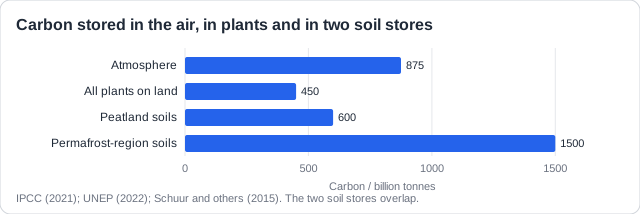
- Peatlands cover about 3% of land but store about 600 billion tonnes of carbon, more than all land plants.
- Draining a peatland lets oxygen in: the peat decomposes aerobically and releases carbon dioxide.
- Methane release falls after drainage, but the carbon dioxide released is far greater.
- The peat shrinks, so the ground sinks; dry peat also burns.
- Drained peatlands give about 4% of human greenhouse gas emissions; rewetting stops the loss.
Holme Fen
- England: an iron post set level with the ground in 1851 now stands over 4 m above it, because the drained peat has shrunk and oxidised
Indonesia
- 2015: drained peat swamps burned for months; at the peak they released about 11.3 million tonnes of CO₂ a day, more than the whole EU (8.9 million)
Flow Country
- Scotland: drains dug for 1980s forestry are being blocked and the trees removed to rewet the bog; in 2024 it became the first peatland World Heritage Site
In the far north, permafrost has locked away dead plants for thousands of years. Warming is unlocking them, and that could push the climate past a tipping point.
Permafrost, clathrates and tipping points
- Soils in the permafrost region hold about 1500 billion tonnes of carbon: about twice the atmosphere's.
- Global warming thaws the permafrost; microbes start to decompose the old organic matter.
- Where thawed ground drains, it releases carbon dioxide; where it is waterlogged, methane.
- More greenhouse gases cause more warming, which thaws more permafrost: a positive feedback.
- Past a tipping point, thawing continues on its own even if emissions stop.
- Deeper still, warming could break down methane clathrates, releasing methane: another tipping point.
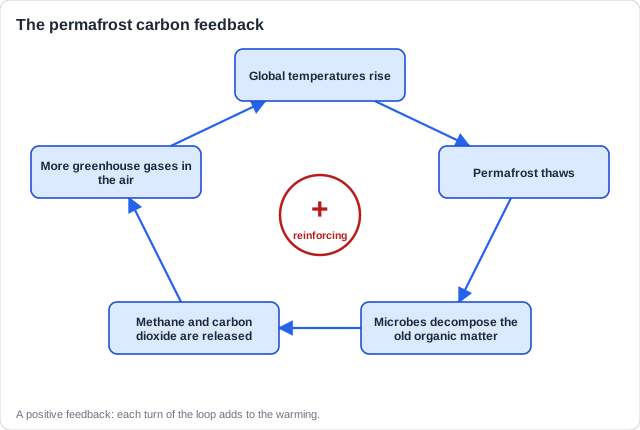
Close the loop, and keep albedo out: A feedback answer must come back to the start: warming, thaw, methane released, methane is a greenhouse gas, more warming. Melting ice and albedo is a different loop: it does not answer a question about permafrost carbon. Methane clathrates are a separate store, deeper down.
Real example: the Arctic has warmed nearly four times as fast as the world as a whole since 1979. In Siberia, the Batagaika 'megaslump' is a collapse of thawing ground that was about 1 km wide in 2023 and is still growing.
Memorize terms 3x faster
Smart flashcards show you cards right before you forget them. Perfect for definitions and key concepts.
Most soils release carbon faster when people farm them. The good news: farming can also keep it in.
Farming and other human activity
- Ploughing lets air in and breaks up soil crumbs: microbes decompose humus faster, releasing CO₂.
- Clearing forest or grassland stops the input of dead organic matter, so the store shrinks.
- Flooded rice paddies and wet manure release methane.
- Warmer soils everywhere decompose faster: more CO₂ from every soil.
- To keep carbon in: no-till, cover crops, compost, and keeping wetlands wet.
Releases soil carbon
- Ploughing
- Draining wetlands
- Burning and clearing
- Flooded rice and wet manure (methane)
Keeps it in the soil
- No-till farming
- Cover crops and compost
- Rewetting peat
- Short drainage of rice paddies
Real example: scientists estimate that the world's farmed soils have lost about 116 billion tonnes of carbon since farming began, much of it as carbon dioxide from ploughing.
How this comes up: Paper 2, Section A: outline a permafrost feedback loop [2], or data on a drained bog to explain. Section B (b): explain how human activities turn soils into carbon sources.
The soils of the Arctic tundra in northern Canada hold large amounts of frozen organic matter, and the region is warming faster than the rest of the world.
Explain how warming of these soils could lead to a climate tipping point.
Model answer plan
See the mark-by-mark plan — for / against / judgement, with marking guidance — in study mode.