Soil properties at Higher Level: This statement is Higher Level only. It shows how to describe a soil with numbers: reading the texture triangle, calculating water, organic matter, bulk density and infiltration, and reading colour and pH.
Practise this as you read
- State a texture class from the triangle.
- Calculate water %, organic matter % and bulk density.
Free preview
This is the free notes preview
You're reading the free notes. Aimnova Pro unlocks the full study experience — and you can try it with your first topic free to keep:
- FlashcardsLock in vocabulary and key terms with spaced repetition.
- Practice questionsAnswer exam-style questions and get instant AI marking.
- Mock exams & past-paper vaultSit full mocks and see exactly how examiners award marks.
- Personalised study planA daily plan built around your exam date and weak areas.
Eight measurements describe a soil: A soil can be described with numbers: its texture, organic matter, water, infiltration, bulk density, colour and pH. Each one predicts how well plants will grow.
The points to remember
- Texture: the percentages of sand, silt and clay, read on the texture triangle.
- Organic matter %: burn dry soil; the mass lost is the organic matter.
- Water %: dry fresh soil at 105 °C; the mass lost is the water.
- Infiltration: how fast water soaks in, in mm per hour.
- Bulk density: dry mass ÷ volume (g per cm³); high = compacted.
- Colour (dark = humus, red = iron, grey = waterlogged) and pH (acid or alkaline).
| Property | How it is measured | What it tells you |
|---|---|---|
| Sand, silt, clay % | sieves, or a jar of water left to settle | drainage and nutrients |
| Organic matter % | burn dry soil in a furnace | fertility, water held |
| Water % | dry fresh soil in an oven at 105 °C | water for plants |
| Infiltration | a ring pushed into the ground and filled | run-off and erosion risk |
| Bulk density | a metal core of known volume, then dried | compaction |
| Colour | matched to a Munsell chart | humus, iron, waterlogging |
| pH | a meter or test kit | which nutrients are available |
Real example: at Rothamsted in England, the Broadbalk wheat field has been sampled and measured since 1843. Its records show how manure, fertiliser and ploughing change a soil's organic matter and pH over generations.
Know your predicted grade
Take timed mock exams and get detailed feedback on every answer. See exactly where you're losing marks.
The texture triangle turns three percentages into one name. Each side is one particle size, and every point inside the triangle is a mix that adds up to 100%.
Reading the triangle
- The three percentages always add up to 100: if you know two, subtract to find the third.
- Clay: find the value on the clay side and follow the line straight across.
- Silt: from the silt side, follow the line down and to the left.
- Sand: from the sand side, follow the line up and to the left.
- Where the lines meet is the sample: name the class it falls in, exactly as printed.
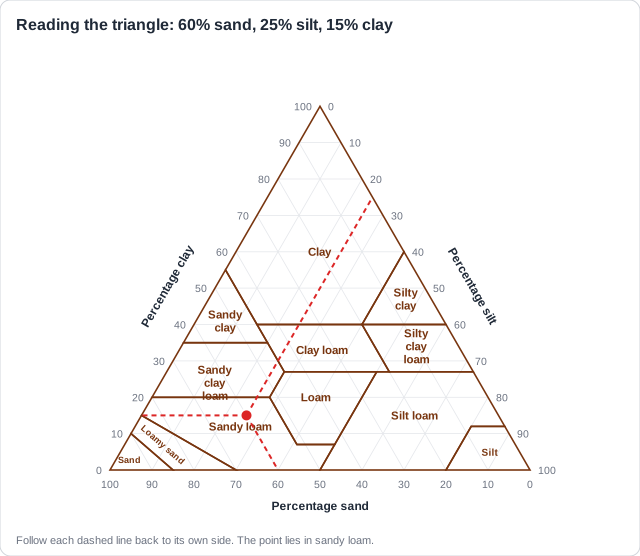
Check
A sample has 10% sand and 60% clay. Silt = 100 - 10 - 60 = 30%.
Clay
From 60 on the clay side, go straight across.
Silt
From 30 on the silt side, go down and to the left.
Name it
The lines meet inside the large clay class: the soil is a clay.
Name one class only: Write the class exactly as the triangle prints it, such as 'silt loam'. If you name two classes, only the first one counts, even if the second is right.
Once you have the class, you can predict how the soil behaves. Loams combine the best of each size.
From class to properties
- Loam (a balanced mix): drains well yet holds water and nutrients: the best farm soil.
- Sandy loam, loamy sand: drain fast, warm early, but need more water and fertiliser.
- Clay, silty clay: hold water and nutrients but waterlog, compact and are hard to work.
- Silt loam: holds water well and is fertile, but crusts and erodes easily.
- So the class predicts drainage, water-holding, nutrients and workability.
| Class | Drainage | Water and nutrients | For farming |
|---|---|---|---|
| Sandy loam | fast | low | good if watered and fed |
| Loam | good | good | the best all-round |
| Silt loam | moderate | high | fertile, but erodes |
| Clay | slow; waterlogs | high | heavy; hard to work |
Real example: the deep silt loams of the Palouse hills in Washington State, USA, grow some of the world's highest wheat yields, but they erode badly when left bare after harvest.
Get feedback like a real examiner
Submit your answers and get instant feedback — what you did well, what's missing, and exactly what to write to score full marks.
Most other properties come from simple mass measurements. Learn the four formulas, then use them.
The formulas
- Water % = (fresh mass - dry mass) ÷ fresh mass × 100.
- Organic matter % = (dry mass - mass after burning) ÷ dry mass × 100.
- Bulk density = dry mass ÷ volume of the soil core (g per cm³).
- Infiltration rate = depth of water that soaked in ÷ time taken (e.g. mm per hour).
- Bulk density above about 1.6 g per cm³ makes it hard for roots to push through.
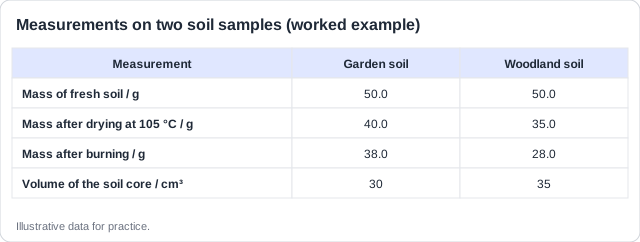
| Result | Garden soil | Woodland soil |
|---|---|---|
| Water % | (50 - 40) ÷ 50 × 100 = 20% | (50 - 35) ÷ 50 × 100 = 30% |
| Organic matter % | (40 - 38) ÷ 40 × 100 = 5% | (35 - 28) ÷ 35 × 100 = 20% |
| Bulk density | 40 ÷ 30 = 1.33 g per cm³ | 35 ÷ 35 = 1.00 g per cm³ |
Read what the result means: The woodland soil holds more water and far more organic matter, and its lower bulk density shows it is loose and full of pores: better for roots and for water soaking in.
Colour and pH need no calculation, but they tell you a lot about what is happening in a soil.
Colour and pH
- Dark brown or black: rich in humus.
- Red, orange or yellow: iron oxides; the soil is well drained and aerated.
- Grey or blue-grey with mottles: waterlogged, short of oxygen.
- Pale: leached (an E horizon).
- pH: most crops grow best at pH 6-7; acid soils lock up nutrients and are limed.
Remember it as: Dark = humus. Red = iron and air. Grey = water and no air.
Real example: upland sheep pastures in Wales are often acid, below pH 5.5, because heavy rain leaches calcium out. Farmers spread crushed limestone (lime) to raise the pH, so grass can take up nutrients again.
Learn what examiners really want
See exactly what to write to score full marks. Our AI shows you model answers and the key phrases examiners look for.
How this comes up: Paper 2, Section A: state a texture class from the triangle [1]; calculate percentages from a test [1] each; explain what the results mean for plants [2].
A student in Nairobi, Kenya, weighs a fresh soil sample (40.0 g), dries it at 105 °C (30.0 g), then burns it (27.0 g).
Calculate the percentage of water in the fresh soil and the percentage of organic matter in the dry soil.
Model answer plan
See the mark-by-mark plan — for / against / judgement, with marking guidance — in study mode.