Sand, silt and clay at Higher Level: This statement is Higher Level only. It compares sand, silt and clay by size and by chemistry: why clay holds nutrients that sand loses, through cation exchange.
Practise this as you read
- Explain water and nutrient differences between sandy and clay soils.
- Describe how adding sand changes a clay soil.
Free preview
This is the free notes preview
You're reading the free notes. Aimnova Pro unlocks the full study experience — and you can try it with your first topic free to keep:
- FlashcardsLock in vocabulary and key terms with spaced repetition.
- Practice questionsAnswer exam-style questions and get instant AI marking.
- Mock exams & past-paper vaultSit full mocks and see exactly how examiners award marks.
- Personalised study planA daily plan built around your exam date and weak areas.
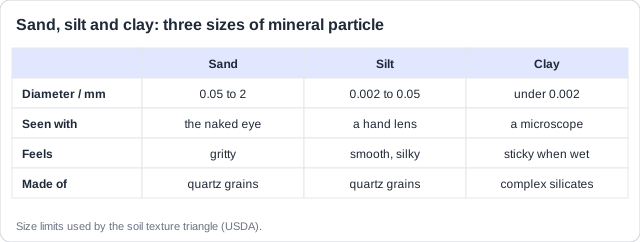
Three sizes, two kinds of mineral: Mineral soil is made of sand, silt and clay. They differ in size, and also in what they are made of: sand and silt are grains of quartz, while clays are complex silicates.
The points to remember
- Sand: the largest particles, 0.05 to 2 mm; you can see the grains; it feels gritty.
- Silt: 0.002 to 0.05 mm; it feels smooth and silky.
- Clay: the smallest, under 0.002 mm; it feels sticky when wet.
- Sand and silt are mostly quartz: hard grains that hardly react.
- Clay particles are complex silicates: tiny, flat plates with a huge surface area.
Remember it as: Sand gritty, silt silky, clay sticky.
Real example: if a sand grain from a beach were the size of a football, a clay particle on the same scale would be about the size of a grain of salt.
Stop wasting time on topics you know
Our AI identifies your weak areas and focuses your study time where it matters. No more overstudying easy topics.
Particle size sets the size of the spaces between particles, and the spaces decide how water and air move.
Physical differences
- Sandy soils: large pores, so they drain fast and are well aerated, but hold little water.
- Sandy soils warm up quickly in spring and are light and easy to dig.
- Clay soils: tiny pores, so they hold water, drain slowly and waterlog easily.
- Clay soils are heavy: sticky when wet, hard and cracked when dry; roots and air struggle.
- Silty soils sit in between: they hold water well but crust and are easily eroded.
| Property | Sandy soil | Silty soil | Clay soil |
|---|---|---|---|
| Pore size | large | medium | tiny |
| Drainage | fast | moderate | slow; waterlogs |
| Water held | little | a lot | a lot, held tightly |
| Air (oxygen) | plenty | moderate | little when wet |
| Digging | light, easy | crusts when dry | heavy; sticky, then cracks |
Real examples: the Breckland of eastern England is so sandy that its fields dry out in summer; much of it was planted with pine as Thetford Forest. London Clay swells when wet and shrinks and cracks in dry summers, so houses built on it can subside. The silty loess of China's Loess Plateau washes away easily in heavy rain.
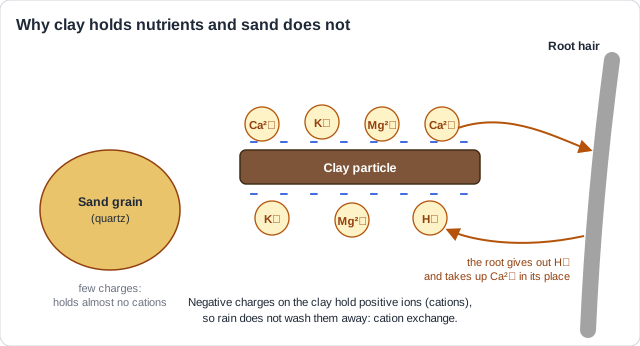
The biggest difference is chemical. Clay holds cations on its surface, so it has a much greater cation-exchange capacity (CEC) than sand or silt.
Cation exchange
- Clay plates carry many negative charges on their surfaces.
- These hold positive ions (cations): calcium, magnesium and potassium, nutrients plants need.
- Roots release H⁺ ions and take the nutrients in exchange: cation exchange.
- Clay has a high cation-exchange capacity (CEC); sand and silt (quartz) have a low CEC.
- So clay soils keep their nutrients; in sandy soils nutrients stay dissolved and are leached away.
- Humus has an even higher CEC than clay, which is why organic matter makes soil fertile.
CEC is measured in centimoles of charge per kilogram of soil (cmol per kg): the higher the number, the more nutrient ions the soil can hold.
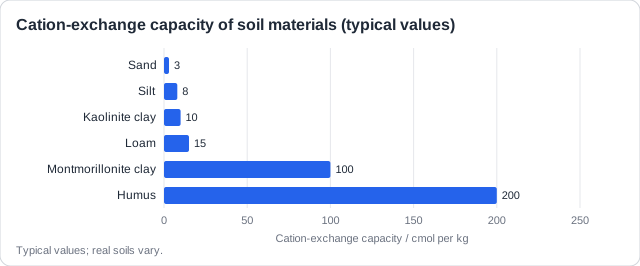
Not every clay is the same: The red oxisols of the Amazon are full of clay, yet they are poor. Their clay is kaolinite, worn down by heat and rain over millions of years, so its CEC is low and the nutrients are leached away.
See how examiners mark answers
Answer exam-style questions with model answers. Learn exactly what earns marks and what doesn't.
No single size is perfect. Farmers and gardeners change a soil's mix to get the good points of each.
Mixing the sizes
- The best farm soil, loam, mixes sand, silt and clay: it drains AND holds water and nutrients.
- Adding sand to a clay soil: better drainage, less waterlogging, more infiltration, less run-off.
- It also adds air spaces (more oxygen for roots), eases root growth and helps soil microbes.
- But: it lowers water-holding, raises leaching of nutrients, and loosens roots' anchorage.
- Adding organic matter (compost) helps every soil: water, nutrients and structure.
Sand added to clay: gains
- Drains faster, waterlogs less
- More infiltration, less run-off
- More air for roots
- Easier root growth; more microbes
Sand added to clay: losses
- Holds less water
- More nutrients leached
- Less stable: weaker anchorage
- Lower CEC overall
Real example: gardeners on London Clay dig in grit to open up the drainage, and compost to add humus. The compost matters most: it improves drainage and air while holding water and nutrients.
How this comes up: Paper 2, Section A: data on soils to compare (CEC, drainage, water), or how adding sand changes a soil. Section B (a): distinguish between sandy and clay soils.
A farm in the Breckland of eastern England has a sandy soil, while a farm in Essex has a heavy clay soil.
Explain how the differences between sand and clay particles affect the water and nutrients available to crops on the two farms.
Model answer plan
See the mark-by-mark plan — for / against / judgement, with marking guidance — in study mode.