The A horizon at Higher Level: This statement is Higher Level only. It explains why the topsoil holds most of the soil's life and roots, why it is both the most valuable and the most vulnerable layer, and how farming can lose it or protect it.
Practise this as you read
- Explain why most root growth is in the A horizon.
- Outline ways to protect topsoil on farms.
Free preview
This is the free notes preview
You're reading the free notes. Aimnova Pro unlocks the full study experience — and you can try it with your first topic free to keep:
- FlashcardsLock in vocabulary and key terms with spaced repetition.
- Practice questionsAnswer exam-style questions and get instant AI marking.
- Mock exams & past-paper vaultSit full mocks and see exactly how examiners award marks.
- Personalised study planA daily plan built around your exam date and weak areas.
The topsoil: The A horizon is the topsoil. It lies just beneath the leaf litter and is dark because it is rich in humus.
The points to remember
- The A horizon lies just beneath the O horizon (the organic humus layer), where there is one.
- It is also called the mixed layer or topsoil.
- It is rich in organic matter: humus mixed with sand, silt and clay.
- Humus makes it darker than the layers below.
Remember it as: A for 'all mixed': humus and minerals together.
Real example: the chernozem soils of Ukraine have an A horizon that is often more than half a metre deep. This thick, humus-rich topsoil is one reason Ukraine is one of the world's biggest wheat exporters.
Practice with exam-style questions
Answer exam-style questions and get AI feedback that shows you exactly what examiners want to see in a full-marks response.
Why do almost all roots, worms and microbes live near the top? Because the topsoil has more of everything they need than the layers below.
Why most life is in the topsoil
- Topsoil has more oxygen than lower horizons: more air spaces, so roots and microbes can respire.
- It has more organic matter, which holds water and nutrients.
- It has more microorganisms (bacteria, fungi) and animals such as earthworms.
- So there is more nutrient recycling: decomposers release nutrients right where the roots are.
- Therefore it is where there is most root growth and other biological activity.
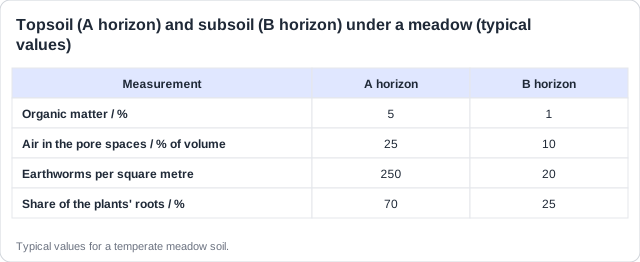
A horizon (topsoil)
- More oxygen
- More organic matter
- More microorganisms
- Fast nutrient recycling
- Most roots
B horizon (subsoil)
- Less oxygen
- Little organic matter
- Few organisms
- Slow recycling
- Few roots
Real example: in 1881 Charles Darwin showed that earthworms in English fields pass so much soil through their bodies that stones and chalk left on the surface slowly sink into the topsoil. That constant mixing is what makes the A horizon the 'mixed layer'.
The A horizon is both the most valuable layer and, with the O horizon, the most at risk, because it is on top.
Most valuable, most vulnerable
- The A horizon is the most valuable layer for plant growth.
- With the O horizon, it is also the most vulnerable: it lies at the surface.
- Erosion: rain and wind carry bare topsoil away.
- Degradation: compaction by machines, loss of organic matter, salinization, pollution.
- Soil forms very slowly (up to 1000 years for 1 cm), so lost topsoil is not renewed in a lifetime.
Why this matters for sustainability: Topsoil forms far more slowly than it can be lost. A farm that loses its topsoil in a few decades cannot wait centuries for it to return, so managing soil sustainably means keeping it in place.
Real example: in the 1930s, farmers on the US Great Plains had ploughed up the prairie grass. When drought came, the bare topsoil blew away in huge dust storms, the Dust Bowl. On 'Black Sunday', 14 April 1935, one storm turned day into night.
Feeling unprepared for exams?
Get a clear study plan, practice with real questions, and know exactly where you stand before exam day. No more guessing.
Where intensive farming has removed the topsoil, crops depend on fertiliser. The better answer is to protect it. One loess region shows how.
Losing it, and protecting it
- Intensive farming can remove the A horizon: ploughing, bare soil and erosion.
- Without topsoil the land needs fertilisers to replace the lost nutrients.
- Keep it covered: cover crops, mulch and crop residues shield it from rain and wind.
- Disturb it less: no-till farming keeps its structure and its organisms.
- Slow the water and wind: contour ploughing, terraces, windbreaks.
- Feed it: compost and manure add organic matter back.
Remember it as: Cover it, don't disturb it, slow the water, feed it.
Problem
- Steep, overgrazed and ploughed slopes lost their topsoil to rain; the Yellow River ran thick with it
Terraces
- From the 1990s, slopes were cut into flat terraces that hold the water and the soil
Cover
- Trees and grass were planted, and goats and sheep were kept off the steepest land
Result
- Far less soil washed into the river; farm yields and incomes rose
How this comes up: Paper 2, Section A: data on topsoil and subsoil to compare and explain. Section B (a): outline why the A horizon matters for plants; (b): explain how farming affects it and how it can be protected.
After a dry spring, strong winds lifted dark topsoil off newly ploughed fields in Lincolnshire, England, while fields under winter crops lost almost none.
Explain why the A horizon is so vulnerable to erosion and why its loss matters.
Model answer plan
See the mark-by-mark plan — for / against / judgement, with marking guidance — in study mode.