Soil formation at Higher Level: This statement is Higher Level only. It explains the five factors that make one soil different from another: climate, organisms, the landscape, the parent rock and time, with tropical, temperate and polar soils, a hillslope, and chalk and volcanic rock.
Practise this as you read
- Explain how climate gives different soils in two biomes.
- Discuss which factor matters most.
Free preview
This is the free notes preview
You're reading the free notes. Aimnova Pro unlocks the full study experience — and you can try it with your first topic free to keep:
- FlashcardsLock in vocabulary and key terms with spaced repetition.
- Practice questionsAnswer exam-style questions and get instant AI marking.
- Mock exams & past-paper vaultSit full mocks and see exactly how examiners award marks.
- Personalised study planA daily plan built around your exam date and weak areas.
Five factors make a soil: Soil forms where rock is broken down by weathering and organic matter is added from above. Five factors decide what kind of soil results: climate, organisms, geomorphology, the parent material and time.
The points to remember
- Climate: temperature and rainfall set how fast rock weathers and dead matter rots.
- Organisms: plants, animals, microbes and people add organic matter and mix the soil.
- Geomorphology (the landscape): slope, aspect and drainage.
- Geology (the parent material): the rock decides the minerals, the texture and the pH.
- Time: soils deepen and their horizons become clearer over hundreds to thousands of years.
- Soil forms by weathering of the rock plus organic matter added from above.
Remember it as: CLORPT: CLimate, Organisms, Relief, Parent material, Time.
Real example: granite under Scots pine in the cold, wet Scottish Highlands weathers into a thin, acid podzol. The same kind of granite under the Amazon rainforest weathers into a red oxisol many metres deep. Same rock, different climate, different soil.
Get feedback like a real examiner
Submit your answers and get instant feedback — what you did well, what's missing, and exactly what to write to score full marks.
Climate is often the strongest factor. Compare a tropical, a temperate and a polar soil.
Climate: tropical, temperate, polar
- Heat speeds up chemical weathering and decomposition: tropical soils are deep and low in humus.
- Cold slows decomposition: polar and boreal soils build thick, peaty organic layers.
- Where rain exceeds evaporation, water moves down: leaching (podzols, oxisols).
- Where evaporation exceeds rain, water moves up: lime or salts collect near the surface.
- In polar regions, permafrost stops drainage, so soils are waterlogged above the ice.
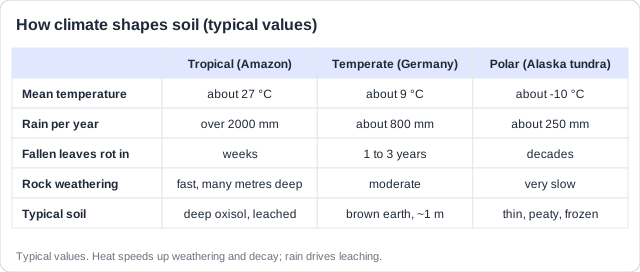
Compare, don't just list: Use 'whereas': 'In the Amazon leaves rot within weeks, whereas on the Alaskan tundra they take decades, so the tundra soil builds up peat.'
Living things build the soil. The vegetation decides what falls on it, and animals and microbes decide how fast it is mixed in and broken down.
Organisms
- Vegetation sets the litter: acid pine needles make podzols; grass roots make deep humus.
- Rich deciduous leaves feed earthworms, giving a well-mixed brown earth.
- Earthworms, ants and termites mix the horizons and make pores for air and water.
- Bacteria and fungi decompose litter and release nutrients.
- People: ploughing, draining, liming, adding fertiliser and clearing vegetation.
| Vegetation | Its litter | The soil |
|---|---|---|
| Pine and spruce | acid needles, rot slowly | podzol: thick O, leached E |
| Oak and beech | rich leaves, rot in 1-3 years | brown earth: well mixed |
| Prairie and steppe grass | roots die back every year | chernozem: deep black A |
Real example: the forests of Minnesota, USA, had no earthworms after the last ice age. European earthworms, brought in with soil and fishing bait, are now eating the thick forest floor, mixing it into the soil and changing which plants can grow.
Learn what examiners really want
See exactly what to write to score full marks. Our AI shows you model answers and the key phrases examiners look for.
The shape of the land moves water and soil. Down a single slope you often find a catena of different soils, from thin at the top to a waterlogged gley soil at the bottom.
Geomorphology: slope, aspect, drainage
- Slope: steep slopes have thin soils, because soil and water move downhill.
- At the foot of a slope the soil is deep, built up from material washed down.
- Aspect: in the northern hemisphere, south-facing slopes are warmer and drier.
- Drainage: well-drained soils are aerated; hollows and valley floors become waterlogged.
- Waterlogged soils have no oxygen, so they turn grey (gley) and organic matter builds up.
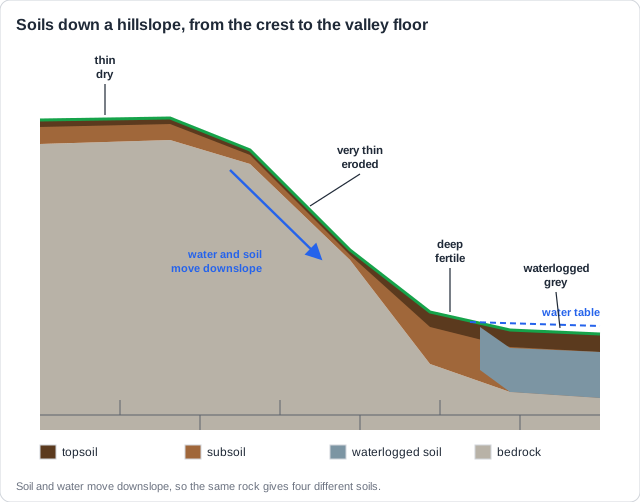
Real example: the soil scientist Geoffrey Milne described this pattern on hillsides in East Africa in 1935 and called it a catena. In the Alps, farmers plant vineyards on the warm, south-facing slopes, where the aspect gives drier, warmer soil.
The rock underneath sets the starting minerals: calcareous rocks and volcanic rocks make very different soils. Time then lets the horizons develop.
Geology and time
- Calcareous rock (chalk, limestone) mostly dissolves: thin, dark, alkaline soils.
- Volcanic ash and lava weather fast and release minerals: deep, fertile soils.
- Granite weathers into quartz sand: sandy, acidic, free-draining soils.
- Time: young soils are thin with few horizons; old soils are deep with clear horizons.
- Rivers, wind and ice erode and deposit material: fertile river mud, wind-blown silt, glacial sand.
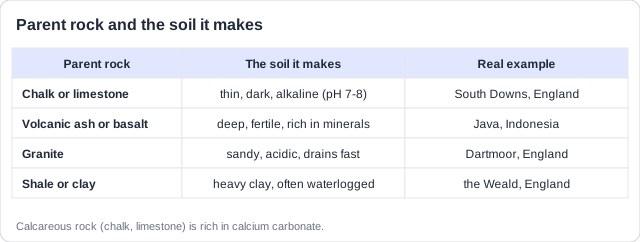
Calcareous (chalk, limestone)
- Dissolves, leaving little behind
- Thin, dark, alkaline soil
- Drains freely
- South Downs grassland, England
Volcanic (ash, basalt)
- Weathers fast
- Deep, rich in minerals
- Very fertile
- Java, Indonesia: over 150 million people
Real example of time: at Glacier Bay in Alaska the ice has retreated about 100 km since the mid-1700s. Ground uncovered longest ago has the deepest soil and the most organic matter; ground uncovered recently is still bare gravel.
Never wonder what to study next
Get a personalized daily plan based on your exam date, progress, and weak areas. We'll tell you exactly what to review each day.
How this comes up: Paper 2, Section A: a slope or a map to explain why soils differ. Section B (a): outline two or more factors; (c): to what extent one factor matters most, with named soils.
Under the boreal forest of Finland the soil is a thin podzol with a thick layer of needle litter, while under the Amazon rainforest it is a red oxisol several metres deep.
Explain how climate has led to these two different soils.
Model answer plan
See the mark-by-mark plan — for / against / judgement, with marking guidance — in study mode.