Soil horizons at Higher Level: This statement is Higher Level only. It goes beyond the order of the layers: what makes each horizon distinctive, the processes that build them, and what happens when intensive farming leaves only B and C.
Practise this as you read
- Describe what makes each horizon distinctive.
- Outline the impact of losing the O and A horizons.
Free preview
This is the free notes preview
You're reading the free notes. Aimnova Pro unlocks the full study experience — and you can try it with your first topic free to keep:
- FlashcardsLock in vocabulary and key terms with spaced repetition.
- Practice questionsAnswer exam-style questions and get instant AI marking.
- Mock exams & past-paper vaultSit full mocks and see exactly how examiners award marks.
- Personalised study planA daily plan built around your exam date and weak areas.
Layers that tell you the soil type: Horizons are horizontal strata in the soil. Every soil type has its own set of them, so the horizons are what make a soil distinctive.
The points to remember
- Horizons are horizontal layers in the soil; the set of horizons is distinctive to each soil type.
- O: the organic layer of leaf litter and humus on top.
- A: the mixed layer (topsoil): humus mixed with mineral grains.
- B: the mineral soil (subsoil), where material washed down from above collects.
- C: the parent rock, broken and weathered; solid bedrock below is sometimes called R.
- Strongly leached soils add an E horizon between A and B: pale, because material is washed out of it.
Remember it as: Organic, mixed, mineral, parent rock: O, A, B, C, from the top down.
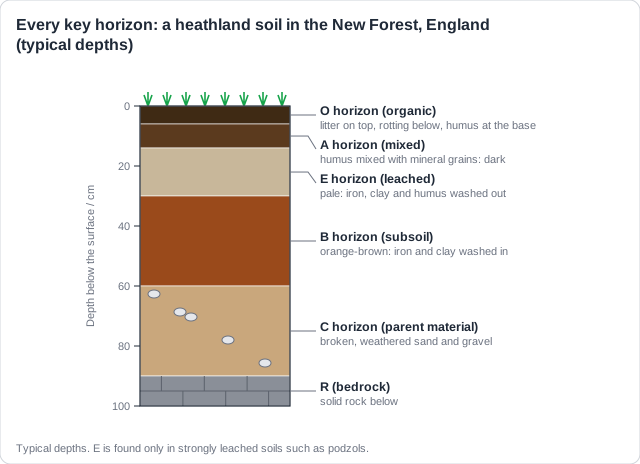
Real example: the heaths of the New Forest in southern England grow on sandy, acid soils. Dig a pit and every horizon is easy to see, including a pale E layer that marks heavy leaching.
Memorize terms 3x faster
Smart flashcards show you cards right before you forget them. Perfect for definitions and key concepts.
Each horizon looks different because a different process made it: humification in the O and A, eluviation out of the E, illuviation into the B, and weathering in the C.
What makes each horizon distinctive
- O is dark and loose: fresh litter on top, rotting litter below, humus at the base.
- A is dark because of humus; it has the most roots, air and life.
- E is pale: iron, clay and humus have been washed out (eluviation).
- B is often orange, red or brown: iron and clay are washed in (illuviation); lime in dry places.
- C is stony: pieces of the parent rock, with almost no organic matter.
- Boundaries can be sharp (podzol) or gradual, where earthworms mix the layers (brown earth).
| Horizon | Also called | What is in it | The process |
|---|---|---|---|
| O | organic layer | litter, rotting leaves, humus | decomposition, humification |
| A | mixed layer, topsoil | humus mixed with mineral grains | mixing by earthworms |
| E | leached layer | pale sand left behind | eluviation: washed out |
| B | mineral soil, subsoil | iron, clay, humus or lime washed in | illuviation: washed in |
| C | parent rock | broken, weathered rock | weathering |
Down
Rain moves down, carrying dissolved minerals and fine clay.
Out
Material leaves the upper layers, which become paler (E).
In
It collects lower down, colouring the B horizon.
Mixed
Earthworms carry humus down and soil up, blurring the boundaries.
Real example: under the beech woods of the Chiltern Hills in England, earthworms are so busy that the dark A horizon fades gradually into the brown B. There is no sharp line, and no E horizon.
Intensive farming changes the horizons themselves. Years of tillage and erosion can strip away the O and A horizons, leaving only B and C.
Farmed soils: only B and C left
- Natural soils keep their O, A, B and C horizons.
- Ploughing mixes the O into the A and leaves soil bare between crops.
- Bare topsoil is eroded by rain and wind, and ploughing itself moves soil downhill.
- On many intensive farms the O and A are gone: B and C are all that remain.
- B at the surface is pale, low in organic matter and nutrients, and holds less water.
- Crops grow less well, so farmers must add more fertiliser: costly and polluting.
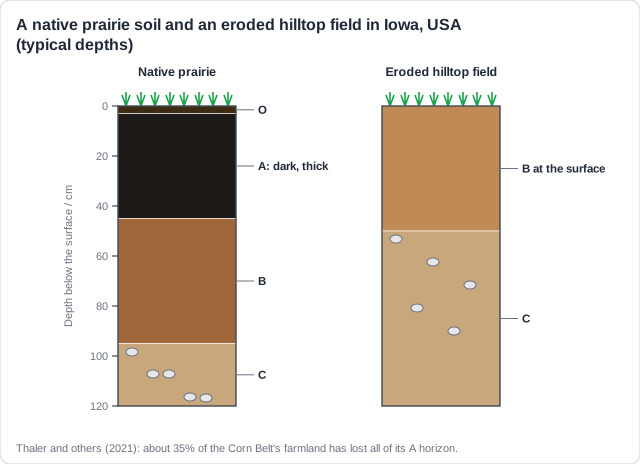
Natural soil: O, A, B, C
- Litter protects the surface
- Dark topsoil full of humus and life
- Holds water and nutrients
- Crops need little fertiliser
Intensive farm: B and C
- Bare, pale subsoil at the surface
- Little organic matter, few organisms
- Dries out, crusts and erodes
- Needs more fertiliser for the same yield
Real example: in the US Corn Belt, a study using satellite images estimated that about 35% of the farmland has lost ALL of its A horizon, mostly on hilltops where ploughing moves soil downhill. Yields there are about 6% lower.
Know your predicted grade
Take timed mock exams and get detailed feedback on every answer. See exactly where you're losing marks.
How this comes up: Paper 2, Section A: a profile with letters to name and describe, or data comparing a natural and a farmed soil. Section B (a): outline what makes each horizon distinctive.
On many hilltops in the US Corn Belt, ploughing and erosion have removed the O and A horizons, so maize is now grown directly in the B horizon.
Outline three impacts on crop growth of farming in the B horizon.
Model answer plan
See the mark-by-mark plan — for / against / judgement, with marking guidance — in study mode.