Managing eutrophication at Higher Level: The same three levels as SL, told through Chesapeake Bay, the EU and Denmark, Lake Washington, the Veluwemeer and the Baltic Sea. At HL, judge each level through law and economics (HL.a, HL.b): who pays, how it is enforced, and why cutting inputs may not be enough on its own.
Practise this as you read
- Evaluate a strategy at each level, with a named example.
- Justify which level works best in one place.
Free preview
This is the free notes preview
You're reading the free notes. Aimnova Pro unlocks the full study experience — and you can try it with your first topic free to keep:
- FlashcardsLock in vocabulary and key terms with spaced repetition.
- Practice questionsAnswer exam-style questions and get instant AI marking.
- Mock exams & past-paper vaultSit full mocks and see exactly how examiners award marks.
- Personalised study planA daily plan built around your exam date and weak areas.
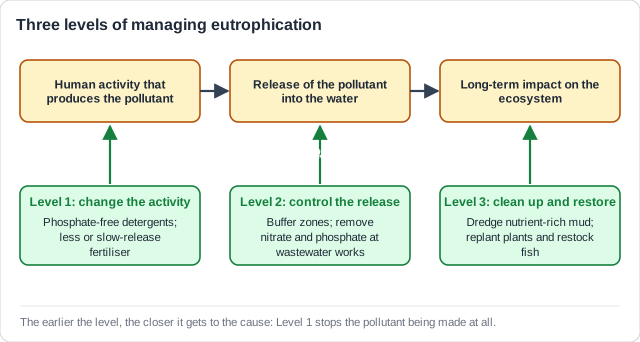
Stop it, catch it, clean it: Pollution has three stages: an activity makes it, it is released into the water, and it does long-term damage. Management can step in at each stage, so there are three levels.
The points to remember
- Level 1: reduce the human activity that makes the pollutant: alternatives to fertilisers and detergents.
- Level 2: reduce the release into the water: treat wastewater to remove nitrates and phosphates; buffer zones.
- Level 3: remove the pollutant and restore the ecosystem: remove mud, reintroduce plants and fish.
- The earlier the level, the closer it is to the cause, and usually the cheaper.
- The same three levels work for other pollution, such as acid rain.
Remember it as: Stop it, catch it, clean it.
Example (HL): Chesapeake Bay's 'pollution diet', 2010. Six US states and Washington DC must cut fertiliser and manure use (level 1), upgrade sewage works and plant buffers (level 2), and rebuild oyster reefs and sea-grass beds (level 3), with limits checked against a 2025 deadline.
Feeling unprepared for exams?
Get a clear study plan, practice with real questions, and know exactly where you stand before exam day. No more guessing.
Level 1 changes what people do, so less nitrate and phosphate is made or used in the first place.
The points to remember
- Phosphate-free detergents: less phosphate in sewage.
- Organic or slow-release fertilisers, and only what the crop needs (precision farming).
- Education: show farmers and gardeners the harm, close to home.
- Laws, taxes and fines on high-nutrient practices; the polluter pays.
- Subsidies for sustainable farming: crop rotation, contour farming, organic fertiliser.
Strengths
- Removes the origin of the problem.
- Organic fertiliser can be cheap, from waste.
- Slow release means less leaching.
- Education has long-term effects.
- Less fertiliser made: fewer greenhouse gases.
Weaknesses
- Crop yields may fall.
- Farmers may resist the change.
- Food prices may rise.
- Laws and taxes must be enforced, and can be unpopular.
Example (HL): the EU and Denmark. The EU limited phosphates in laundry detergents from 2013 and in dishwasher detergents from 2017. Since 1987 Denmark has set fertiliser limits for each farm and required winter crops, and the nitrogen washing off its fields has fallen by about half.
Level 2 lets the activity go on but stops the nutrients reaching the water. It acts between the field or the toilet and the river.
The points to remember
- Wastewater treatment: remove nitrate (by bacteria) and phosphate (by chemicals) before release.
- Buffer zones of trees and grass beside rivers, and wetlands, soak up run-off.
- Spread fertiliser in the dry season, when crops are growing, and not near rivers.
- Cover crops, contour ploughing, and drip irrigation cut run-off.
- Keep livestock away from rivers; store manure safely.
Strengths
- Stops nutrients reaching water.
- Buffers add habitat and cut erosion.
- Buffers are low cost.
- Treatment can recover phosphorus for reuse.
Weaknesses
- Does not remove the origin.
- Buffers take farmland and heavy rain overwhelms them.
- Treatment works are costly to build and run.
- Chemical stripping leaves toxic sludge; needs experts.
Example (HL): Lake Washington, Seattle. In the 1950s treated sewage from about ten works fed blooms in the lake. By 1968 all of it was piped away to the sea instead, and within a few years the water was clear again: one of the first lakes saved by controlling release.
Release, not production: If the question asks how to stop nutrients reaching a river, give level 2 answers (buffers, timing, treatment). 'Pass a law' or 'educate farmers' alone does not say how the release is stopped, and terracing makes no sense on flat plains.
Memorize terms 3x faster
Smart flashcards show you cards right before you forget them. Perfect for definitions and key concepts.
Level 3 deals with the damage already done: it takes the nutrients out of the lake and brings the living community back.
The points to remember
- Remove the mud (dredging or mud-pumping): the phosphate stored in it can no longer feed blooms.
- Reintroduce water plants and fish; remove fish that stir up mud (biomanipulation).
- Restore wetlands and mangroves that filter the water.
- Strengths: the community and biodiversity return; it encourages more management.
- Weaknesses: high cost, slow, results uncertain; fails if inputs go on.
Trap sediment
- Clearer water: more light for sea grass and corals.
Absorb nutrients
- Less eutrophication and hypoxia.
Remove toxins
- Metals that poison producers are held.
Stop erosion
- Less sediment washed into the sea.
Example (HL): the Veluwemeer, the Netherlands. After the phosphate in its sewage was cut, the water stayed murky, so in the 1990s managers fished out large numbers of bream that stir up the mud. The water cleared, and underwater plants called stoneworts spread back over the lake bed.
Restoring is not preventing: A question on preventing eutrophication gives no credit for restoration strategies such as dredging. For mangroves or wetlands, say HOW they clean the water: 'they improve water quality' alone earns no mark.
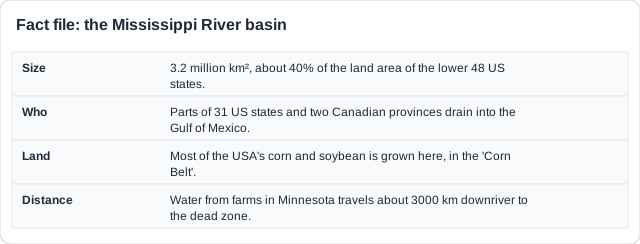
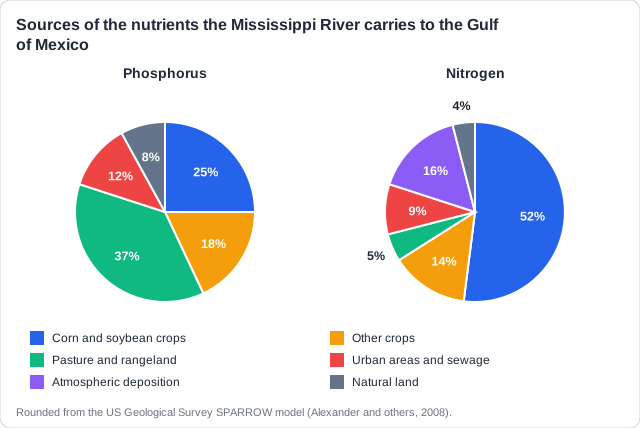
Nutrient pollution is hard to manage because it comes from millions of fields and drains, not one pipe. Read a basin map and source charts for the reasons.
The points to remember
- Non-point (diffuse) sources: no single pipe to target.
- A huge area across many states or countries: hard to agree and regulate.
- Farming is the main source, and governments put food production first.
- Polluters are far from the damage, so they may not know or care.
- Restoring the water is expensive, and subsidies and education cost money too.
| Level | Best for | Main drawback |
|---|---|---|
| 1: change the activity | Removing the root cause | Costly or unpopular for farmers |
| 2: control the release | Point sources such as sewage works | Does not stop the pollutant being made |
| 3: clean up and restore | Lakes already damaged | Expensive, slow, fails if inputs go on |
Example (HL): the Baltic Sea Action Plan. Since 2007 the nine countries around the Baltic have agreed nutrient cuts for each country. Inputs have fallen, but the dead zones have barely shrunk: phosphate stored in the mud keeps the positive feedback going.
Which level is best?: Usually level 1, because it removes the cause. But it may not be affordable for every farmer, so the best plans combine all three levels, as Chesapeake Bay does.
Know your predicted grade
Take timed mock exams and get detailed feedback on every answer. See exactly where you're losing marks.
How this comes up: Paper 2 Section B asks you to evaluate strategies for reducing the impact of farm pollution on an aquatic ecosystem [9], marked with markbands.
Chesapeake Bay receives fertiliser, manure and sewage from six US states.
Evaluate management strategies for reducing the impact of agricultural pollution on an aquatic ecosystem.
Model answer plan
See the mark-by-mark plan — for / against / judgement, with marking guidance — in study mode.