The range of water pollutants at Higher Level: This statement is Higher Level only. It names five kinds of water pollutant, each with a real case: sewage, tributyltin, PCBs, plastics and heat.
Practise this as you read
- Outline each type of pollutant with its source and effect.
- Explain why persistent chemicals reach their highest levels in top predators.
Free preview
This is the free notes preview
You're reading the free notes. Aimnova Pro unlocks the full study experience — and you can try it with your first topic free to keep:
- FlashcardsLock in vocabulary and key terms with spaced repetition.
- Practice questionsAnswer exam-style questions and get instant AI marking.
- Mock exams & past-paper vaultSit full mocks and see exactly how examiners award marks.
- Personalised study planA daily plan built around your exam date and weak areas.
Five kinds of water pollutant: Water can be polluted by organic matter, dissolved chemicals, persistent chemicals that build up in food chains, plastics and heat. Each harms life in a different way. The first, and the most common, is organic matter.
Organic matter (sewage)
- Organic matter: sewage, manure, food waste and dead plants.
- Bacteria decompose it and use up dissolved oxygen as they do.
- So it raises the water's BOD; fish and insect larvae suffocate.
- Sewage also carries pathogens (bacteria, viruses) and nutrients (nitrate, phosphate).
- Other types to know: heavy metals (mercury, lead), pesticides, sediment.
Remember it as: Rot uses oxygen: more sewage, less oxygen, fewer fish.
Real example: in England, storm overflows released sewage into rivers and seas 464,056 times in 2023, for over 3.6 million hours. Below an overflow, bacteria feeding on the sewage use up the oxygen, and swimmers can catch stomach bugs.
Never wonder what to study next
Get a personalized daily plan based on your exam date, progress, and weak areas. We'll tell you exactly what to review each day.
Some pollutants dissolve completely. The water can look clean but still poison the animals living in it.
Dissolved substances: tributyltin
- Some pollutants are dissolved in the water, so you cannot see them.
- Tributyltin (TBT) was put in boat paint to stop barnacles growing on hulls.
- TBT is an endocrine disruptor: it upsets an animal's hormones.
- It harms at tiny doses: a few nanograms per litre.
- Female dog whelks grew male organs (imposex) and stopped breeding; oysters grew deformed.
Remember it as: TBT: a hull paint that changed the sex of sea snails.
Paint
- From the 1960s, boat owners painted TBT on their hulls. It slowly leaks into the water and kills barnacles and weed.
Oysters
- In the 1970s the bay's farmed oysters grew thick, deformed shells, and very few young oysters settled. The farms nearly failed.
Snails
- Along Europe's coasts, female dog whelks grew male organs and stopped breeding.
Bans
- France banned TBT on boats under 25 m in 1982, and oysters recovered. A worldwide ban on all ships came into force in 2008.
Endocrine disruptor: An endocrine disruptor harms at doses far too small to kill. Many plastics chemicals and medicines in sewage, such as the hormones in contraceptive pills, act the same way.
Some chemicals are not broken down by bacteria or by the body. PCBs are the best-known example.
Persistent chemicals that biomagnify
- Persistent: not broken down, so it lasts for decades.
- Fat-soluble: stored in fat, not passed out in urine.
- Bioaccumulation: it builds up in one animal over its life.
- Biomagnification: its concentration rises at each step up the food chain.
- So top predators (orcas, seals, people) get the highest doses.
Remember it as: Lasts, stores in fat, climbs the food chain.
Bioaccumulation
- In ONE animal, over its lifetime.
- Taken in faster than it is lost.
- Example: an old seal holds more than a young one.
Biomagnification
- ALONG a food chain.
- Each level eats many of the level below.
- Example: fish to seal to orca, rising each step.
Real example: in 2016 a female orca called Lulu was found dead on Tiree, Scotland. Her blubber held 957 mg of PCBs per kg, among the highest levels ever measured. PCBs were banned decades ago, yet her small group has not had a calf in over 20 years: PCBs stop breeding.
Stop wasting time on topics you know
Our AI identifies your weak areas and focuses your study time where it matters. No more overstudying easy topics.
The last two types are things, not chemicals: plastic objects, and heat.
Plastics and heat
- Plastics do not biodegrade; they break into microplastics.
- Animals swallow or get tangled in plastic; microplastics carry other chemicals.
- Heat: power stations and factories release warm cooling water.
- Warm water holds less oxygen, and animals need more oxygen as they warm up.
- Sudden warming can kill fish (thermal shock) and helps algae grow.
Remember it as: Plastic chokes and carries poison; heat steals the oxygen.
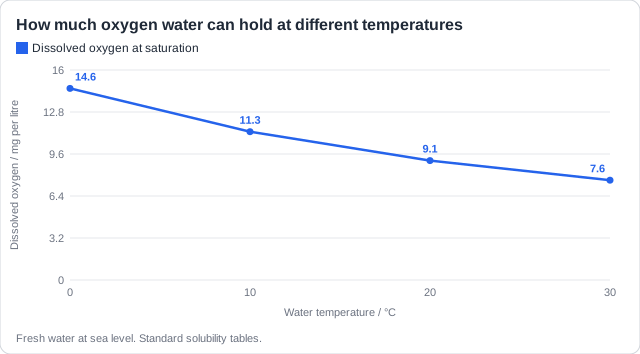
Real examples: in May 2021 the cargo ship X-Press Pearl burned off Colombo, Sri Lanka, and spilled about 1,680 tonnes of nurdles, the largest plastic spill known. In the hot summer of 2022, France's power company cut output at nuclear plants on the Rhône and Garonne rivers, because the rivers were too warm to take more heated cooling water.
How this comes up: Paper 1 or Paper 2: a fact file or a food chain with PCB or TBT data, with 'outline' or 'explain' [2-4]; or 'outline four types of water pollutant' [4], each with its effect.
PCBs were banned in most countries by the 1980s, yet killer whales off Scotland still carry very high levels of PCBs in their blubber.
Explain why killer whales carry higher concentrations of PCBs than the fish at the start of their food chain.
Model answer plan
See the mark-by-mark plan — for / against / judgement, with marking guidance — in study mode.