Ecosystem services at Higher Level: The same four services as SL, told through the Baltic Sea, Brittany and Lake Taihu. At HL, weigh who pays: fishers, tourism businesses, water companies and the people who drink the water, and link the losses to the economics of managing eutrophication (4.4.8, HL.b).
Practise this as you read
- Explain how one bloom affects several services at once.
- Quote a real case with a number.
Free preview
This is the free notes preview
You're reading the free notes. Aimnova Pro unlocks the full study experience — and you can try it with your first topic free to keep:
- FlashcardsLock in vocabulary and key terms with spaced repetition.
- Practice questionsAnswer exam-style questions and get instant AI marking.
- Mock exams & past-paper vaultSit full mocks and see exactly how examiners award marks.
- Personalised study planA daily plan built around your exam date and weak areas.
What people lose: Ecosystem services are what a lake or sea does for us. Eutrophication damages four of them in particular.
Fisheries
- Fish and shellfish die or move away.
- Catches and incomes fall.
Recreation
- Swimming, boating and angling stop.
- Visitors stay away.
Aesthetics
- Green scum, murky water.
- Smell of rotting algae.
Health
- Toxins in drinking water and shellfish.
- Costly water treatment.
The points to remember
- Fisheries: less food and income from fish and shellfish.
- Recreation: swimming, boating and fishing for fun are spoiled or banned.
- Aesthetics: the water looks and smells unpleasant, so its beauty is lost.
- Health: toxins and germs harm people and pets; drinking water costs more to clean.
Remember it as: Fish, fun, view, health.
Example (HL): the Baltic Sea. About 85 million people live in its catchment. Summer blooms and dead zones hit its fisheries, close beaches from Poland to Finland and spoil the view and smell of its coasts.
Get feedback like a real examiner
Submit your answers and get instant feedback — what you did well, what's missing, and exactly what to write to score full marks.
The first service to suffer is food. Fish and shellfish need oxygen, and dead zones and toxic blooms take it away.
The points to remember
- Dead zones kill animals on the sea bed and push fish away, so catches fall.
- Boats must travel further to find fish, so fishing costs more.
- Toxic blooms close shellfish harvests: eating them can poison people.
- Red tides kill fish in fish farms, which cannot swim away.
- Over time the species change: fewer valuable fish, more jellyfish.
Example (HL): eastern Baltic cod. Low-oxygen water now covers much of the deep basins where these cod feed and spawn. The cod became thin and small, and in 2019 the EU closed the main commercial fishery for them.
Link it to food: When a question asks about food production, describing the eutrophication chain is not enough: the last step must be fewer fish or shellfish to catch, sell or eat.
Clear water and clean beaches bring visitors, and visitors bring jobs. A bloom turns that around in a few days.
The points to remember
- Swimming bans and beach closures when toxic algae are present.
- Scum, murky water and dead fish: the place looks ugly (aesthetic value lost).
- Rotting algae give off hydrogen sulphide: a smell of bad eggs.
- Fewer fish, so less angling; mats of weed stop boating.
- Fewer tourists, so hotels, cafes and boat hire lose income.
Example (HL): Brittany's green tides, France. Nitrate from pig and dairy farms feeds sea lettuce, which piles up on the beaches each summer. As it rots it gives off hydrogen sulphide; in 2009 a horse died after sinking into it, and beaches are closed every year.
Learn what examiners really want
See exactly what to write to score full marks. Our AI shows you model answers and the key phrases examiners look for.
Some blooms are made of cyanobacteria that produce poisons. Then a lake that supplies drinking water becomes a health risk.
The points to remember
- Toxins from blooms in drinking water can damage the liver and cause sickness.
- Skin rashes and illness in swimmers; dogs can die after drinking the water.
- Shellfish poisoning in people who eat contaminated mussels or oysters.
- Water companies must spend more on treatment, or stop supply altogether.
Example (HL): Wuxi and Lake Taihu, China, 2007. A huge bloom on Lake Taihu made Wuxi's tap water smell and taste foul. About two million people had to buy bottled water for about a week, and the government closed or moved hundreds of factories around the lake.
How this comes up: Paper 1 gives a case study of a lake or river with blooms and asks how its recreational value may be affected [3].
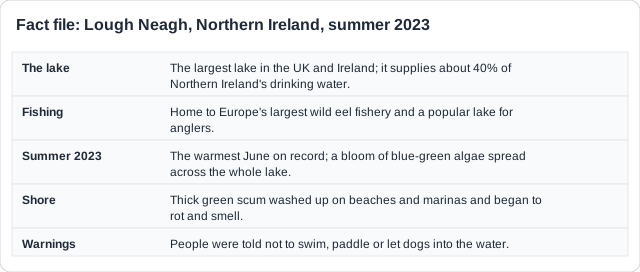
The fact file describes Lough Neagh, Northern Ireland, in the summer of 2023.
With reference to the fact file, explain how algal blooms may affect the recreational value of Lough Neagh.
Model answer plan
See the mark-by-mark plan — for / against / judgement, with marking guidance — in study mode.