Governing freshwater at Higher Level: This statement is Higher Level only. It uses the HL lens on law and governance: who makes the rules for water, at which scale, and how well they work.
Practise this as you read
- Name one local rule and one international agreement.
- Weigh laws against education.
Free preview
This is the free notes preview
You're reading the free notes. Aimnova Pro unlocks the full study experience — and you can try it with your first topic free to keep:
- FlashcardsLock in vocabulary and key terms with spaced repetition.
- Practice questionsAnswer exam-style questions and get instant AI marking.
- Mock exams & past-paper vaultSit full mocks and see exactly how examiners award marks.
- Personalised study planA daily plan built around your exam date and weak areas.
Rules for a shared resource: Water belongs to no one person, so without rules it is over-used. Governance is needed at every scale, from a town to the whole planet.
The points to remember
- Freshwater is a shared resource: if everyone takes as much as they like, it runs out.
- This is the tragedy of the commons: each user gains, all users lose.
- Governance means the rules, and the bodies that make and enforce them.
- Local governance controls how people and farms use water in one place.
- Global governance is needed when rivers, aquifers and the water cycle cross borders.
Remember it as: Shared water needs shared rules.
Real example: the tragedy of the commons shows in falling aquifers: each farm's well is legal, but together they pump water out faster than rain refills it.
Study smarter, not longer
Most students waste 40% of study time on topics they already know. Our AI tracks your progress and optimizes every minute.
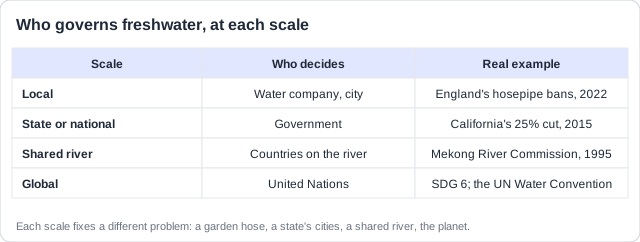
Local rules work because someone can enforce them: a water company, a city or a state government. The guide's example is a ban on watering gardens in a drought.
Local regulations
- Bans in droughts: hosepipes, watering lawns, filling pools, washing cars.
- Licences and meters limit what farms and industry may take from rivers and aquifers.
- Taxes, prices and incentives, e.g. money for farmers to fit drip irrigation.
- Planning rules: green roofs, less paving, ponds, so rain soaks in and is stored.
- Early warning of droughts, and education campaigns to cut household use.
- Tackle the impacts of drought, not its causes (climate change, deforestation).
Real example: in the dry summer of 2022, several English water companies, including Southern Water, Thames Water and Yorkshire Water, brought in hosepipe bans: no watering gardens, washing cars or filling pools with a hose. In 2015, during a long drought, California's governor ordered cities to cut water use by 25%, the first such order in the state's history.
Impacts, not causes: When a question asks how governance can reduce the impacts of drought, give rules that save or store water. Cutting greenhouse gases tackles the cause of drought, not its impacts.
When a river crosses a border, no single government controls it. International agreements become necessary.
International agreements
- Rivers such as the Mekong and the Indus cross borders: an upstream dam affects every country below.
- Treaties set how much water each country may take.
- River commissions let countries share data, plan dams and settle disputes.
- SDG 6: safe water and sanitation for all, and sustainable water use, by 2030.
- The UN Water Convention (1992) sets rules for shared rivers; open to every country since 2016.
Mekong River Commission (1995)
- Cambodia, Laos, Thailand, Vietnam
- Shares data and reviews dam plans
- But China, upstream, is not a member and has built many dams
Indus Waters Treaty (1960)
- India and Pakistan, agreed with the World Bank's help
- Survived several wars
- In 2025 India said it was holding the treaty in abeyance
Real example: the Mekong flows through China, Myanmar, Laos, Thailand, Cambodia and Vietnam. The four countries downstream set up the Mekong River Commission in 1995, because dams and water use upstream change the fish and rice farming that millions of people depend on downstream.
Practice with exam-style questions
Answer exam-style questions and get AI feedback that shows you exactly what examiners want to see in a full-marks response.
Governments can make laws, or they can educate people to choose to save water. Questions ask which works better.
Laws or education?
- Laws can control large users (farms, industry) quickly and can be enforced with fines.
- But laws can be unpopular, hard to enforce, and ignored across borders.
- Education changes values and habits for the long term, at low cost.
- But education is slow and depends on people choosing to act.
- International agreements need trust: a country can leave or suspend them.
Real example: the EU's Water Framework Directive (2000) is a law that requires every member country to manage each river basin and bring its rivers to good condition. Singapore uses a law, its water conservation tax, together with school programmes and campaigns.
The usual conclusion: Laws control large-scale use quickly; education changes behaviour over time. The strongest answers conclude that they work best together, and support that with named examples.
How this comes up: Paper 2, Section B (b): explain, with examples, how governance at different scales keeps water use sustainable [7].
Many rivers and aquifers are now used faster than they are refilled.
Explain how local and global governance can help to maintain freshwater use at sustainable levels.
Model answer plan
See the mark-by-mark plan — for / against / judgement, with marking guidance — in study mode.