Saving water at home at Higher Level: The same techniques as SL, with different examples: Melbourne's Millennium Drought and Singapore. At HL, link each technique to how it changes people's behaviour, and to the governance and footprints met later in 4.2.
Practise this as you read
- Sort each technique: device, reuse, rule or price.
- Link each one to how much water it saves.
Free preview
This is the free notes preview
You're reading the free notes. Aimnova Pro unlocks the full study experience — and you can try it with your first topic free to keep:
- FlashcardsLock in vocabulary and key terms with spaced repetition.
- Practice questionsAnswer exam-style questions and get instant AI marking.
- Mock exams & past-paper vaultSit full mocks and see exactly how examiners award marks.
- Personalised study planA daily plan built around your exam date and weak areas.
Use less, use it twice: Every household uses water for drinking, cooking, washing, flushing and gardens. Water conservation at home cuts how much water a city needs.
The points to remember
- Water conservation means using less water, or using the same water twice.
- At home it works through devices, reuse, rules and prices, and habits.
- It cuts demand, so a city's reservoirs and aquifers last longer in a drought.
- Building dams or desalination plants adds supply: that is not conservation.
- A fall in population is not a strategy: name what people or the city did.
Remember it as: Use less, use it twice, pay for what you use.
Real example: during Australia's Millennium Drought, Melbourne asked every resident to use no more than 155 litres a day ('Target 155', from 2008). Daily use per person fell from well over 200 litres to about 160.
Two answers that do not count: 'They built a desalination plant' adds supply; it does not save water. 'The population fell' is not something anyone did. Name a real action: meters, low-flush toilets, a hosepipe ban.
Know your predicted grade
Take timed mock exams and get detailed feedback on every answer. See exactly where you're losing marks.
The simplest savings come from the things in the house that use water. A dual-flush toilet or a low-flow shower head saves water every day without anyone having to remember.
Devices and fixes
- Low-flush or dual-flush toilets use far less water per flush.
- Low-flow shower heads and tap aerators mix air into the water.
- Water-efficient washing machines and dishwashers, chosen by their label.
- Fix leaking taps, pipes and toilets inside the home.
- Replace lawns with drought-tolerant plants; use public pools, not private ones.
- Habits: shorter showers, tap off while brushing. Count them as one point.
Uses a lot
- Older toilet: about 9 to 13 litres a flush
- A leaking tap or toilet, all day
- A green lawn in a dry summer
- A private swimming pool
Uses less
- Dual-flush toilet: about 4 or 6 litres
- A washer fixed in minutes
- Drought-tolerant plants and gravel
- A shared public pool
Real example: since 2009 Singapore has required water-efficiency labels on taps and toilets, and later on washing machines; the least efficient models may not be sold.
One habit, one mark: Shorter showers, turning the tap off and showers instead of baths are all habits: together they count as one strategy. Fixing pipes counts only for pipes in the home, not the city's water mains.
Not every use needs drinking-quality water. Flushing a toilet or watering a garden can use water that has been used once, or rain from the roof.
Grey water and rainwater
- Grey water is used water from showers, basins and washing machines, never toilets.
- Filtered grey water can flush toilets and water gardens, so less clean water is used.
- Rainwater harvesting: gutters lead rain from the roof into a tank or water butt.
- Rainwater can water gardens, wash cars and flush toilets instead of mains water.
- Limits: tanks cost money, need space, and fill only when it rains; neither is safe to drink.
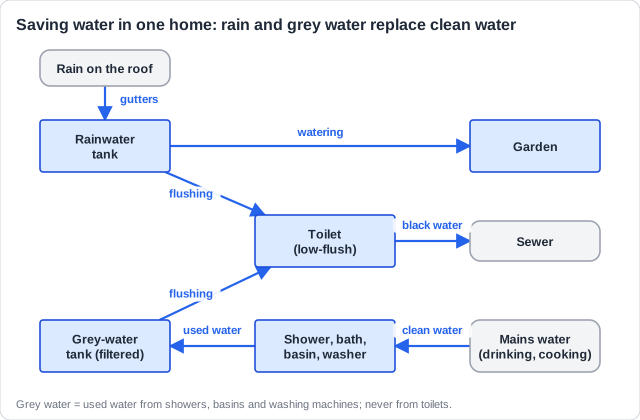
Real example: during the Millennium Drought, the state of Victoria gave households rebates for rainwater tanks connected to their toilets and washing machines.
Say what the water replaces: 'Use grey water' is half an answer. Add the link: 'to flush toilets, so less clean mains water is used'.
Get feedback like a real examiner
Submit your answers and get instant feedback — what you did well, what's missing, and exactly what to write to score full marks.
People use less when water costs more or when the law limits it. A water meter turns every litre into money on the bill.
Rules and prices
- Metering: a meter measures each home's use, so people pay for what they use.
- Rising tariffs: the more you use, the higher the price per litre.
- Rationing or quotas: a legal limit on how much each person or home may use.
- Restrictions: bans on hosepipes, watering lawns, washing cars or filling pools.
- Campaigns teach people how to save water: say what they are told to do.
Remember it as: Measure it, price it, limit it, explain it.
Real example: in 2017 Singapore raised the price of water by 30%, its first rise in 17 years, and every home's bill includes a water conservation tax.
'Education' alone is not enough: Single words such as 'education', 'awareness', 'regulations' or 'lifestyle change' are too vague. Say what happens: 'a campaign teaches people to take shorter showers', 'a ban on hosepipes in summer'.
Papers often give a graph of water use and ask for the percentage decrease. Use the formula first, then the numbers.
Reading water-use data
- Percentage change = (new value - old value) / old value x 100.
- Always divide by the old (first) value.
- A fall gives a minus sign: write it as 'a decrease of ...%'.
- Quote numbers with units when you describe a graph: '1,200 down to 523 million litres a day'.
- Compare the latest value with any target shown, and say how far there is still to go.
Check your answer: A decrease can never be more than 100%. If you get a bigger number, you divided by the new value.
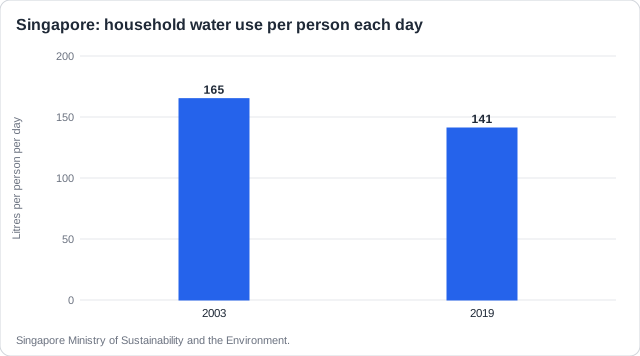
Worked example: Percentage change = (141 - 165) / 165 x 100 = -14.5%.
So household use per person fell by about 15%.
Learn what examiners really want
See exactly what to write to score full marks. Our AI shows you model answers and the key phrases examiners look for.
How this comes up: Paper 2, Section B (a): outline four water conservation techniques for homes [4].
Singapore has almost no natural freshwater of its own, and its government wants each person to use less water at home.
Outline four water conservation techniques that could be used at a domestic level.
Model answer plan
See the mark-by-mark plan — for / against / judgement, with marking guidance — in study mode.