Transboundary water disputes at Higher Level: This statement is Higher Level only. When water crosses borders, water stress can become a dispute between countries. You learn one dispute in depth, the Nile, with its history and politics.
Practise this as you read
- Explain why shared rivers cause disputes.
- Weigh conflict against cooperation.
Free preview
This is the free notes preview
You're reading the free notes. Aimnova Pro unlocks the full study experience — and you can try it with your first topic free to keep:
- FlashcardsLock in vocabulary and key terms with spaced repetition.
- Practice questionsAnswer exam-style questions and get instant AI marking.
- Mock exams & past-paper vaultSit full mocks and see exactly how examiners award marks.
- Personalised study planA daily plan built around your exam date and weak areas.
Water does not stop at borders: A transboundary river is shared by the countries it flows through. When one takes more, another gets less, and water stress turns into a political dispute.
Why shared water causes disputes
- Rivers and aquifers cross borders: the Nile, the Jordan, the Mekong, the Indus.
- Upstream countries can dam, divert or pollute water before it reaches downstream countries.
- Demand keeps rising with population growth, farming and industry.
- Climate change makes supply less predictable: more droughts, changing rains.
- The same water is needed for farms, cities, industry, hydropower and ecosystems.
- As water gets scarcer, its value rises, and so do the stakes.
Remember it as: Upstream holds the tap; downstream holds the bucket.
Real example: the Nile flows through or drains 11 countries. Egypt, at the very end, gets almost no rain, so whatever Ethiopia, Sudan and the others upstream do to the river decides how much water reaches Egypt's farms and cities.
Memorize terms 3x faster
Smart flashcards show you cards right before you forget them. Perfect for definitions and key concepts.
Today's Nile dispute grew out of agreements made when Britain controlled much of the region.
The history behind the Nile dispute
- 1929: a treaty under British rule gave Egypt a veto over projects upstream.
- 1959: Egypt and Sudan shared the Nile: 55.5 and 18.5 billion cubic metres a year.
- Ethiopia was left out, though about 85% of the Nile's water starts in its highlands.
- Egypt gets about 97% of its water from the Nile, about 500 cubic metres per person.
- So Egypt sees any upstream dam as a threat to its survival; Ethiopia sees the old deals as unfair.
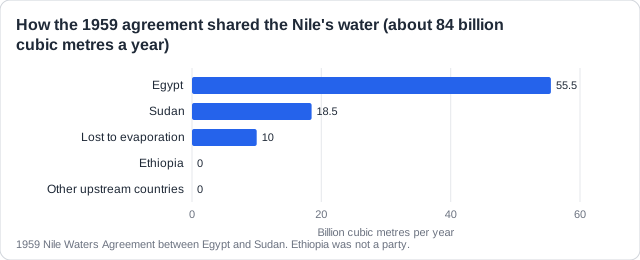
Real example: Egypt used its 1959 share to build the Aswan High Dam. Ethiopia was not asked, and has never accepted that the old agreements bind it.
In 2011 Ethiopia began the Grand Ethiopian Renaissance Dam.
2011
Building starts, paid for mostly by Ethiopians through bonds.
2015
Egypt, Sudan and Ethiopia sign a Declaration of Principles, but no deal on filling.
2020
US-brokered talks fail; Ethiopia starts filling the reservoir in July.
2023
Talks end in December with no agreement.
2024
A Nile basin treaty without Egypt and Sudan comes into force.
2025
The dam opens in September: 5,150 megawatts, 74 billion cubic metres.
Ethiopia
- About half its people had no electricity.
- Its own rivers, its right to use them.
Egypt
- Fears less water in drought years.
- Wants a binding deal on filling and release.
Sudan
- Gains flood control and cheap power.
- Worries about the safety of its own dams.
Real example: Egypt took the dispute to the UN Security Council in 2020 and 2021. In October 2024 six upstream countries brought a new Nile treaty into force, the Cooperative Framework Agreement; Egypt and Sudan reject it.
Know your predicted grade
Take timed mock exams and get detailed feedback on every answer. See exactly where you're losing marks.
Shared water causes tension, but most disputes end in agreements, not war.
How countries cooperate over shared water
- Treaties set each country's share and how to settle disputes.
- Joint management bodies (river basin commissions) share data and plan together.
- Water markets: users can trade water rights, so water goes where it is most needed.
- Virtual water trade: a dry country imports water-hungry food instead of growing it.
- Technology sharing: efficient irrigation, desalination, data on flows.
- Shared benefits: cheap hydropower, flood control, trade, so cooperation pays.
| River | Who shares it | What happened |
|---|---|---|
| Indus | India, Pakistan | 1960 treaty survived two wars; India held it 'in abeyance' in 2025 |
| Jordan | Israel, Jordan, Palestine, Syria, Lebanon | Water shares written into the 1994 Israel-Jordan peace treaty |
| Colorado | USA, Mexico, seven US states | 1944 treaty; states still argue over shares |
| Mekong | China, Laos, Thailand, Cambodia, Viet Nam | Mekong River Commission (1995); China not a member |
Real example: the Indus Waters Treaty held through wars in 1965 and 1971. In April 2025, after an attack in Kashmir, India said it would hold the treaty 'in abeyance'; a court of arbitration ruled it remains in force.
How this comes up: Paper 2, Section B (c) [9] (November 2024): to what extent could the changing value of freshwater lead to conflict between societies? Name a dispute, its history and politics, and ways it can be managed.
Ethiopia opened the Grand Ethiopian Renaissance Dam on the Blue Nile in 2025 with no agreement with Egypt or Sudan.
To what extent are transboundary water disputes likely to lead to conflict rather than cooperation?
Model answer plan
See the mark-by-mark plan — for / against / judgement, with marking guidance — in study mode.
Explain why freshwater's value is rising, use named examples of conflict AND cooperation, and judge when cooperation is more likely: strong treaties, shared benefits and effective governance.