Water stress at Higher Level: This statement is Higher Level only. Water stress is a wider measure than water scarcity: it adds water quality, environmental flows and accessibility to the amount of water.
Practise this as you read
- Define stress and scarcity side by side.
- Explain stress without scarcity from data.
Free preview
This is the free notes preview
You're reading the free notes. Aimnova Pro unlocks the full study experience — and you can try it with your first topic free to keep:
- FlashcardsLock in vocabulary and key terms with spaced repetition.
- Practice questionsAnswer exam-style questions and get instant AI marking.
- Mock exams & past-paper vaultSit full mocks and see exactly how examiners award marks.
- Personalised study planA daily plan built around your exam date and weak areas.
Scarcity counts the water; stress also asks if it is fit to use: Water scarcity asks: is there enough water? Water stress asks that too, and also asks whether the water is clean, whether rivers keep enough to stay alive, and whether people can reach it.
Water stress and water scarcity
- Water scarcity looks at one thing: how much water is available.
- Water stress looks at availability and water quality, environmental flows and accessibility.
- So stress is the wider measure: every scarce place is stressed, but not every stressed place is scarce.
- A region can have plenty of water and no scarcity, yet still be stressed because the water is polluted.
| Water scarcity | Water stress | |
|---|---|---|
| Amount of water | Yes | Yes |
| Water quality | No | Yes |
| Environmental flows | No | Yes |
| Accessibility | No | Yes |
Real example: Bangladesh has huge rivers, the Ganges and the Brahmaputra, and heavy monsoon rain, so it is not short of water. But from the 1970s millions of tube wells were dug, and in the 1990s the groundwater was found to hold natural arsenic. Testing in 1998 and 1999 found about 57 million people drinking water above the World Health Organization's safe limit. Plenty of water, but high water stress.
Study smarter, not longer
Most students waste 40% of study time on topics they already know. Our AI tracks your progress and optimizes every minute.
Water stress is measured with four questions. A place can pass one and fail another.
The four things water stress looks at
- Quantity: is there enough water for everyone's needs?
- Quality: is it clean and safe, or salty, cloudy or toxic?
- Environmental flows: is enough left in rivers and wetlands to keep ecosystems alive?
- Accessibility: can people actually reach it and afford it, through pipes, wells or taps?
Remember it as: Enough, clean, left for nature, within reach.
Real example, environmental flows: the Colorado River in the USA and Mexico is so heavily used by farms and cities that it has rarely reached the sea since 1998, and its delta wetlands dried out. In 2014 the two countries agreed to release a planned 'pulse flow', and the river reached the Gulf of California for the first time in 16 years.
Accessibility: Mexico City: Real example, accessibility: Mexico City sits on a large aquifer, yet many homes in poorer districts such as Iztapalapa get piped water only on some days and buy the rest from water trucks.
Papers give a case with data and ask why a place has water stress but not water scarcity. You need reasons on both sides.
Stress but not scarcity: what to say
- Say what stress includes: availability and quality.
- Say what scarcity includes: availability only.
- Stress goes up when low recharge makes an aquifer saltier or cloudier.
- Stress goes up when drought causes algal blooms, making a lake's water toxic.
- Scarcity stays low if people get water from another source: a lake, a reservoir, or water transported in.
- Answer both halves: only stress, or only scarcity, cannot get full marks.
Water available?
- Yes: big rivers and monsoon rain
- So no water scarcity
Water clean?
- No: arsenic in many tube wells
- About 57 million people affected (1998-99)
Result
- Water stress
- Caused by poor quality, not lack of water
A common slip: Explaining only why there is stress, or only why there is no scarcity, caps the answer. Say what each measure includes, then give a reason from the data for each.
Practice with exam-style questions
Answer exam-style questions and get AI feedback that shows you exactly what examiners want to see in a full-marks response.
How this comes up: Paper 1 (May 2026): a case with a fact file and an aquifer graph; outline why a region may have water stress but not water scarcity [3]. Paper 2: define or distinguish the two measures.
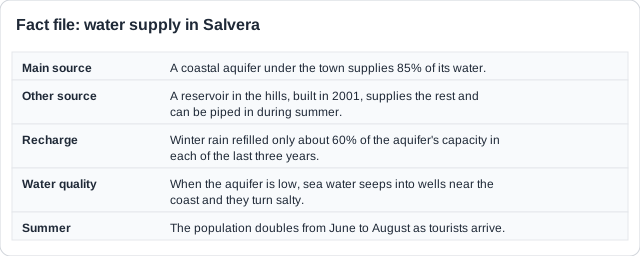
Read the graph against the dashed crisis line: when is the aquifer below it?
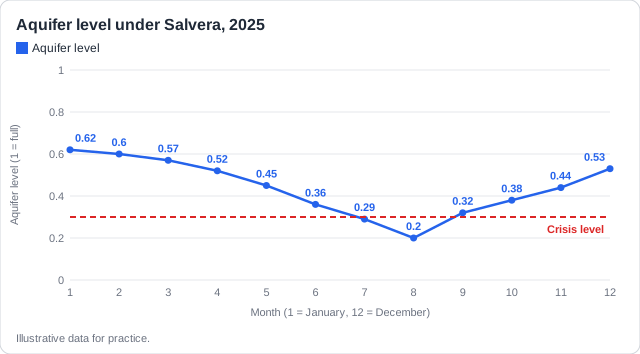
Salvera gets most of its water from an aquifer under the town (Figures 1 and 2).
With reference to Figure 1 and Figure 2, outline why Salvera may experience water stress, but its population may not be experiencing water scarcity.
Model answer plan
See the mark-by-mark plan — for / against / judgement, with marking guidance — in study mode.