Citizen science and water at Higher Level: This statement is Higher Level only. It asks whether ordinary people can monitor water well enough to help manage it sustainably, and how to make their data trustworthy.
Practise this as you read
- Define citizen science with its three features.
- Weigh more data against less precise data.
Free preview
This is the free notes preview
You're reading the free notes. Aimnova Pro unlocks the full study experience — and you can try it with your first topic free to keep:
- FlashcardsLock in vocabulary and key terms with spaced repetition.
- Practice questionsAnswer exam-style questions and get instant AI marking.
- Mock exams & past-paper vaultSit full mocks and see exactly how examiners award marks.
- Personalised study planA daily plan built around your exam date and weak areas.
Science by everyone: Citizen science turns thousands of volunteers into a monitoring network. For water, that means far more rivers, lakes and ponds watched than scientists alone could manage.
The points to remember
- Citizen science (community or crowdsourced science): members of the public collect scientific data.
- Anyone can take part.
- Everyone follows the same protocol, so data from many people can be combined.
- The data are open access: anyone can see and use them.
- It is playing a growing role in monitoring and managing water.
Remember it as: Anyone can join, one protocol, open data.
Real example: since 2012 Earthwatch's FreshWater Watch has trained volunteers to test nitrate and phosphate in local water. More than 14,000 people have sent over 40,000 data sets from more than 1,200 rivers, lakes and ponds, from English chalk streams to Lake Tanganyika in East Africa.
Stop wasting time on topics you know
Our AI identifies your weak areas and focuses your study time where it matters. No more overstudying easy topics.
Volunteers can measure water quality, the life in the water, and how much water there is. The data become a tool for managing water when they reach the people who decide.
What volunteers measure
- Quality: nitrate and phosphate (nutrients), E. coli (sewage), litter, cloudiness.
- Life: river insects and other indicator species show long-term water health.
- Quantity: water levels and flow, read from gauges or photos.
- Management: the data can push authorities to act, e.g. on sewage spills.
- Simple tools: colour-change tubes, phone apps, photos with a time and place.
Real example: in Ilkley, England, a volunteer group tested the River Wharfe for sewage bacteria. Their data helped it become the UK's first river bathing water in December 2020, so the water company now must cut sewage released into it.
Quantity counts too: Citizen science is not only about pollution. With the CrowdWater app, run by the University of Zurich, volunteers photograph a stream and read its level against a virtual gauge, adding data where there is no official station.
The big question in the guide: can water-quality data be crowdsourced accurately? Weigh the benefits against the limits.
Benefits
- More data: many places, often, over many years; spots pollution events.
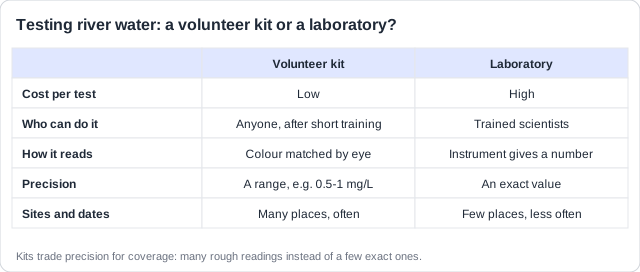
- Cheap compared with paid scientists and laboratory tests.
- Uses local knowledge of the river and its problems.
- Raises awareness and stewardship: people care for water they have tested.
- Open data helps managers and can press authorities to act.
Limitations, and how to reduce them
- Less precise: kits give a range, and colours are matched by eye.
- Training and care vary, so some readings are wrong.
- Sampling bias: easy, popular sites and weekends are over-sampled.
- Volunteers may stop taking part, leaving gaps in the record.
- Data may need checking before authorities accept them.
- Fixes: one protocol, training, checks against laboratory samples, many repeats.
Balance the answer: Rough data from many places can still show where a river is polluted, even if each reading is less exact. Say what the data are good enough for, and what they are not.
See how examiners mark answers
Answer exam-style questions with model answers. Learn exactly what earns marks and what doesn't.
How this comes up: Paper 2, Section A: evaluate citizen science as a tool for monitoring and managing water [4].
In Ilkley, England, volunteers sampled the River Wharfe for sewage bacteria for several years before it became a listed bathing water.
Evaluate the use of citizen science to monitor and manage local water resources.
Model answer plan
See the mark-by-mark plan — for / against / judgement, with marking guidance — in study mode.