Water footprints at Higher Level: This statement is Higher Level only. It applies the footprint idea from 1.3 to water: how much water lies behind what we eat, wear and buy, and how that guides decisions about water security.
Practise this as you read
- Split a footprint into green, blue and grey water.
- Judge whether a footprint is sustainable.
Free preview
This is the free notes preview
You're reading the free notes. Aimnova Pro unlocks the full study experience — and you can try it with your first topic free to keep:
- FlashcardsLock in vocabulary and key terms with spaced repetition.
- Practice questionsAnswer exam-style questions and get instant AI marking.
- Mock exams & past-paper vaultSit full mocks and see exactly how examiners award marks.
- Personalised study planA daily plan built around your exam date and weak areas.
All the water behind what we use: Most of the water you use is invisible: it was used to grow your food and make your clothes. A water footprint counts all of it.
The points to remember
- A water footprint measures all the freshwater used by a person, a nation or to make a product.
- It counts direct use (taps, showers) and indirect use: the water hidden in food and goods.
- Green water: rain used by crops. Blue water: river, lake or groundwater used.
- Grey water: the water needed to dilute the pollution made.
- It is given in litres or cubic metres (1 m3 = 1,000 litres) per person, per year or per product.
Remember it as: Green from rain, blue from rivers, grey to clean up.
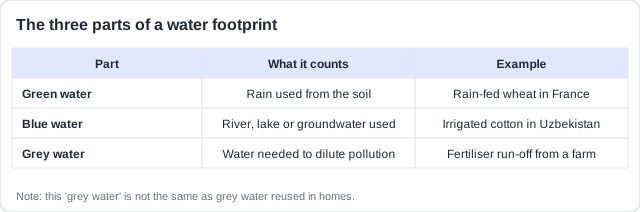
Real example: the Water Footprint Network works out that the average person in the world has a footprint of about 1,385 cubic metres a year: almost 4,000 litres a day, far more than anyone drinks or washes with.
Know your predicted grade
Take timed mock exams and get detailed feedback on every answer. See exactly where you're losing marks.
Every product has a footprint: the water used at every step, from the field to the shop. The guide lists crops, livestock, textiles and steel.
Products
- Products made from animals have the biggest footprints: animals eat crops that need water.
- 1 kg of beef needs about 15,400 litres; 1 kg of chicken about 4,300.
- A cup of coffee needs about 130 litres, mostly to grow the beans.
- Cotton clothes need a lot of irrigation water; synthetic fibres need less water but use oil.
- Farming is about 92% of humanity's water footprint.

Real example: California grows about 80% of the world's almonds, and each almond needs about 12 litres of water, much of it irrigation water in a state that suffers droughts.
Adding up everything a country's people consume gives its national footprint, usually shown per person so countries can be compared.
Nations
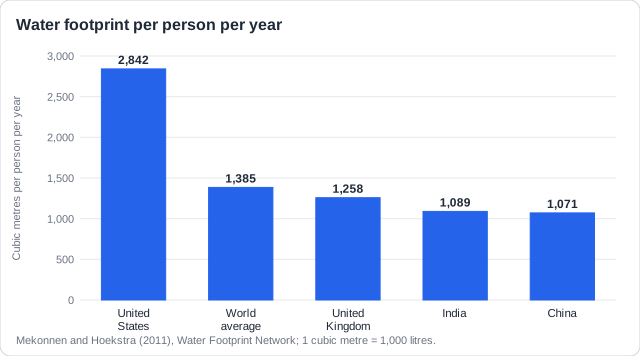
- The world average is about 1,385 m3 per person per year.
- The United States is about 2,842 m3: more meat, more goods, more irrigation.
- India (1,089) and China (1,071) are lower per person, but huge in total.
- A nation's footprint has an internal part (its own water) and an external part (imports).
- Importing food imports virtual water, used in the country that grew it.
Real example: the United Kingdom takes relatively little water from its own rivers, but much of its footprint is external: the water used abroad to grow its imported food, cotton and coffee.
Get feedback like a real examiner
Submit your answers and get instant feedback — what you did well, what's missing, and exactly what to write to score full marks.
A footprint is a measure of sustainable use. It also shows decision-makers where the water goes, so it can guide water security.
Using footprints to decide
- Sustainable if the footprint is no bigger than the water that is renewed each year.
- Governments: decide which crops to grow and which to import, and where water is over-used.
- Companies: find the thirstiest step in their supply chain and cut it.
- Consumers: choose products with smaller footprints, such as chicken instead of beef.
- Limits: an average hides where the water came from; a litre in a wet place matters less than in a dry one.
- Limits: green water does less harm than blue; grey water is only an estimate.
Footprints help
- Show hidden water in food and goods
- Compare people, nations, products
- Guide crop, import and buying choices
But
- Averages hide where water came from
- Green and blue water count the same
- Grey water is only an estimate
Real example: a kilogram of avocados grown with irrigation in dry central Chile puts far more pressure on local rivers than the same footprint from rain-fed farms in a wet region: the number is the same, the harm is not.
How this comes up: Paper 2, Section B (b): explain how water footprints measure sustainability and inform decisions [7].
The average person in the United States has a water footprint of about 2,842 cubic metres a year, twice the world average.
Explain how water footprints can be used to assess sustainable water use and to inform decisions about water security.
Model answer plan
See the mark-by-mark plan — for / against / judgement, with marking guidance — in study mode.