Water budgets and sustainable harvesting at Higher Level: The same ideas as SL with different examples: the Dead Sea, Lake Chad and Saudi Arabia's desert aquifers. At HL, expect to calculate a sustainable rate of pumping and explain what happens if it is exceeded.
Practise this as you read
- Write the budget as a formula before the numbers.
- Compare what is taken with what is replaced.
Free preview
This is the free notes preview
You're reading the free notes. Aimnova Pro unlocks the full study experience — and you can try it with your first topic free to keep:
- FlashcardsLock in vocabulary and key terms with spaced repetition.
- Practice questionsAnswer exam-style questions and get instant AI marking.
- Mock exams & past-paper vaultSit full mocks and see exactly how examiners award marks.
- Personalised study planA daily plan built around your exam date and weak areas.
Every water body has a budget: A lake, a reservoir, an aquifer or a whole drainage basin gains water from inputs and loses it through outputs, like a bank account with money in and money out.
The points to remember
- Any water body (a lake, a reservoir, an aquifer, a drainage basin) is an open system.
- Inputs: precipitation, rivers flowing in, groundwater seeping in, meltwater.
- Outputs: evaporation, rivers flowing out, seepage, and abstraction by people.
- Draw it as a flow diagram: the water body in a box, inputs and outputs as labelled arrows.
Remember it as: Water in, water out, and a store in between.
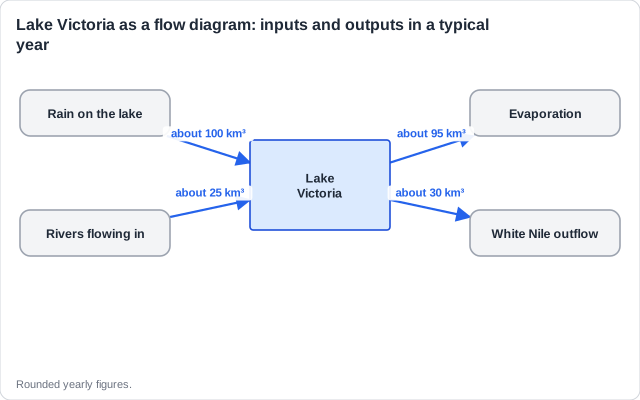
Real example: the Dead Sea's main input is the River Jordan; its only output is evaporation, as no river leaves it. Today its mineral works also pump out water to evaporate in salt ponds.
Practice with exam-style questions
Answer exam-style questions and get AI feedback that shows you exactly what examiners want to see in a full-marks response.
When a water body's inputs and outputs balance over the years, it is in steady state. Its level rises and falls with the seasons, but always comes back.
The points to remember
- In a steady state, inputs equal outputs, so the store stays about the same.
- It still goes up and down with the seasons, around a steady average.
- If outputs are bigger than inputs for years, the store shrinks.
- Reasons a reservoir varies: seasonal rainfall (input) and seasonal extraction (output).
Steady state
- Inputs = outputs over the years
- Level goes up and down, then back
- Sustainable
Not steady
- Outputs > inputs year after year
- Level keeps falling
- Unsustainable
Real example: Lake Chad has shrunk by about 90% since the 1960s. Droughts cut its inputs and irrigation took water from its rivers, while evaporation went on: outputs beat inputs for decades.
'Less rain' is not enough: Say it is a seasonal or changing input or output: 'storage falls in the dry summer because rainfall input stops while the city keeps extracting water'.
The flow diagram turns into a sum. One formula answers every water-budget question.
The water-budget formula
- Formula: change in storage = total inputs - total outputs.
- Add up all the inputs; add up all the outputs; subtract.
- Zero: steady state. Positive: the store grows. Negative: it shrinks.
- Keep the units the whole way through (km³, million m³, mm).
Add the inputs
Jordan River 0.2 km³ + springs 0.2 km³ = 0.4 km³.
Add the outputs
Evaporation and mineral works: about 1.1 km³.
Subtract
0.4 - 1.1 = -0.7 km³ a year.
Say what it means
Spread over about 600 km², the level falls by over 1 m a year.
Real example: these are the Dead Sea's rounded yearly figures. Before the 1960s the Jordan brought about 1.3 km³ a year, enough to balance evaporation; since Israel, Jordan and Syria began diverting it, the sea has fallen by over 1 m a year.
Feeling unprepared for exams?
Get a clear study plan, practice with real questions, and know exactly where you stand before exam day. No more guessing.
The same budget tells us how much water people can take for ever without the store running down: the sustainable rate of harvesting.
The points to remember
- A sustainable harvest takes no more than the store gains each year, so it never shrinks.
- Lake or reservoir: harvest at most inputs - the outputs that must continue (evaporation, rivers, wildlife).
- Aquifer: pumping at most the yearly recharge, minus what springs and rivers need.
- Deep aquifers refill over thousands of years: on a human timescale their water is non-renewable.
- Pump faster than recharge and the water table falls: wells must go deeper, and springs dry up.
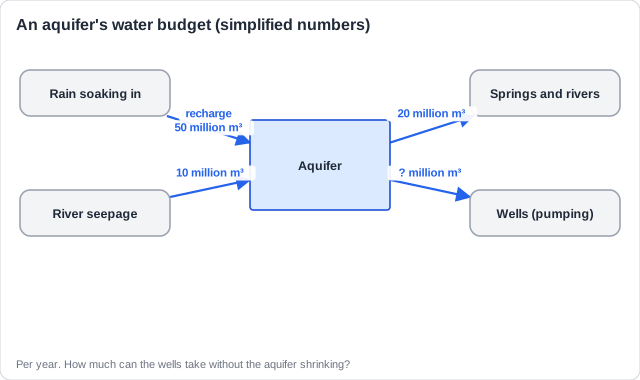
Worked example: the most the wells can take: Formula: sustainable pumping = inputs - outputs that must continue.
Inputs = 50 + 10 = 60 million m³. Springs and rivers need 20 million m³. Sustainable pumping = 60 - 20 = 40 million m³ a year.
Real example: from the 1980s Saudi Arabia pumped water that had lain in deep desert aquifers for thousands of years to grow wheat. Recharge was almost nil, so the aquifers fell fast, and the country stopped growing wheat this way in 2016.
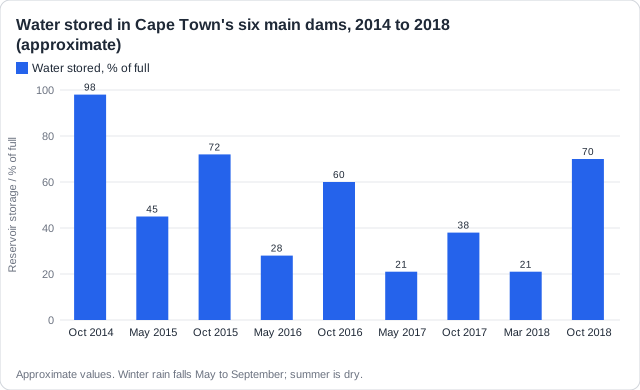
Reservoirs are managed with the same budget. A graph of how full they are shows the inputs and outputs changing with the seasons.
Input changes
- Winter rain refills the dams.
- In 2015-2017 the winters were very dry.
Output changes
- Summer irrigation and city use empty them.
- Evaporation is highest in hot summers.
What the city did
- Use cut from about 1,200 to 500 million litres a day.
- Day Zero, when taps would be shut, was avoided.
Real example: the dams held about 900 billion litres when full. At 20%, with the last 10% too muddy to use, about 90 billion litres were usable: 75 days at 1,200 million litres a day, but 180 days at 500 million.
Memorize terms 3x faster
Smart flashcards show you cards right before you forget them. Perfect for definitions and key concepts.
How this comes up: Paper 1: use an aquifer's water budget to calculate a sustainable rate of pumping [2], then explain the result [1].
An aquifer under a farming region receives 90 million m³ of recharge a year. Springs that feed a protected wetland need 25 million m³ a year. Farmers now pump 100 million m³ a year.
(a) Calculate the maximum sustainable rate of pumping.
(b) Explain what will happen to the aquifer if pumping continues at the present rate.
Model answer plan
See the mark-by-mark plan — for / against / judgement, with marking guidance — in study mode.