When the predicted biome does not develop at Higher Level: An HL-only page. The Scottish Highlands have the right climate for forest, yet they are bare moorland. Iowa's climate predicts prairie, yet it is a sea of maize. This page explains why climate alone does not decide what grows.
Practise this as you read
- Explain why the biome predicted by temperature and rainfall may not develop.
- Suggest which biome would develop without farming or towns.
Free preview
This is the free notes preview
You're reading the free notes. Aimnova Pro unlocks the full study experience — and you can try it with your first topic free to keep:
- FlashcardsLock in vocabulary and key terms with spaced repetition.
- Practice questionsAnswer exam-style questions and get instant AI marking.
- Mock exams & past-paper vaultSit full mocks and see exactly how examiners award marks.
- Personalised study planA daily plan built around your exam date and weak areas.
Prediction is not a promise: Temperature and rainfall predict a biome, but what actually grows can be different. Secondary influences and human interventions can stop the predicted biome from developing.
The points to remember
- Temperature and rainfall predict which biome should grow in an area.
- But the predicted biome may not develop.
- Two kinds of cause: secondary influences (natural) and human interventions.
- The predicted biome is what would grow without interference from farming or cities.
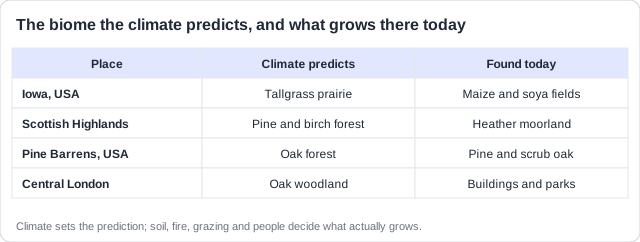
Real example: Iowa's hot summers, cold winters and about 850 mm of rain predict tallgrass prairie, and prairie once covered about 80% of the state. Farmers ploughed it for maize and soya from the 1800s; today less than 0.1% of the prairie is left.
Practice with exam-style questions
Answer exam-style questions and get AI feedback that shows you exactly what examiners want to see in a full-marks response.
Some causes are natural. Climate is the main control on biomes, but other local, or secondary, factors can win in a particular place.
Secondary influences
- Soil: sandy, thin or waterlogged soil can stop the predicted plants growing.
- Rock: limestone or chalk gives thin, dry soil; grass may grow where trees are expected.
- Relief: altitude, steep slopes and the direction a slope faces change local conditions.
- Fire: frequent natural fires kill young trees and favour grasses or fire-proof plants.
- Wild grazers: elephants, deer or wildebeest eat or knock down young trees.
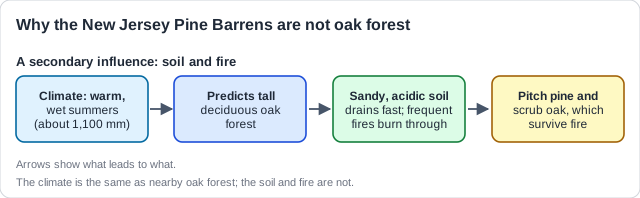
Real example: the Pine Barrens cover about 4,500 km² of New Jersey, USA. Their deep, sandy soil holds little water or nutrients, and fires sweep through every few years. Pitch pines resprout from their trunks after a fire, so they win; in the 'pine plains' the pines are shorter than a person.
Most often, the cause is people. Across much of the world the biome the climate predicts has been replaced by farms, pasture or towns.
Human interventions
- Clearing for farmland: forest or grassland replaced by crops.
- Grazing by sheep, cattle or goats: animals eat tree seedlings, so trees cannot return.
- Burning to improve grazing: fire keeps land open.
- Urban development: buildings, roads and parks replace the natural biome.
- Drainage or irrigation: wetlands dried out, deserts watered for crops.
Remember it as: Climate proposes; soil, fire and people decide.
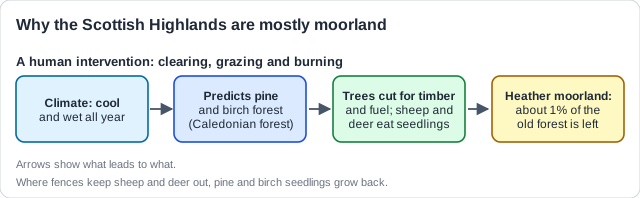
Real example: the Caledonian forest of pine and birch once covered much of the Scottish Highlands. Centuries of felling, then sheep farming and large herds of red deer, left open moorland; farmers also burn heather to give young shoots for grazing. Where fences keep the deer out, as at Glen Affric, pine and birch seedlings grow back.
Feeling unprepared for exams?
Get a clear study plan, practice with real questions, and know exactly where you stand before exam day. No more guessing.
To find the biome that would develop without farming or towns, ask what succession would do if people stopped. The answer is usually the biome the climate predicts.
The biome that would develop
- Left alone, land changes by succession towards the biome its climate predicts.
- Grass, then shrubs, then trees, where the climate supports forest.
- So the local biome that would develop is the one the climate predicts.
- Farming, grazing or mowing stops this change; stop them and it starts again.
1882
- Scientists fenced off part of a wheat field and stopped harvesting and ploughing it.
Weeds
- Within a few years weeds and grasses covered the old field.
Shrubs
- Hawthorn and bramble spread next, and young trees grew among them.
Woodland
- Today it is woodland of oak, ash and sycamore: the temperate forest England's climate predicts.
Real example: central London's climate predicts oak woodland, the forest that covered the Thames valley before farms and the city. If the city were abandoned, the parks and gardens would slowly turn back into that woodland.
Name both biomes: Say which biome the climate predicts AND what grows now, then the cause. 'People changed it' with no biome named is too vague.
How this comes up: Paper 1 gives a fact file or map: name the predicted biome, then explain why it has not developed. Chain it: the climate predicts X; this cause stops it; so Y grows.
Iowa has hot summers, cold winters and about 850 mm of rain a year. Today most of the state is maize and soya fields.
Explain why tallgrass prairie is no longer the main biome in Iowa, and what would develop if the farms were abandoned.
Model answer plan
See the mark-by-mark plan — for / against / judgement, with marking guidance — in study mode.