Tropical cyclones at Higher Level: An HL-only statement. Hurricanes, typhoons and cyclones are one kind of storm with three names. You will see what makes one, how it draws its energy from a warm ocean, and what it does when it reaches land.
Practise this as you read
- Define a tropical cyclone and say when it becomes a hurricane or typhoon.
- Outline the conditions it needs and explain how it works.
Free preview
This is the free notes preview
You're reading the free notes. Aimnova Pro unlocks the full study experience — and you can try it with your first topic free to keep:
- FlashcardsLock in vocabulary and key terms with spaced repetition.
- Practice questionsAnswer exam-style questions and get instant AI marking.
- Mock exams & past-paper vaultSit full mocks and see exactly how examiners award marks.
- Personalised study planA daily plan built around your exam date and weak areas.
A spinning storm: A tropical cyclone is a storm system that circulates rapidly around a centre of low pressure.
The points to remember
- A tropical cyclone is a storm system that spins rapidly around a centre of low pressure.
- It forms in the tropics, over warm oceans.
- It is marked by strong winds, heavy rain and high waves.
- It grows in stages: tropical depression, tropical storm (it gets a name), then Category 1 to 5.
- Categories 1-5 (the Saffir-Simpson scale) are set by the sustained wind speed.
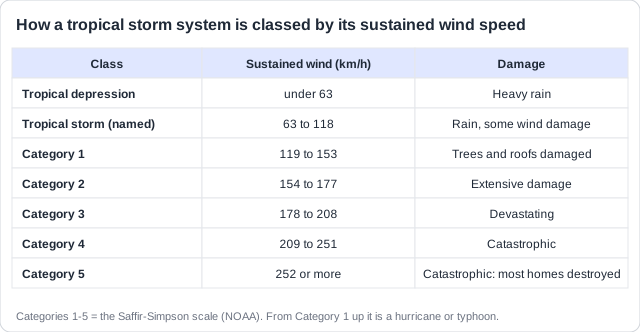
Real example: Katrina began as a tropical depression over the Bahamas on 23 August 2005. It became Tropical Storm Katrina, crossed Florida as a Category 1 hurricane, and over the warm Gulf of Mexico reached Category 5, with sustained winds of about 280 km/h.
Feeling unprepared for exams?
Get a clear study plan, practice with real questions, and know exactly where you stand before exam day. No more guessing.
A tropical cyclone has a different name in different oceans. The storm is the same; only the name changes.
Hurricane, typhoon or cyclone
- Once sustained winds exceed 119 km/h, it is called a hurricane or a typhoon.
- Hurricane: formed in the North Atlantic, the Caribbean or the north-east Pacific.
- Typhoon: formed in the north-west Pacific, near Japan, China and the Philippines.
- Cyclone: the name used in the Indian Ocean and the South Pacific.
- The name depends on where it forms: the storm itself is the same.
The threshold: Only once the sustained wind is over 119 km/h is it a hurricane or typhoon. Below that it is a tropical storm, however much rain it brings: Tropical Storm Allison (2001) never reached 119 km/h, yet it flooded Houston.
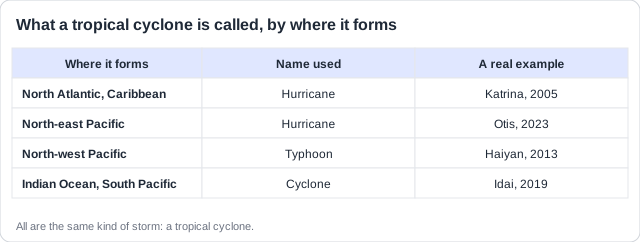
Remember it as: Atlantic hurricane, Asian typhoon, Indian Ocean cyclone.
What a cyclone needs: Tropical cyclones originate in the tropics because that is where the ocean is warm enough to give them their energy.
The points to remember
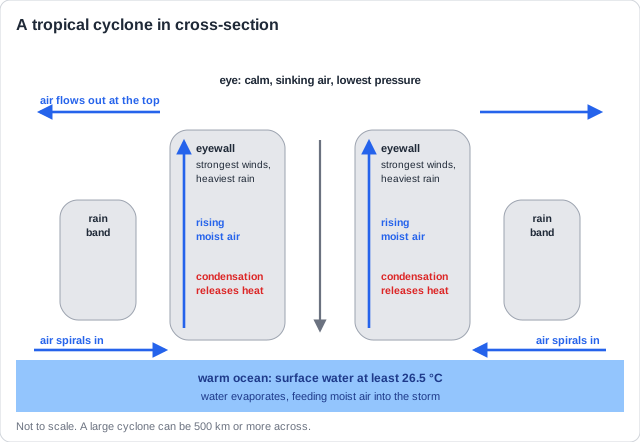
- Warm ocean: surface water at least about 26.5 °C, warm to a depth of about 50 m.
- Between about 5° and 30° north or south of the equator.
- Not on the equator: the Earth's spin (the Coriolis effect) is needed to make the storm rotate.
- Moist air, and winds that change little with height (low wind shear), so the storm is not torn apart.
- So they form in late summer and autumn, when the sea is warmest.
Real example: the Atlantic hurricane season runs from 1 June to 30 November and peaks in September, when the sea is warmest. Almost no cyclone forms near the equator: the closest ever seen was Typhoon Vamei, which formed only about 150 km north of it, near Singapore, in December 2001.
Why the spin matters: The Coriolis effect makes the storm spin: anticlockwise north of the equator, clockwise south of it.
Memorize terms 3x faster
Smart flashcards show you cards right before you forget them. Perfect for definitions and key concepts.
A cyclone is a heat engine: its fuel is warm, moist air from the ocean.
How a cyclone works
- Warm water evaporates; the moist air rises and cools.
- The water vapour condenses into cloud, releasing heat (latent heat), so the air rises faster.
- Rising air leaves low pressure at the surface; more air spirals in to replace it.
- The eye in the centre is calm, with sinking air and the lowest pressure; the eyewall round it has the strongest winds.
- Over land or cold water it loses its energy supply, and friction with the land slows it: it weakens.
- Cyclones carry heat from the tropics towards the poles.
Real example: Cyclone Freddy (2023) crossed the whole south Indian Ocean, about 8,000 km, from north-west Australia to Madagascar and Mozambique. Each time it crossed land it weakened; each time it reached warm sea again it strengthened. It lasted 36 days, the longest-lived tropical cyclone ever recorded. Over land in Malawi its rain caused floods and landslides that killed more than 1,000 people.
What they do: Strong winds, a storm surge and heavy rain: three hazards in one storm.
The points to remember
- Strong winds wreck homes, power lines and crops and flatten forests.
- A storm surge, the sea pushed onto the land by wind and low pressure, floods the coast. It kills most.
- Heavy rain brings river floods and landslides, even far inland.
- Ecosystems are hit: coral reefs broken, mangroves and forests stripped, soil washed away.
- Not all bad: the rain refills reservoirs and ends droughts, and the storm mixes and cools the sea.
Real example: Typhoon Haiyan crossed the central Philippines on 8 November 2013 with sustained winds of about 315 km/h, one of the strongest storms ever to reach land. In Tacloban city a storm surge over 5 m high swept inland. More than 6,000 people died and about 4 million lost their homes.
Rain far inland: In March 2019 Cyclone Idai hit Beira, in Mozambique. Its rain flooded a huge area inland, and more than 1,000 people died in Mozambique, Zimbabwe and Malawi.
Know your predicted grade
Take timed mock exams and get detailed feedback on every answer. See exactly where you're losing marks.
How this comes up: Paper 1 case studies of storm-hit islands (Dominica, Mauritius) ask how the storm formed and what it did. Paper 2 can ask you to outline the conditions or explain how a cyclone forms.
Each year about 20 tropical storms form over the Bay of Bengal and the Arabian Sea, but only a few become cyclones.
Outline four conditions needed for a tropical cyclone to form.
Model answer plan
See the mark-by-mark plan — for / against / judgement, with marking guidance — in study mode.
Use the numbers: 26.5 °C, 5° to 30°, 119 km/h: a number makes a point precise and hard to miss.