The second law at Higher Level: The same law as SL, with different examples: power stations, humpback whales and the Earth's energy balance. At HL, expect a [4] that asks how a food chain demonstrates the law, where entropy wording earns marks.
Practise this as you read
- State the law two ways: inefficient transformations, and entropy increasing.
- Outline four separate losses or ideas for a [4], one per paragraph.
Free preview
This is the free notes preview
You're reading the free notes. Aimnova Pro unlocks the full study experience — and you can try it with your first topic free to keep:
- FlashcardsLock in vocabulary and key terms with spaced repetition.
- Practice questionsAnswer exam-style questions and get instant AI marking.
- Mock exams & past-paper vaultSit full mocks and see exactly how examiners award marks.
- Personalised study planA daily plan built around your exam date and weak areas.
Nothing is 100% efficient: The second law of thermodynamics says that whenever energy changes form, some of it is degraded, mostly into heat.
The points to remember
- The second law: every energy transformation is inefficient.
- Some energy is always degraded into a less useful form, usually heat.
- The amount of energy stays the same (the first law, 2.2.2), but its quality falls.
- Light and chemical energy are concentrated and can do work; heat is spread out and cannot.
- So no transformation, in a machine or in a living thing, is ever 100% efficient.
Remember it as: Energy is never lost, but it is always downgraded.
High-quality energy
- Sunlight, chemical energy in food or fuel.
- Concentrated: it can do work.
Low-quality energy
- Heat, spread out in the surroundings.
- Cannot be used again for work.
Real example: a coal power station turns only about a third to 40% of the chemical energy in coal into electricity. The rest is degraded to heat, released through its cooling towers.
Practice with real exam questions
Answer exam-style questions and get AI feedback that shows you exactly what examiners want to see in a full-marks response.
Energy enters an ecosystem as sunlight and leaves as heat: it flows through and never cycles, so a constant input from the Sun is needed. Every step along a food chain is an energy transformation, so the second law applies at every step.
The second law in a food chain
- Energy is transformed at every trophic level: chemical energy in food becomes movement, growth and heat.
- The biggest loss is heat from cellular respiration (see 2.2.7); heat cannot be passed on.
- Energy is also lost because not all of an organism is eaten, digested or absorbed (see 2.2.12).
- So transfers between levels are never 100% efficient: often only about 10% passes on.
- So higher levels hold less energy: fewer, often larger, organisms (see 2.2.17).
- After four or five levels too little energy is left for another level (see 2.2.14).
Remember it as: Every step up the chain, most of the energy goes up as heat.
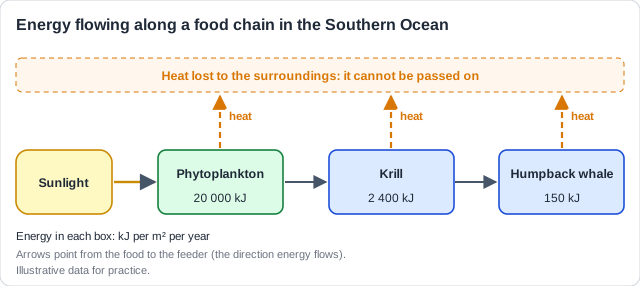
Why it matters for food: Because energy is lost at every step, eating lower in the food chain, such as more plant foods, feeds more people from the same land (see 5.2).
Real example: humpback whales feed on krill, just one step above the phytoplankton. Eating so low in the chain loses less energy, which helps the largest animals on Earth find enough of it. Ocean chains are often more efficient than chains on land, because fewer parts of ocean organisms are left uneaten.
Name the law, then the heat: Start with the law itself: 'energy transformations are never 100% efficient'. Then say where the energy goes: 'lost as heat from respiration', never 'destroyed' or 'used up'.
The second law can also be written in terms of order and disorder, using entropy. Some questions credit this wording.
Order and disorder
- Entropy measures disorder: how spread out energy is.
- Energy stored in biomass is ordered and concentrated: low entropy.
- Heat is energy spread out in the surroundings: high entropy.
- Every transformation along a chain turns ordered energy into heat, so entropy increases.
- That is the second law put another way: disorder always increases.
Real example: the Earth receives concentrated sunlight and sends the same amount of energy back to space as spread-out heat. Life uses the sunlight in between, and entropy increases. Entropy is taken further in 2.2.29.
Two ways to say it: Either wording of the law is accepted: 'transformations are never 100% efficient' or 'entropy (disorder) increases'. Then link it to heat lost at each trophic level.
Feeling unprepared for exams?
Get a clear study plan, practice with real questions, and know exactly where you stand before exam day. No more guessing.
How this comes up: Paper 2, Section B (a): outline how a food chain shows the second law [4].
In the Southern Ocean, phytoplankton are eaten by krill, which are eaten by humpback whales.
Outline how the flow of energy along a food chain demonstrates the second law of thermodynamics.
Model answer plan
See the mark-by-mark plan — for / against / judgement, with marking guidance — in study mode.