Respiration and heat at Higher Level: The same ideas as SL, with different examples: a plant that melts snow with its own heat and hummingbirds that cool down at night. At HL, heat from respiration explains why birds and mammals need so much food.
Practise this as you read
- Explain why respiration makes heat, using the word 'efficient'.
- Follow the heat out of the body and say why it cannot be passed on.
Free preview
This is the free notes preview
You're reading the free notes. Aimnova Pro unlocks the full study experience — and you can try it with your first topic free to keep:
- FlashcardsLock in vocabulary and key terms with spaced repetition.
- Practice questionsAnswer exam-style questions and get instant AI marking.
- Mock exams & past-paper vaultSit full mocks and see exactly how examiners award marks.
- Personalised study planA daily plan built around your exam date and weak areas.
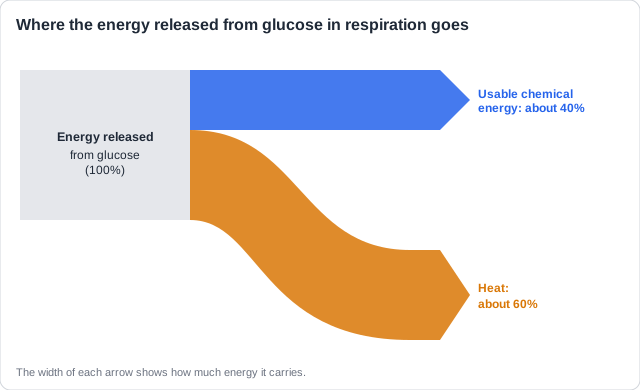
Respiration always runs warm: Respiration is not 100% efficient. Some of the energy released from glucose is transformed into heat instead of the usable chemical form.
The points to remember
- Respiration is not 100% efficient.
- It cannot move all the energy in glucose (a carbohydrate) into the usable chemical form.
- The rest is transformed into heat: roughly 60% of the energy released.
- Every organism that respires makes heat: animals, plants, fungi and bacteria.
- The faster an organism respires, the more heat it makes.
Remember it as: Every cell that respires is a tiny heater.
Real example: the flowers of the eastern skunk cabbage respire so fast that they stay far warmer than the freezing air and melt the snow around them.
Study smarter, not longer
Most students waste 40% of study time on topics they already know. Our AI tracks your progress and optimizes every minute.
Once energy has become heat inside an organism, the organism cannot use it again for its cells' work.
Heat is a one-way exit
- Heat cannot be turned back into chemical energy inside the organism.
- It is lost from the body to the air, water or ground around it.
- So energy lost as heat is not stored in biomass and cannot be passed on when the organism is eaten.
- Mammals and birds use this heat to keep warm, but it still leaves the body in the end.
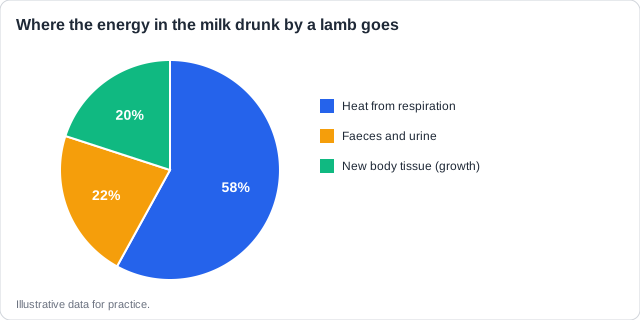
- So they must keep respiring, and keep eating, to replace the heat they lose.
Remember it as: Heat out, never back in.
Real example: a hummingbird loses heat so fast from its tiny body that at night it lets its body temperature drop by many degrees, a state called torpor. Respiring more slowly saves the energy it would otherwise lose as heat.
Lost, not destroyed: Say the energy is 'lost as heat' or 'transformed into heat'. It is not 'used up' or 'destroyed': energy cannot be destroyed (see 2.2.2). Why this makes every transfer inefficient is 2.2.8.
How this could come up: Paper 2, Section A: outline a process in a named organism, one point per mark [3].
A ruby-throated hummingbird weighs about 3 g and must feed on flower nectar every few minutes during the day.
Outline why the hummingbird produces heat, and what happens to that heat.
Model answer plan
See the mark-by-mark plan — for / against / judgement, with marking guidance — in study mode.