Population interactions at Higher Level: The same six interactions as SL. At HL, practise tracing each change through a food web and linking it to evolution.
Practise this as you read
- Trace every knock-on effect one step at a time, with its cause.
- Link interactions to selective pressures: tolerant hosts, milder parasites, wary prey.
Free preview
This is the free notes preview
You're reading the free notes. Aimnova Pro unlocks the full study experience — and you can try it with your first topic free to keep:
- FlashcardsLock in vocabulary and key terms with spaced repetition.
- Practice questionsAnswer exam-style questions and get instant AI marking.
- Mock exams & past-paper vaultSit full mocks and see exactly how examiners award marks.
- Personalised study planA daily plan built around your exam date and weak areas.
Six ways to interact: Populations that share an ecosystem affect each other in six ways: herbivory, predation, parasitism, mutualism, disease and competition.
The points to remember
- Herbivory: an animal feeds on a plant.
- Predation: a predator kills and eats its prey.
- Parasitism: a parasite lives on or in a host and feeds on it, harming it.
- Mutualism: both species benefit.
- Disease: a pathogen infects a host and harms it.
- Competition: two populations need the same limited resource. Different species: interspecific. Same species: intraspecific.
Remember it as: Plus or minus: four interactions are +/-, mutualism is +/+, competition is -/-.
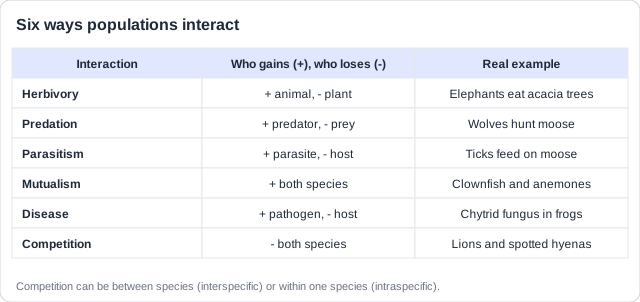
Name the interaction, in its own word: Write 'herbivory', not 'herbivore' or 'food source'; 'mutualism', not 'symbiosis' alone. Two different species compete interspecifically, never intraspecifically.
Real example: the chytrid fungus has spread to frogs on every continent where they live, and has wiped out some species: disease.
See how examiners mark answers
Access past paper questions with model answers. Learn exactly what earns marks and what doesn't.
A model of a feeding relationship: Predator and prey numbers rise and fall in linked cycles. The predator peak comes after the prey peak.
The points to remember
- More prey means more food, so predator numbers rise.
- More predators eat more prey, so prey numbers fall.
- With less food, predators fall; with fewer predators, prey recover.
- The predator peak comes after the prey peak: a time lag, because predators take time to breed.
- Each population regulates the other: this is negative feedback.
- Both gain: the predator gets food; the prey is kept below its food limit and loses its weak and diseased members, so it stays healthy.
Remember it as: Prey up, predators up, prey down, predators down: and round again.
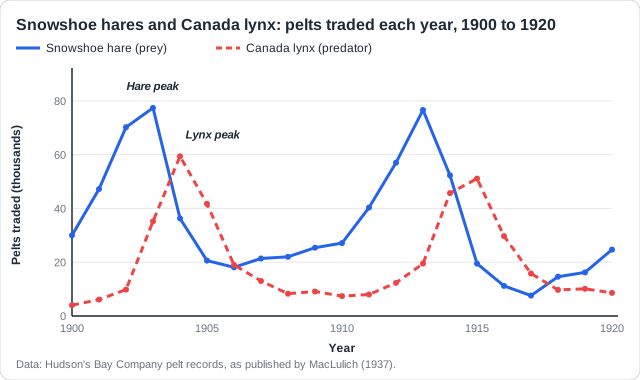
Read the graph: hares peaked in 1903 and 1913; lynx peaked in 1904 and 1915. The gap is the time lag.
Name it, do not describe it: Write 'predation' or 'predator-prey'. 'Big fish eat small fish' describes the relationship but does not name it.
Real example: on Isle Royale, wolves and moose have been counted every winter since 1959, and their numbers rise and fall together.
Change one, change many: A change in one population passes along the food web to the others, one step at a time. It can change the carrying capacity for other species.
The points to remember
- More predators: fewer herbivores, so plants recover and soil is held in place.
- Fewer predators: more herbivores, overgrazing, less plant cover and more soil erosion.
- A competitor that increases leaves less food for the other species, so its numbers fall.
- A change in one species can lower the carrying capacity for another: fewer prey for a predator, more herbivores for a plant, a lost partner in mutualism.
- Give every step: what changes, why, and what that changes next.
Remember it as: Follow the arrows: one step, its cause, then the next step.
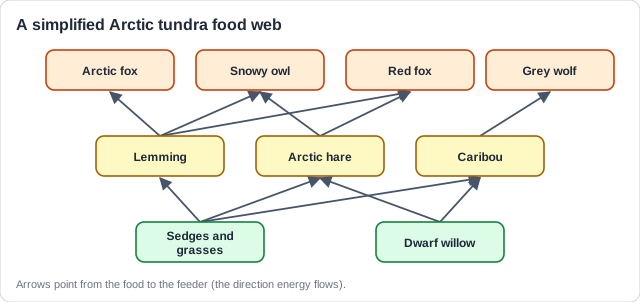
Too vague to score: 'The food web will collapse' or 'the ecosystem becomes unstable' says nothing. Give each step and its cause.
Real example: as the Arctic warms, red foxes are moving north onto the tundra, where they compete with Arctic foxes for lemmings and even kill them, so Arctic fox numbers fall.
Study smarter, not longer
Most students waste 40% of study time on topics they already know. Our AI tracks your progress and optimizes every minute.
More than numbers: Interactions change population sizes, how animals behave and, over many generations, how species evolve.
The points to remember
- Ecological: population sizes rise and fall, and changes pass along the food web.
- Behavioural: prey avoid places where predators hunt; predators switch to the prey easiest to catch that season.
- Evolutionary: predators, parasites and competitors are selective pressures: individuals with helpful traits survive and breed more.
- A new parasite spreads slowly, then fast; hosts die, so the parasite falls; hosts recover; the cycle repeats around a dynamic equilibrium.
- Over time tolerant hosts survive and milder parasites spread best, so the parasite becomes less deadly.
Remember it as: Numbers, behaviour, evolution: three kinds of consequence.
Behaviour: a real example
- Moose calves are born in spring, so wolves kill more calves in early summer.
Evolution: a real example
- Avian malaria kills many Hawaiian honeycreepers.
- Some honeycreepers in the lowlands now survive it: tolerance has evolved.
Checks and balances: Herbivores, predators and decomposers hold each other in check, so the whole ecosystem stays steady.
The points to remember
- Herbivores eat producers, which limits plant numbers; when plants fall, herbivores fall too: negative feedback.
- Herbivores pass energy to carnivores, whose predation limits herbivore numbers.
- Dung, dead animals and dropped leaves feed decomposers, which return nutrients to plants.
- Herbivores spread seeds, and large grazers such as elephants and bison keep grasslands open.
- Many kinds of herbivores and predators make the ecosystem more resilient.
- A predator makes its prey's growth slow sooner, level off lower and rise and fall; by easing competition among the prey it can prevent a crash.
Remember it as: Eat, be eaten, rot, recycle: each link holds another in check.
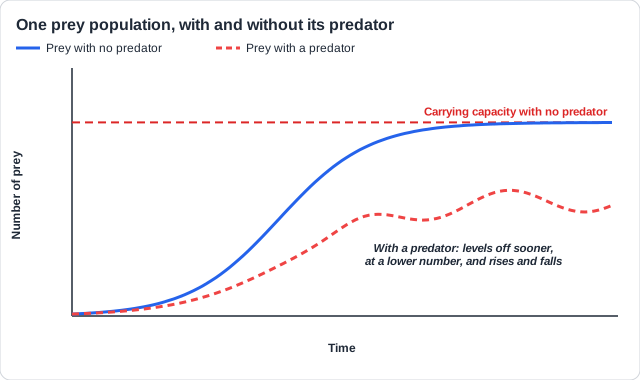
Answer the question about the curve: Say what the predator does to the prey's growth. The prey's damage to its habitat, or a J-curve with no predator, does not answer it.
Real example: on the North American prairies, bison graze and wallow, opening patches where other plants grow, and wolves once limited their numbers.
Practice with real exam questions
Answer exam-style questions and get AI feedback that shows you exactly what examiners want to see in a full-marks response.
How this comes up: Paper 2, Section B (a): outline host-parasite cycles [4]. Paper 1: name the relationship [1], predict knock-on effects [2].
A parasitic mite arrives on an island and infects the island's only species of lizard.
Outline how the populations of the lizard and the mite may reach an equilibrium over time.
Model answer plan
See the mark-by-mark plan — for / against / judgement, with marking guidance — in study mode.