Abiotic factors at Higher Level: The same six factors as SL, with different cases: an acid river in Spain, the dark rainforest floor, trout in warming rivers.
Practise this as you read
- Pair the abiotic factor with the biotic process it limits.
- Plan how to measure a factor: instrument, sites, repeats.
Free preview
This is the free notes preview
You're reading the free notes. Aimnova Pro unlocks the full study experience — and you can try it with your first topic free to keep:
- FlashcardsLock in vocabulary and key terms with spaced repetition.
- Practice questionsAnswer exam-style questions and get instant AI marking.
- Mock exams & past-paper vaultSit full mocks and see exactly how examiners award marks.
- Personalised study planA daily plan built around your exam date and weak areas.
Six factors to know: Many abiotic factors affect where species live. The guide names six: learn what each is and how it affects living things.
The points to remember
- Temperature: speeds up or slows down growth; too hot or too cold kills.
- Sunlight: plants need light for photosynthesis.
- pH: how acidic or alkaline water or soil is; few species live at very low or high pH.
- Salinity: how salty water or soil is; sea species and freshwater species need different levels.
- Dissolved oxygen: the oxygen in water; fish and insect larvae need it to breathe.
- Soil texture: how sandy, silty or clayey a soil is; it decides how much water and air the soil holds.
Remember it as: Temperature, Sunlight, pH, Salt, Oxygen, Soil: T-S-P-S-O-S.
Real example: the Rio Tinto in southern Spain has water with a pH of about 2, as acidic as lemon juice, from old mines and natural rocks. Almost no fish or plants live in it; only a few specialist microbes do.
Know your predicted grade
Take timed mock exams and get detailed feedback on every answer. See exactly where you're losing marks.
Papers often ask which abiotic factor limits plant growth or productivity in a place.
Limiting factors
- A limiting factor is the one in shortest supply: it holds back growth, whatever the others are.
- Give its direction: 'low rainfall', 'low winter temperatures', not just 'rainfall' or 'temperature'.
- Link it to plants: 'so less photosynthesis' or 'so plants grow more slowly'.
- In a desert, low rainfall limits most. In cold places, low temperature and a short growing season.
- Under a closed canopy, low light limits the biotic process of photosynthesis.
- Fire and grazing animals are not abiotic factors: do not give them.
Remember it as: Name it, give its direction, link it to photosynthesis.
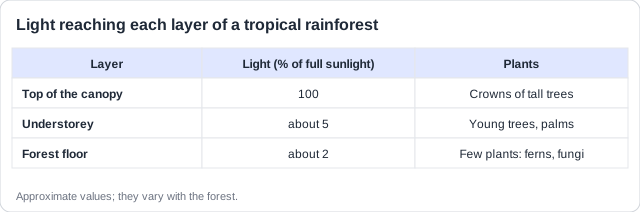
Reading it: at the forest floor only about 2% of sunlight arrives, so low light limits photosynthesis and few plant species can grow there. Light is the abiotic factor; photosynthesis is the biotic process.
Link it, and give the direction: 'Temperature' alone, or 'it lowers productivity' alone, is not enough. Write 'low temperatures slow photosynthesis'.
A tolerance curve shows why a species lives in some places and not others.
Reading a tolerance curve
- Each species survives only within a range of each abiotic factor: its range of tolerance.
- It does best at the optimum, the peak of the curve.
- Near the edges it is in stress: it survives but grows and breeds less.
- Beyond the limits it cannot survive, so it is absent from those places.
- So abiotic factors, measured, help explain where a species is found.
Remember it as: Peak = optimum. Edges = stress. Outside = absent.
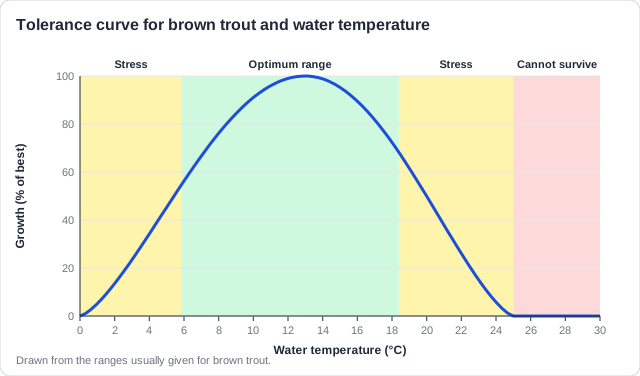
Real example: in hot, dry summers, parts of rivers in England and Scotland warm above 20 °C; brown trout move to cooler, shaded stretches or die, because warm water also holds less dissolved oxygen.
Get feedback like a real examiner
Submit your answers and get instant feedback — what you did well, what's missing, and exactly what to write to score full marks.
Measuring abiotic factors shows how conditions change across an area, and so why species are found where they are.
Measuring abiotic factors
- Use the right instrument for the factor (see the table).
- A data logger with a probe records readings automatically, at set times, for hours or days.
- Along a transect, take readings at regular intervals, such as every 10 m.
- Take readings at several sites or regular times to see any change.
- Repeat each reading and use the mean, so the results are reliable.
- Measure all sites in the same conditions, e.g. the same day and time.
| Abiotic factor | How to measure it |
|---|---|
| Temperature | Thermometer or temperature probe |
| Sunlight (light intensity) | Light meter or light sensor |
| pH | pH probe or meter (or indicator paper) |
| Salinity | Salinity or conductivity meter |
| Dissolved oxygen | Oxygen probe or meter |
| Soil texture | Sieves of different mesh sizes |
| Soil moisture | Soil moisture probe, or weigh soil before and after drying |
| Turbidity (cloudiness of water) | Secchi disc |
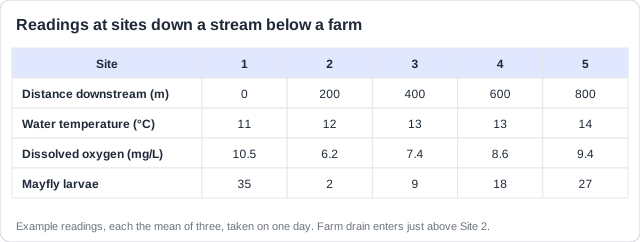
Reading it: where the farm drain enters, dissolved oxygen falls and mayfly larvae almost vanish; both recover downstream. A data logger left at Site 2 would show whether the oxygen drops at night too.
How this comes up: Paper 1: suggest how to measure an abiotic factor along a transect [3], or describe how to monitor one [2]. Also: identify the factor that limits growth, from a table [1].
A student is studying why plants change from the bottom of a valley to the top of a hill.
Suggest how the student might measure the changes in one abiotic factor along a transect up the hill.
Model answer plan
See the mark-by-mark plan — for / against / judgement, with marking guidance — in study mode.