Distribution at Higher Level: The same ideas as SL, with different places: the Serengeti, Mount Kinabalu and the spread of cane toads across Australia.
Practise this as you read
- Sort each factor on a figure into abiotic or biotic.
- Link each cause to more or fewer individuals.
Free preview
This is the free notes preview
You're reading the free notes. Aimnova Pro unlocks the full study experience — and you can try it with your first topic free to keep:
- FlashcardsLock in vocabulary and key terms with spaced repetition.
- Practice questionsAnswer exam-style questions and get instant AI marking.
- Mock exams & past-paper vaultSit full mocks and see exactly how examiners award marks.
- Personalised study planA daily plan built around your exam date and weak areas.
Two kinds of factor: The distribution of a population is decided by abiotic factors and biotic factors.
The points to remember
- Abiotic factors are the non-living, physical parts: temperature, sunlight, rainfall, pH, salinity, soil.
- Biotic factors are the living parts: food organisms, predators, competitors, parasites, disease.
- Biotic factors include interactions: predation, herbivory, competition, parasitism, mutualism, disease.
- Both kinds decide the distribution of a population: where it is found.
- To describe them: say what each kind is, then give an example from a named ecosystem.
Remember it as: A-biotic: 'a' means 'not', so not living. Biotic: living.
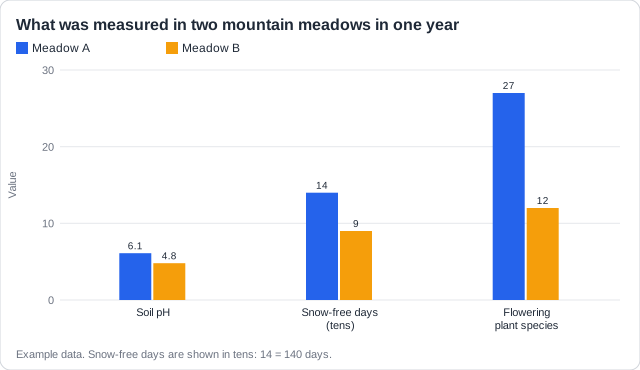
Real example: in the Serengeti, a savanna in Tanzania, the abiotic factors include the rainfall and the long dry season. The biotic factors include lions preying on wildebeest and zebra and wildebeest competing for grass.
Name the ecosystem: An answer with no named ecosystem cannot get full marks. A biome, such as 'tropical rainforest', counts as named.
Practice with real exam questions
Answer exam-style questions and get AI feedback that shows you exactly what examiners want to see in a full-marks response.
Abiotic factors often set the broad pattern of where each species can live.
The points to remember
- Abiotic factors often change steadily across an area: up a mountain, away from a river, inland from the sea.
- Each species lives where the conditions suit it, so vegetation changes in zones.
- To describe a relationship, pair each vegetation type with its condition: 'pine forest on thin, dry soil'.
- Use the figure's own words and numbers, such as altitudes.
Remember it as: Change the conditions, change the vegetation.
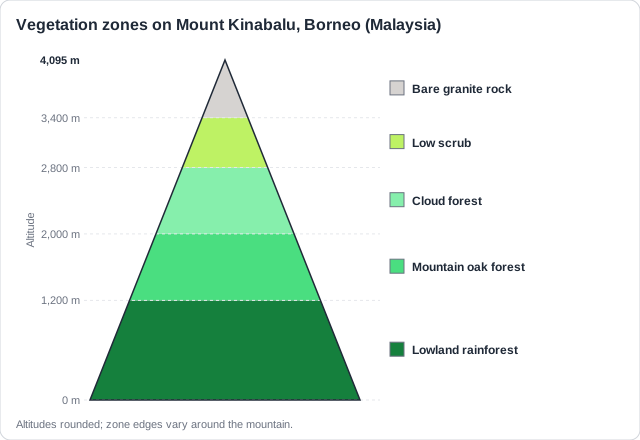
Real example: on Kinabalu the lowland rainforest stops at about 1,200 m, where it becomes cooler. Near the top, the soil is so thin over bare granite that only low scrub can grow.
A map or a plot shows a distribution. Name the pattern you see, in words that show where.
Words for a distribution pattern
- In patches (clumped): grouped together, often around a resource.
- Scattered (fragmented): small areas spread out, with gaps between them.
- Evenly spaced: about the same distance apart, often because they compete for space.
- Along a line: following a river, a coast or a road.
- In one part: say where, using the compass: 'most green space is on the edges of the city'.
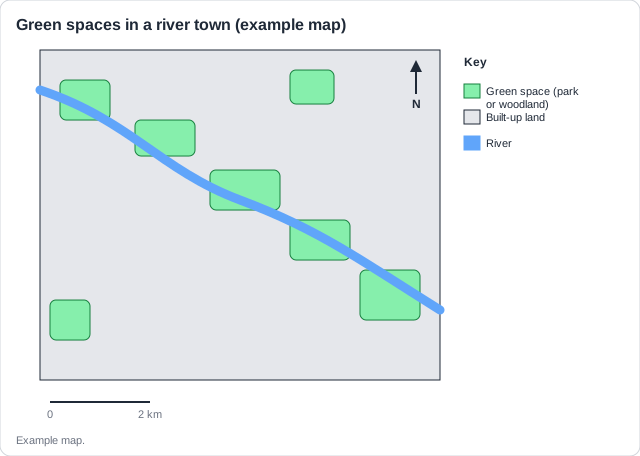
Reading it: the green spaces follow the river as a corridor across the town, with only two small, scattered ones elsewhere. A corridor lets wildlife move between the parks.
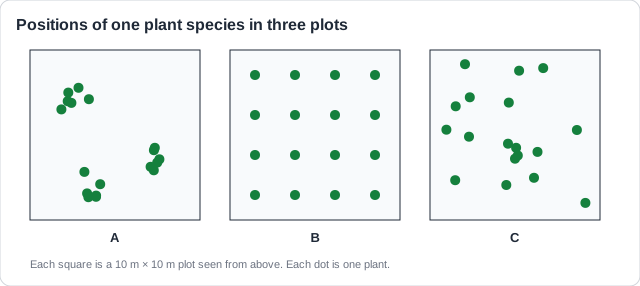
Say what the pattern is: 'Uneven' or 'found in the south' alone is not a pattern. Say how it is spread: 'along the river', 'on the edges'.
Feeling unprepared for exams?
Get a clear study plan, practice with real questions, and know exactly where you stand before exam day. No more guessing.
A common task: explain why one place has more of a species than another.
The points to remember
- Give a cause, then link it to more or fewer individuals.
- More food, water or shelter: more survive and breed, and more arrive.
- More predators, disease or competitors: more die, and fewer young survive.
- More human disturbance (housing, roads, noise): animals leave or die.
- The survey itself: animals that avoid traps or cameras are undercounted.
Remember it as: Cause, then 'so more survive' or 'so more die'.
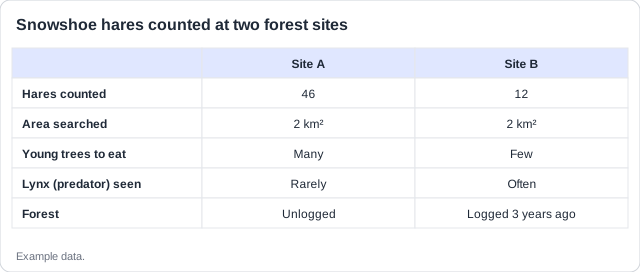
Reading it: Site A has more young trees, so hares have more food and more survive and breed. Site B has more lynx, so more hares are eaten.
Real example: Cane toads, brought to Australia in 1935, have spread across the warm north but not into the cold south: temperature, an abiotic factor, limits them. Few Australian predators can eat them safely, a biotic factor that helped them spread.
How this comes up: Paper 2, Section B (a): describe biotic and abiotic factors with reference to a named ecosystem [4]. Paper 1 and Section A: read a map, a table or a chart of two places.
A documentary compares life in the coldest and the hottest ecosystems on Earth.
Describe biotic and abiotic factors with reference to a named ecosystem.
Model answer plan
See the mark-by-mark plan — for / against / judgement, with marking guidance — in study mode.