Populations at Higher Level: The same definition as SL. This page follows one real recovery, the Iberian lynx, through its census numbers.
Practise this as you read
- Define a population with all four parts.
- Calculate a percentage change from census numbers.
Free preview
This is the free notes preview
You're reading the free notes. Aimnova Pro unlocks the full study experience — and you can try it with your first topic free to keep:
- FlashcardsLock in vocabulary and key terms with spaced repetition.
- Practice questionsAnswer exam-style questions and get instant AI marking.
- Mock exams & past-paper vaultSit full mocks and see exactly how examiners award marks.
- Personalised study planA daily plan built around your exam date and weak areas.
Same species, same place, same time: A population is a group of organisms of the same species, living in the same area at the same time, that can interbreed.
The points to remember
- The same species: only one kind of organism is counted.
- The same area: one place with a clear edge, such as one forest or one lake.
- The same time: counted over one period, such as one year.
- Capable of interbreeding: the individuals can meet and mate with each other.
- So a population is an interbreeding unit.
Remember it as: Same species, same place, same time, can breed together.
Real example: the Iberian lynx of the Doñana wetlands in southern Spain are one population: one species, in one protected area, counted each year, and able to meet and breed.
Give all four parts: A definition that leaves out the area or the time is not complete. Write all four parts.
Learn what examiners really want
See exactly what to write to score full marks. Our AI shows you model answers and the key phrases examiners look for.
A species is bigger than a population: it is every individual of that kind, wherever it lives.
The points to remember
- A species is every individual of that kind, wherever it lives.
- A population is the part of a species in one area at one time.
- One species may be one population or many.
- Two groups that are too far apart to meet and mate are two populations.
- Mixing two species (lions and zebras) gives a community, not a population.
Remember it as: Species = everywhere. Population = here and now.
Species
- Every individual, worldwide.
- Example: all the tigers on Earth.
Population
- One area, one time, can interbreed.
- Example: the tigers of one reserve in India.
Real example: the Iberian lynx is one species split into several populations, such as Doñana, the Sierra Morena mountains in Spain and the Guadiana valley in Portugal. Farmland and roads keep most of them apart, so each breeds mainly within itself.
Papers often give a graph of a population's numbers and ask you to calculate how much it changed.
Calculating a percentage change
- Read the starting and final numbers from the graph.
- Change = final number minus starting number.
- Percentage change = change ÷ starting number × 100.
- Give the answer with a % sign; a fall gives a negative answer.
- Numbers rise with births and arrivals; they fall with deaths and departures.
Remember it as: Change, divide by the start, times 100.
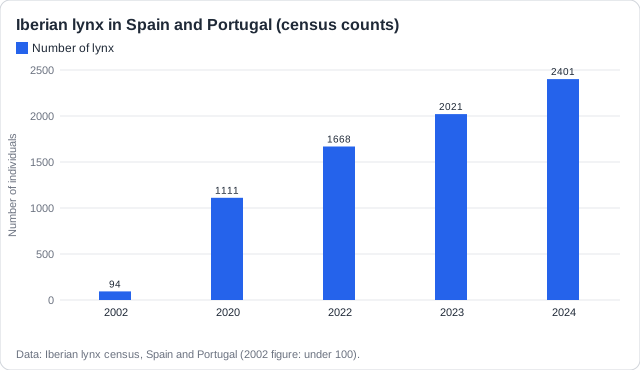
Worked example: from 2002 to 2023 the lynx rose from 94 to 2,021. The change is 2,021 − 94 = 1,927. Then 1,927 ÷ 94 × 100 = 2,050%: about 21 times as many lynx.
Divide by the starting number: Divide by the number you started with, not the final one, or the answer will be wrong.
Never wonder what to study next
Get a personalized daily plan based on your exam date, progress, and weak areas. We'll tell you exactly what to review each day.
You can investigate a population in a local ecosystem, such as your school grounds or a park.
Investigating a local population
- Choose one species that you can recognise.
- Mark out one area with a clear edge, such as a school field or a pond.
- Count at one time, and write down the date and how long you looked.
- If there are too many to count, estimate from samples (later pages show how).
- Record the conditions too, such as temperature, so results can be compared.
Remember it as: One species, one area, one time: then count.
Real example: in the City Nature Challenge, people in hundreds of cities photograph wild species over the same four days each spring and upload them to the iNaturalist app, so each city's results cover one area and one time.
How this comes up: Paper 1: a graph of a species' numbers; calculate the percentage increase between two years [1].
Figure 1 shows the number of Iberian lynx counted in Spain and Portugal between 2002 and 2024.
Calculate the percentage increase in the number of lynx between 2020 and 2024.
Model answer plan
See the mark-by-mark plan — for / against / judgement, with marking guidance — in study mode.