Sustainability as a natural property at Higher Level: The same ideas as SL, with the Wet Tropics of Australia and the Hubbard Brook forest, where the balance has been measured since 1963.
Practise this as you read
- Compare inputs and outputs on a flow diagram.
- Give evidence that ecosystems can last for millions of years.
Free preview
This is the free notes preview
You're reading the free notes. Aimnova Pro unlocks the full study experience — and you can try it with your first topic free to keep:
- FlashcardsLock in vocabulary and key terms with spaced repetition.
- Practice questionsAnswer exam-style questions and get instant AI marking.
- Mock exams & past-paper vaultSit full mocks and see exactly how examiners award marks.
- Personalised study planA daily plan built around your exam date and weak areas.
Nature does it without trying: Sustainability is a natural property of ecosystems: left alone, an ecosystem is sustainable.
The points to remember
- Left alone, most ecosystems are sustainable: they can keep going indefinitely.
- They run on sunlight, an energy input that does not run out.
- They recycle matter: nutrients go round and round, so nothing is used up.
- Their inputs balance their outputs, so their storages stay about the same.
- People try to copy this when they use resources sustainably (1.3).
Remember it as: Sunlight in, matter recycled, inputs = outputs: it can go on for ever.
Real example: the rainforests of Queensland's Wet Tropics have existed for more than 100 million years.
Stop wasting time on topics you know
Our AI identifies your weak areas and focuses your study time where it matters. No more overstudying easy topics.
Inputs balanced by outputs: A sustainable ecosystem is in a steady state: what comes in each year equals what goes out.
The points to remember: reading a flow diagram
- In a steady-state ecosystem, inputs are balanced by outputs.
- Flows keep going, but the storages stay about the same over the years.
- On a flow diagram: add up the inputs, add up the outputs, then compare.
- Equal: a steady state, so the ecosystem is sustainable.
- Outputs bigger than inputs: a storage is running down, which cannot last.
Remember it as: Add the ins, add the outs, compare.
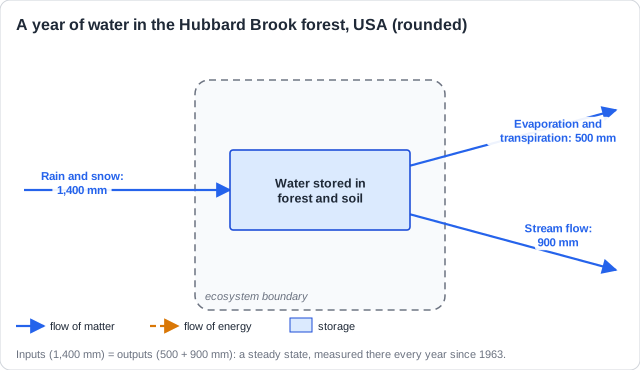
Real example: scientists have measured the rain in, and the stream water out, at Hubbard Brook since 1963. In undisturbed years the two balance.
How do we know some ecosystems really can last? The best evidence comes from tropical rainforests.
The points to remember: the evidence
- Fossils, such as pollen and leaves, show some tropical rainforests have lasted millions of years.
- They lasted through climate changes, fires and storms, recovering each time.
- Long-term measurements of undisturbed forests show inputs about equal to outputs.
The Wet Tropics: Fossil pollen shows the Wet Tropics rainforests have existed for more than 100 million years. Living plant families there first appeared when dinosaurs were alive.
So: cyclones, such as Yasi in 2011, flatten parts of the forest, but it grows back. Over millions of years, it has kept going.
See how examiners mark answers
Access past paper questions with model answers. Learn exactly what earns marks and what doesn't.
Why natural ecosystems keep going: Four things work together. Resilience, diversity and storages were met in 1.2.16 to 1.2.18.
The points to remember
- Energy: a steady supply of sunlight powers the producers.
- Matter: decomposers recycle nutrients, so nothing runs out.
- Negative feedback keeps populations in check (1.2.9).
- Diversity and large storages help it recover after a disturbance (1.2.17).
Remember it as: Sunlight, recycling, feedback, diversity.
Real example: in the Daintree, fungi and termites break down fallen wood, and the nutrients are taken up again by the trees before rain can wash them away.
People can break the natural balance by taking more out than comes in.
The points to remember: breaking the balance
- Humans can make outputs bigger than inputs: harvesting, clearing, overfishing.
- Then storages run down: soil nutrients, water, fish stocks.
- Pushed far enough, the ecosystem may pass a tipping point into a new state (2.1.22).
The Hubbard Brook experiment: In 1965-66 scientists cut down every tree in one small valley. Stream flow rose by about 40%, and the nitrate washed out rose more than 40 times: the nutrient storage began to run down.
Remember: a steady state is sustainable only while the inputs keep up with the outputs.
Study smarter, not longer
Most students waste 40% of study time on topics they already know. Our AI tracks your progress and optimizes every minute.
How this comes up: Paper 2, Section B (a) [4]: four linked points with a named example. Or a flow diagram in Section A.
A student claims that sustainability is a natural property of ecosystems.
Outline four pieces of evidence that support this claim.
Model answer plan
See the mark-by-mark plan — for / against / judgement, with marking guidance — in study mode.