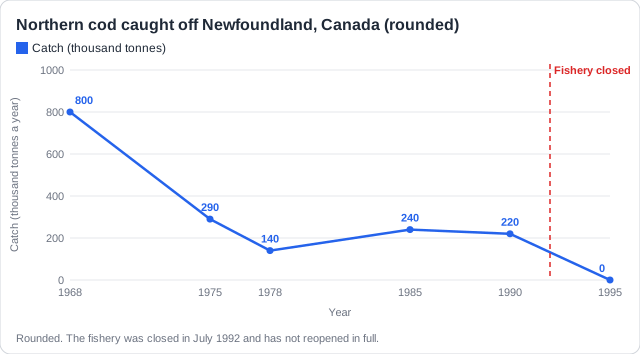
Human activity and tipping points at Higher Level: The same ideas as SL. HL's real case is the northern cod off Newfoundland, which collapsed in 1992 and has not come back.
Practise this as you read
- Trace the Amazon loop step by step.
- Explain why a tipped ecosystem is hard to restore.
Free preview
This is the free notes preview
You're reading the free notes. Aimnova Pro unlocks the full study experience — and you can try it with your first topic free to keep:
- FlashcardsLock in vocabulary and key terms with spaced repetition.
- Practice questionsAnswer exam-style questions and get instant AI marking.
- Mock exams & past-paper vaultSit full mocks and see exactly how examiners award marks.
- Personalised study planA daily plan built around your exam date and weak areas.
When an ecosystem tips: Human activity can push an ecosystem to a tipping point. The original ecosystem collapses and a new equilibrium develops.
The points to remember
- At a tipping point, a small extra change makes the ecosystem collapse.
- The original ecosystem is replaced by a new equilibrium: a different stable state.
- Human activity often pushes it there: clearing, overfishing, pollution, taking water.
- Past the tipping point, positive feedback takes over and change speeds up.
- Going back is hard: the new state holds itself in place.
Remember it as: Push, tip, collapse, new state, hard to undo.
Tipping points and feedback loops in any system were met in 1.2.11 and 1.2.12. Here they happen to whole ecosystems, because of people.
Collapse, then a new equilibrium: Say both halves: the old ecosystem collapses, and a different one takes its place and stays.
Feeling unprepared for exams?
Get a clear study plan, practice with real questions, and know exactly where you stand before exam day. No more guessing.
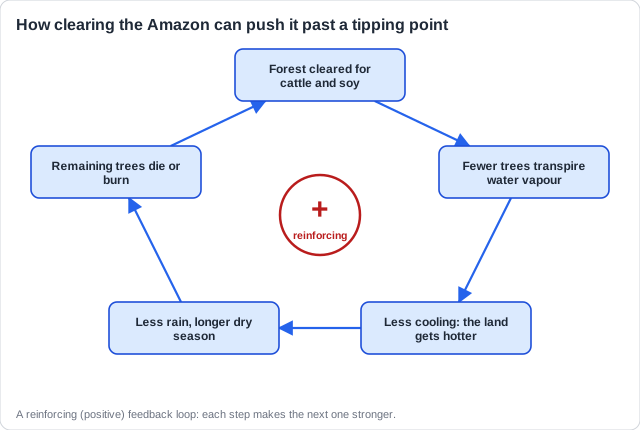
The Amazon rainforest: Amazon trees transpire, which cools the land and falls again as rain. The forest makes much of its own rain.
The points to remember: the Amazon loop
- Deforestation removes trees that transpire water vapour.
- Less water vapour means less cooling of the land and less rain.
- The remaining forest becomes hotter and drier, with a longer dry season.
- More trees die and burn, so even less vapour: a reinforcing loop.
- Past the tipping point, large areas could turn to savanna: the new equilibrium.
Real data: air samples show the heavily cleared south-east Amazon now gives off more carbon dioxide than it takes in, a sign that this part of the forest is losing its balance.
The northern cod: an ecosystem that tipped: For about 500 years, huge numbers of cod were caught off Newfoundland, Canada. Then factory trawlers came.
The points to remember: the northern cod
- Human activity: overfishing removed cod faster than they could breed.
- In 1992 the stock had fallen by about 99%; the fishery closed and about 30,000 people lost jobs.
- Cod were the top predator; without them, shrimp and snow crab increased.
- New equilibrium: thirty years on, cod have not fully recovered.
Hard to undo: the shrimp and crab, and the fish that eat young cod, now hold the new state in place.
Memorize terms 3x faster
Smart flashcards show you cards right before you forget them. Perfect for definitions and key concepts.
Some ecosystems resist being tipped far better than others. Resilience was met in 1.2.16 to 1.2.18.
The points to remember: more or less likely to tip
- More species diversity and complex food webs: more resilient.
- A keystone species present: more resilient.
- Large storages, plenty of nutrients, water or biomass: more resilient.
- A larger system and strong negative feedback: more resilient.
- A steady state, inputs balanced by outputs, as in a climax community: more resilient.
- Strong positive feedback or human damage to diversity and storages: less resilient.
- Already close to a tipping point: less resilient.
Say which way, and say 'large': Each factor needs its effect: more or less resilient. 'Storages' alone is not enough: say large or abundant storages.
Real example: overfishing took the cod, a top predator, out of the food web, so the ecosystem lost the negative feedback that had kept shrimp and crab in check.
How this comes up: Paper 2, Section B (a) [4]: four factors and their effect on resilience. Section B (c) [9]: tipping points and people.
Coral reefs around the world are under growing pressure from warming seas and overfishing.
Outline how four different factors influence the resilience of an ecosystem.
Model answer plan
See the mark-by-mark plan — for / against / judgement, with marking guidance — in study mode.