aimnova.
DashboardMy LearningPaper MasteryStudy Plan

Aimnova site navigation

Stay in the loop

Get the latest study resources and updates

New features, study tips and exam insights — straight to your inbox.

IB Diploma

  • IB Past Papers
  • IB Study Notes
  • IB Question Bank
  • IB Mock Exams
  • IB Revision

IB Subjects

  • IB Math AA
  • IB Math AI
  • IB Economics
  • IB Business Management
  • IB Physics
  • IB Biology
  • View all IB subjects→

IB Past Papers

  • IB Math AA HL Past Papers
  • IB Math AA SL Past Papers
  • IB Math AI HL Past Papers
  • IB Math AI SL Past Papers
  • IB Economics HL Past Papers
  • IB Economics SL Past Papers
  • IB ESS Past Papers
  • View all past papers→

Study Resources

  • Study Notes
  • Question Bank
  • Mock Exams
  • Flashcards
  • Revision Guide
  • Exam Skills
  • Command Terms
  • Grade Calculator
  • Exam Timetable 2026

Aimnova

  • Features
  • Pricing
  • For Teachers
  • For Schools
  • For Parents
  • About Us
  • Blog
  • Contact
aimnova.

AI-powered study platform for smarter revision, past-paper analysis and examiner-style feedback.

TermsPrivacyCookies·© 2026 Aimnova. All rights reserved.29b4255

Aimnova is not affiliated with or endorsed by the International Baccalaureate Organization (IB).

NotesESS HLTopic 2.1Ecosystems as open systems
Back to ESS HL Topics
2.1.205 min read

Ecosystems as open systems (ESS HL)

IB Environmental Systems and Societies • Unit 2

Smart study tools

Turn reading into results

Move beyond passive notes. Answer real exam questions, get AI feedback, and build the skills that earn top marks.

Get Started Free

Contents

  • Ecosystems as open systems at Higher Level
  • An ecosystem: a community and its surroundings
  • Energy and matter in and out
  • Neighbouring ecosystems are linked
  • Exam-style question
Ecosystems as open systems at Higher Level: The same ideas as SL, with Singapore's mangroves and forest and the Belize Barrier Reef.

Practise this as you read

  • Name the energy and matter that cross an ecosystem's boundary.
  • Outline how losing one ecosystem harms its neighbour.

Free preview

This is the free notes preview

You're reading the free notes. Aimnova Pro unlocks the full study experience — and you can try it with your first topic free to keep:

  • FlashcardsLock in vocabulary and key terms with spaced repetition.
  • Practice questionsAnswer exam-style questions and get instant AI marking.
  • Mock exams & past-paper vaultSit full mocks and see exactly how examiners award marks.
  • Personalised study planA daily plan built around your exam date and weak areas.
Start Studying Free Full access to Aimnova Pro · cancel anytime
A community and its surroundings: An ecosystem is a community and the physical environment with which it interacts.

The points to remember

  • An ecosystem is a community plus the physical environment it interacts with.
  • Living parts are biotic; non-living parts (soil, water, air, light, temperature) are abiotic.
  • Name a local ecosystem precisely: 'deciduous woodland', 'freshwater pond', 'salt marsh'.
  • Not enough: a broad group ('terrestrial', 'freshwater ecosystem') or just 'forest'.
  • Not an ecosystem: a biome ('taiga biome') is a much larger, worldwide group.
  • Ecosystems come in any size: a pond, a wood, a whole reef.
Remember it as: Community + surroundings = ecosystem. Name it exactly, never just 'forest'.

Precise enough

  • Temperate deciduous woodland
  • Freshwater pond
  • Salt marsh

Too broad

  • Forest
  • Terrestrial ecosystem
  • Taiga biome

Real example: Singapore holds a mangrove wetland at Sungei Buloh and tropical rainforest at Bukit Timah, only a few kilometres apart.

Memorize terms 3x faster

Smart flashcards show you cards right before you forget them. Perfect for definitions and key concepts.

Try Flashcards FreeYour first topic is free to keep • No credit card required

Open and closed systems were met in 1.2.5. Every real ecosystem is open.

The points to remember: open systems

  • Ecosystems are open systems: both energy and matter cross their boundary.
  • Energy enters as sunlight and leaves as heat.
  • Matter enters and leaves: water, nutrients and soil, gases, and living things.
  • Living things cross too: seeds blown in, animals migrating or wandering out.
  • We draw the boundary, so what counts as an input depends on where we draw it.
Remember it as: Sunlight in, heat out. Water, nutrients, gases and living things in and out.
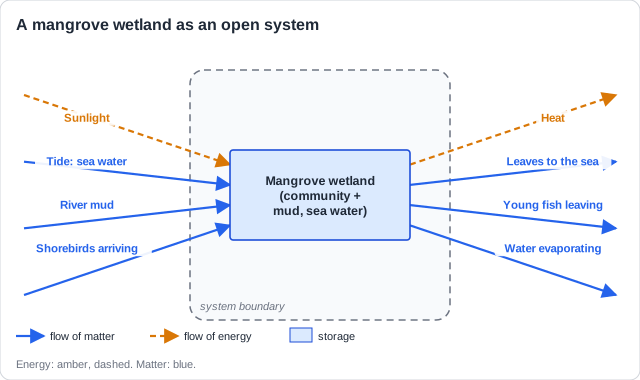
A mangrove wetland inside a dashed boundary. In: sunlight (energy), sea water on the tide, river mud, shorebirds arriving. Out: heat (energy), leaves to the sea, young fish leaving, water evaporating
Energy and matter both cross the boundary: an open system.

Real example: at Sungei Buloh, the tide floods the mangroves twice a day, and shorebirds from Siberia arrive to feed each year from about September to March.

Neighbours share their flows: Along warm coasts, mangroves, seagrass and coral reefs sit side by side and pass matter and energy between them.

The points to remember: when one ecosystem is lost

  • Open ecosystems are linked, so losing one affects its neighbours.
  • Less protection from storm waves and currents for the ecosystem behind it.
  • Fewer nursery and breeding grounds for species that move between them.
  • Less organic matter and nutrients passed on to the neighbour.
  • Cloudier water without filtering or trapping, so less light for photosynthesis.
  • Species move in, raising competition; fewer grazing fish can even mean more seagrass.
  • Fewer tourists, so less money to protect the neighbouring ecosystem.
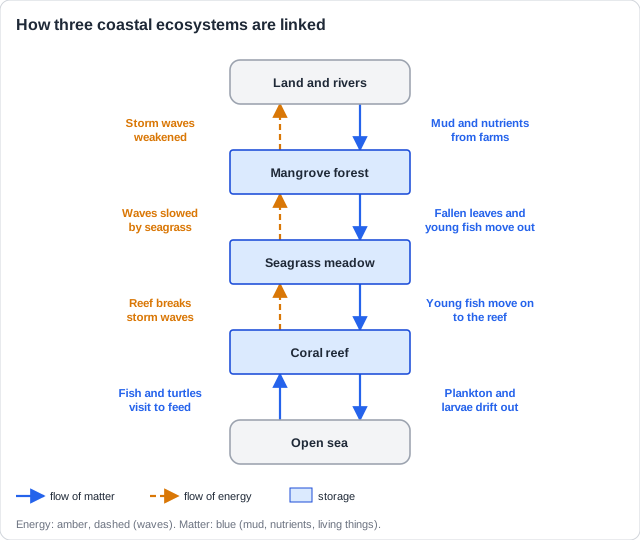
Diagram, top to bottom: land and rivers, mangrove forest, seagrass meadow, coral reef, open sea. Blue arrows downwards: mud and nutrients from farms; fallen leaves and young fish move out; young fish move on to the reef; plankton and larvae drift out. Amber dashed arrows upwards: reef breaks storm waves; waves slowed by seagrass; storm waves weakened. Blue arrow up from the sea: fish and turtles visit to feed
What passes between land, mangroves, seagrass, the reef and the open sea.
Say what happens to the neighbour: 'Biodiversity is lost' or 'the water is cloudier' alone is not enough: say how it harms the neighbouring ecosystem.

Real example: on the Belize Barrier Reef, mangrove cays and seagrass beds shelter young reef fish, so clearing mangroves for building also harms the reef.

Know your predicted grade

Take timed mock exams and get detailed feedback on every answer. See exactly where you're losing marks.

Try Mock Exams FreeYour first topic is free to keep • No credit card required
How this comes up: Paper 1 [1]: identify an ecosystem from a map. Paper 1 [2]: outline how losing one ecosystem affects its neighbour.
Diagram, top to bottom: land and rivers, mangrove forest, seagrass meadow, coral reef, open sea. Blue arrows downwards: mud and nutrients from farms; fallen leaves and young fish move out; young fish move on to the reef; plankton and larvae drift out. Amber dashed arrows upwards: reef breaks storm waves; waves slowed by seagrass; storm waves weakened. Blue arrow up from the sea: fish and turtles visit to feed
Figure 1: the links between the coastal ecosystems.
IB-style questionOutline[2 marks]

Figure 1 shows how mangroves, seagrass and a coral reef are linked along a tropical coast. Boat anchors and dredging have destroyed much of the seagrass.

With reference to Figure 1, outline how loss of the seagrass meadow could impact the mangrove forest.

Model answer plan

See the mark-by-mark plan — for / against / judgement, with marking guidance — in study mode.

Claim your free topic

Try an IB Exam Question — Free AI Feedback

Test yourself on Ecosystems as open systems. Write your answer and get instant AI feedback — just like a real IB examiner.

Scientists describe a lake as an open system.

the term open system.
[1 mark]

Related ESS HL Topics

Continue learning with these related topics from the same unit:

2.1.1The biosphere
2.1.2Organisms and species
2.1.3Classification
2.1.4Identification of organisms
View all ESS HL topics

Practice with flashcards

Spaced repetition flashcards for Ecosystems as open systems

Improve your exam technique

Command terms, paper structure, and mark-scheme tips for ESS HL

Previous
2.1.19Habitat
Next
Sustainability as a natural property of ecosystems2.1.21

15 questions to test your understanding

Reading is just the start. Students who tested themselves scored 82% on average — try IB-style questions with AI feedback.

Start FreeView All ESS HL Topics