Habitat at Higher Level: The same idea as SL. HL uses a species with only one habitat left, the axolotl, to show why habitats matter.
Practise this as you read
- Describe a habitat in four parts.
- Explain why losing a habitat threatens a species.
Free preview
This is the free notes preview
You're reading the free notes. Aimnova Pro unlocks the full study experience — and you can try it with your first topic free to keep:
- FlashcardsLock in vocabulary and key terms with spaced repetition.
- Practice questionsAnswer exam-style questions and get instant AI marking.
- Mock exams & past-paper vaultSit full mocks and see exactly how examiners award marks.
- Personalised study planA daily plan built around your exam date and weak areas.
Where a living thing lives: A habitat is the location in which a community, species, population or organism lives.
The points to remember
- A habitat is the location where a community, species, population or organism lives.
- Describe its geographical location: where on Earth (a country, an island, a lake).
- Describe its physical location: where exactly it lives there (a burrow, a canal bottom, a treetop).
- Name the type of ecosystem it needs (sea cliffs, freshwater wetland, cloud forest).
- Say the conditions that ecosystem must give it to survive: food, water, temperature, shelter.
Remember it as: Where on Earth, where exactly, which ecosystem, what it needs.
Write 'habitat', not 'home': 'Home' is not accepted as the scientific word. Use habitat, and say what it provides.
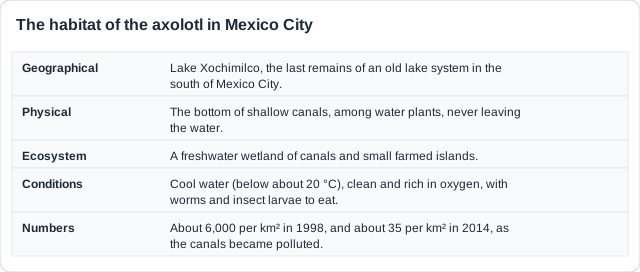
Real example: the axolotl lives wild only in Xochimilco's canals. As the canals were polluted, the number per km² fell from about 6,000 (1998) to 35 (2014).
Stop wasting time on topics you know
Our AI identifies your weak areas and focuses your study time where it matters. No more overstudying easy topics.
Habitat and niche are easy to mix up. Keep them apart with one question each.
Habitat or niche?
- Habitat = where a species lives.
- Niche = how it lives there: everything it needs and all its interactions (2.1.8).
- Many species can share one habitat; each species has its own niche.
Habitat
- Where it lives
- Can be shared by many species
Niche
- How it lives there
- Belongs to one species
Real example: axolotls, carp and water birds share Xochimilco's canals, but carp stir up the mud and eat axolotl eggs: same habitat, different niches.
Habitats in a local ecosystem: Even a small wood or shore contains many habitats, each with its own conditions and species.
The points to remember
- A local ecosystem holds many small habitats close together.
- Each small habitat has its own conditions: light, water, temperature, shelter.
- So each one holds different species, which you can find by searching it.
A local habitat: on a rocky shore, a rock pool stays wet at low tide, so anemones, crabs and small fish can live in it.
Try it: Pick one species near you and describe its habitat in four parts: where on Earth, where exactly, which ecosystem, what it needs.
See how examiners mark answers
Access past paper questions with model answers. Learn exactly what earns marks and what doesn't.
How this comes up: Paper 2, Section B (a) [4]: outline a habitat, four points for a named species. Or Paper 1 [1] or [2] from a fact file.
A conservation charity is raising money to protect rare amphibians.
Outline the habitat of a named species.
Model answer plan
See the mark-by-mark plan — for / against / judgement, with marking guidance — in study mode.