Sampling methods at Higher Level: The same methods as SL, with different real cases: the Great Elephant Census, the Iberian lynx and the River Thames.
Practise this as you read
- Choose a sampling method and say why it suits the habitat.
- Explain how each step makes the estimate reliable.
Free preview
This is the free notes preview
You're reading the free notes. Aimnova Pro unlocks the full study experience — and you can try it with your first topic free to keep:
- FlashcardsLock in vocabulary and key terms with spaced repetition.
- Practice questionsAnswer exam-style questions and get instant AI marking.
- Mock exams & past-paper vaultSit full mocks and see exactly how examiners award marks.
- Personalised study planA daily plan built around your exam date and weak areas.
Count a part, estimate the whole: Abundance is rarely counted in full. Ecologists count the organisms in samples and scale up.
The points to remember
- A full count (a census) works only for small, visible, slow-moving populations.
- Most animals are hard to count: they move, hide, are active at night or are camouflaged.
- Many live in remote or dense habitats, or range over huge areas.
- Some look like other species, so they are hard to identify.
- So we count a sample of the area and scale up to estimate the whole population.
Remember it as: Moves, hides, comes out at night, lives far away, looks like another: so we sample.
Real example: in the 2016 Great Elephant Census, aircraft surveyed savanna elephants across 18 African countries and estimated about 352 000: far too many, over too large an area, to count one by one.
Give a reason they are hard to find, see or identify: 'They are dangerous' or 'quadrats do not work for animals' does not explain why counting is hard.
Practice with real exam questions
Answer exam-style questions and get AI feedback that shows you exactly what examiners want to see in a full-marks response.
Where you put your samples matters as much as how many you take.
The three ways to place samples
- Random sampling: points chosen by random numbers on a grid, so there is no bias.
- Systematic sampling: samples at regular intervals, e.g. every 10 m, for quick, even coverage.
- Transect sampling: samples at regular points along a line across a habitat, to show change.
- Choose random when the habitat looks the same throughout.
- Choose a transect when conditions change across the habitat (a gradient).
- Choose systematic to cover a large area quickly; it can miss a pattern that repeats.
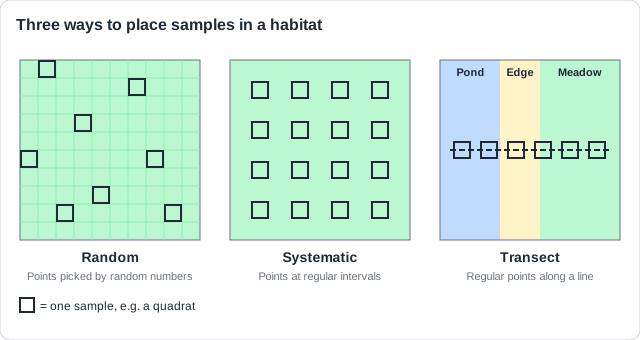
Remember it as: Random: fair. Systematic: regular. Transect: shows change.
Real example: in the Great Elephant Census, planes flew straight lines at regular spacing and counted the elephants in a strip on each side: systematic sampling, scaled up to the whole area.
An estimate is only as good as its samples: Reliable means you would get a similar answer if you did the survey again.
The points to remember
- Take many samples and repeat the survey: one sample may be unusual.
- Place samples at random (or regularly), never where it looks interesting: this avoids bias.
- Use the same method and effort each time, at the same time of day.
- Survey in different seasons, because numbers change through the year.
- Scale up: mean per sample × (total area ÷ area of one sample).
- Every sample is an estimate; only a total census is exact, and it is rarely possible.
Photograph
Take aerial photos of the whole area.
Grid
Place a grid over each photo.
Count
Count the animals in squares chosen at random.
Scale up
Multiply the mean per square by the number of squares.
Remember it as: Many, random, same method, every season.
Worked example: percentage change = (new − old) ÷ old × 100. Iberian lynx numbers rose from 94 in 2002 to 2401 in 2024: (2401 − 94) ÷ 94 × 100 = 2454%, a more than 25-fold rise.
Feeling unprepared for exams?
Get a clear study plan, practice with real questions, and know exactly where you stand before exam day. No more guessing.
Measuring a human impact: To measure the effect of pollution, sample both the living (biotic) and non-living (abiotic) parts, at several sites and times.
The points to remember
- Choose sites at increasing distance from the source, along a transect, plus a clean control site.
- Abiotic: probes for oxygen, pH, temperature and salinity; a Secchi disc for light.
- Biotic: kick samples or grabs; identify and count species with a key.
- Turn the counts into a biotic index or a diversity index, and count animals killed.
- Take several samples at each site, and repeat over time to see recovery.
Remember it as: Sites, control, abiotic probes, biotic samples, repeat.
Real example: in the River Thames, invertebrates are sampled at many sites to track the river's recovery from sewage pollution.
Plan both kinds: Only living, or only non-living, measurements is half a plan: give both.
How this comes up: Paper 1 or Section A: why a population is hard to count [1-2], how data were collected [2-3], a percentage change [1]. Section B: plan a field study [7] or judge how reliable sampling is [9].
About 500 cranes spend each winter in a wide valley.
Describe a method to estimate the number of cranes in the valley.
Model answer plan
See the mark-by-mark plan — for / against / judgement, with marking guidance — in study mode.