The circular economy at Higher Level: The same model as SL. At HL, add product stewardship, and see decoupling as ecological economics: most success so far is relative decoupling (less harm for each unit of growth), not absolute.
Practise this as you read
- Share responsibility: maker, seller and user.
- Link each decoupling idea to a real strategy.
Free preview
This is the free notes preview
You're reading the free notes. Aimnova Pro unlocks the full study experience — and you can try it with your first topic free to keep:
- FlashcardsLock in vocabulary and key terms with spaced repetition.
- Practice questionsAnswer exam-style questions and get instant AI marking.
- Mock exams & past-paper vaultSit full mocks and see exactly how examiners award marks.
- Personalised study planA daily plan built around your exam date and weak areas.
From a line to a loop: A linear economy runs in a line and ends in waste. A circular economy runs in a loop.
The points to remember
- Linear: take, make, waste. Materials are used once, then thrown away.
- Circular: products and materials are kept in use, then returned.
- It decouples economic activity from the use of finite resources, such as metals and oil.
- So the economy can do well while using fewer resources and causing less harm.
Remember it as: A line ends in the bin; a loop comes back.
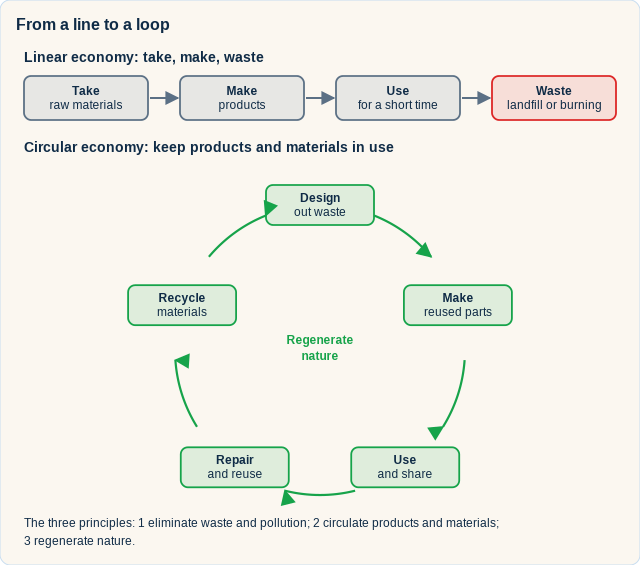
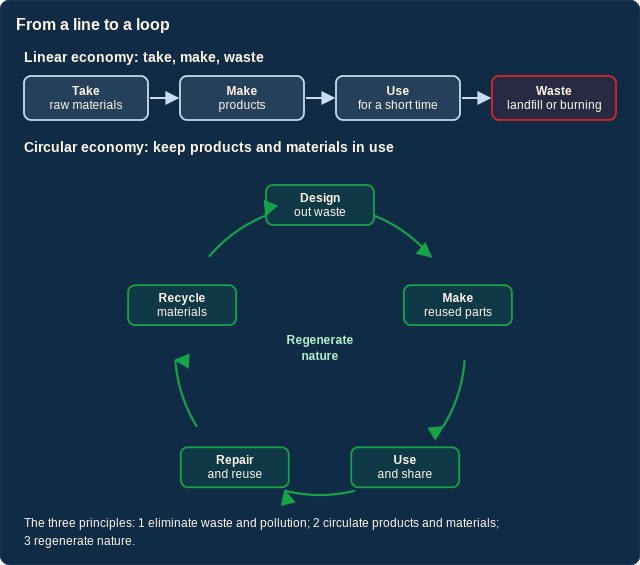
This is called eco-economic decoupling: the economy keeps working, but it is no longer tied to digging up more finite resources or to more pollution.
A real example: Patagonia's Worn Wear scheme repairs and resells used clothing, keeping it in use for longer.
See how examiners mark answers
Answer exam-style questions with model answers. Learn exactly what earns marks and what doesn't.
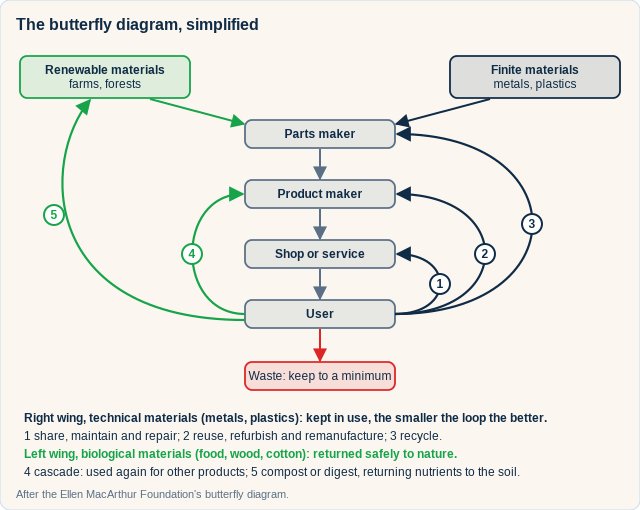
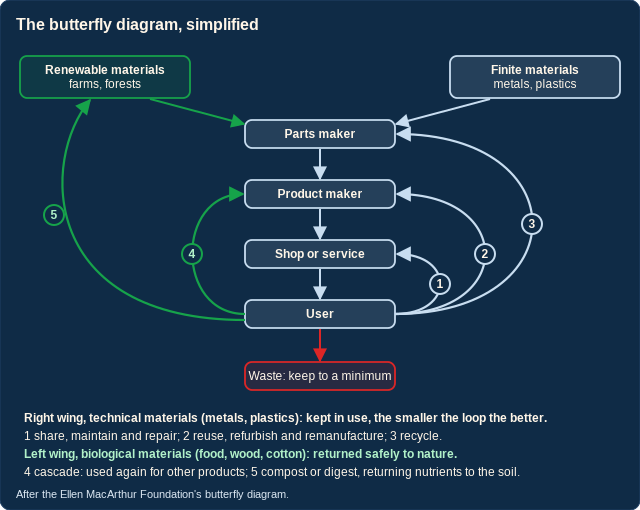
Three principles: The circular economy rests on three principles, shown in the butterfly diagram.
The points to remember
- Eliminate waste and pollution: design them out from the start.
- Circulate products and materials: share, repair, reuse, remanufacture, recycle.
- Regenerate nature: return nutrients to the soil and restore natural systems.
- The butterfly diagram shows the loops: technical materials on one wing, biological on the other.
- The smaller the loop, the better: repairing keeps more value than recycling.
Remember it as: Design out, keep in, give back.
Real example: Amsterdam aims to halve its use of new raw materials by 2030 and to be fully circular by 2050.
Like every model, the circular economy has uses and limitations.
The points to remember
- Use: it regenerates natural systems: compost returns nutrients to the soil.
- Use: it cuts greenhouse gas emissions: less mining, making and burning.
- Use: it improves local food networks and supports local communities.
- Use: less waste, because products last longer: a longer life cycle.
- Use: it changes consumer habits: repair, rent and share instead of buy and throw away.
- Limitation: little environmental awareness in consumers and companies; no regulations forcing recycling.
- Limitation: some waste cannot be recycled (technical limits), and there is a lack of finance.
Remember it as: Uses: nature, climate, local, longer life, new habits. Limits: awareness, rules, technology, money.
Real example: in 2024 the European Union agreed a right-to-repair law, so makers must offer repairs for some products: regulation can close one of the gaps.
Recycling is not automatically green: Recycling needs a market for recycled goods, and some recycling uses a lot of energy. Repair and reuse come first.
Study smarter, not longer
Most students waste 40% of study time on topics they already know. Our AI tracks your progress and optimizes every minute.
Who is responsible?: Product stewardship is how a circular economy shares out responsibility.
The points to remember
- Designers and makers: use fewer raw materials and more recycled ones.
- Sellers: take back old products and packaging for recycling.
- Users: reduce, reuse and recycle; choose local, low-impact products.
- It covers every stage of the life cycle: from raw materials to disposal (cradle to grave).
- Fines can enforce it, and it promotes a circular economy.
Remember it as: Maker, seller, user: cradle to grave.
Real example: under the European Union's rules on electrical waste, shops that sell new appliances must take back old ones for recycling.
A link to ecological economics: The circular economy and the doughnut (1.3.20) are both applications of ecological economics: an economy that fits within the planet's limits.
How this comes up: Paper 2, Section A: describe how eco-economic decoupling might help reduce an environmental problem [2].
Smog from coal-burning power stations is harming the health of a city's people.
Describe how the concept of eco-economic decoupling might help reduce the city's smog.
Model answer plan
See the answer broken into clear points, with guidance on how each point earns marks.