aımnova
DashboardMy LearningCrash CoursesStudy Plan

Aimnova site navigation

Stay in the loop

Get the latest study resources and updates

New features, study tips and exam insights — straight to your inbox.

IB Diploma

  • IB Past Papers
  • IB Study Notes
  • IB Question Bank
  • IB Mock Exams
  • IB Revision

IB Subjects

  • IB Math AA
  • IB Math AI
  • IB Economics
  • IB Business Management
  • IB Physics
  • IB Biology
  • View all IB subjects→

IB Past Papers

  • IB Math AA HL Past Papers
  • IB Math AA SL Past Papers
  • IB Math AI HL Past Papers
  • IB Math AI SL Past Papers
  • IB Economics HL Past Papers
  • IB Economics SL Past Papers
  • IB ESS Past Papers
  • View all past papers→

Study Resources

  • Study Notes
  • Question Bank
  • Mock Exams
  • Crash Courses
  • Flashcards
  • Revision Guide
  • Exam Skills
  • Command Terms
  • Grade Calculator
  • Exam Timetable 2027

Aimnova

  • Features
  • Pricing
  • For Teachers
  • For Schools
  • For Parents
  • About Us
  • Blog
  • Contact
aımnova

IB study, practice and feedback built around the real exam.

TermsPrivacyCookies·© 2026 Aimnova. All rights reserved.d9e1c61

Aimnova is not affiliated with or endorsed by the International Baccalaureate Organization (IB).

NotesESS HLTopic 1.3Ecosystem collapse
Back to ESS HL Topics
1.3.75 min read

Ecosystem collapse (ESS HL)

IB Environmental Systems and Societies · Unit 1

IB exam ready

Study like the top scorers do

Access a smart study planner, AI tutor, and exam vault — everything you need to hit your target grade.

Start Free

Contents

  1. 1Ecosystem collapse at Higher Level
  2. 2From overuse to collapse
  3. 3The Newfoundland cod
  4. 4What collapse does
  5. 5Exam-style question
Ecosystem collapse at Higher Level: The same example as SL, the Newfoundland cod. At HL, explain the collapse as a chain: overuse, positive feedback, a tipping point and a new stable state, and link it to the laws and economics of shared resources.

Practise this as you read

  • Explain each step of the chain with a detail from the cod.
  • Link the collapse to all three pillars.

Free preview

This is the free notes preview

You're reading the free notes. Aimnova Pro unlocks the full study experience — and you can try it with your first topic free to keep:

  • FlashcardsLock in vocabulary and key terms with spaced repetition.
  • Practice questionsAnswer exam-style questions and get instant AI marking.
  • Mock exams & past-paper vaultSit full mocks and see exactly how examiners award marks.
  • Personalised study planA daily plan built around your exam date and weak areas.
Start Studying Free Full access to Aimnova Pro · cancel anytime
Past the point of no return: When a resource is used faster than it is replaced, the ecosystem it belongs to can collapse.

The points to remember

  • Unsustainable use: taking a resource faster than it can regrow or be replaced.
  • The stock shrinks; fewer adults leave fewer young, so it shrinks faster (positive feedback).
  • Past a tipping point the ecosystem collapses: it does not recover, even when the use stops.
  • It may settle into a new stable state, with other species in charge.
  • A collapse harms all three pillars: nature, people and the economy.
Remember it as: Take more than regrows, and the stock falls past the point of no return.
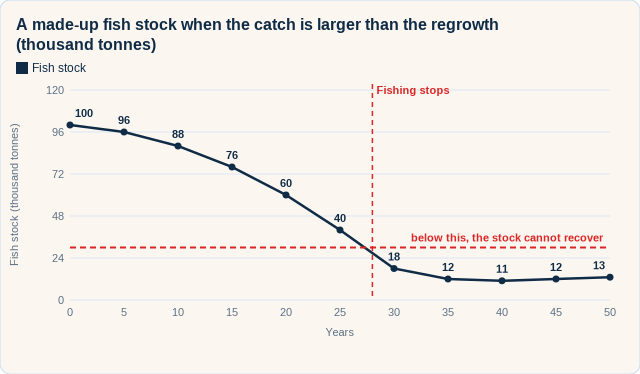
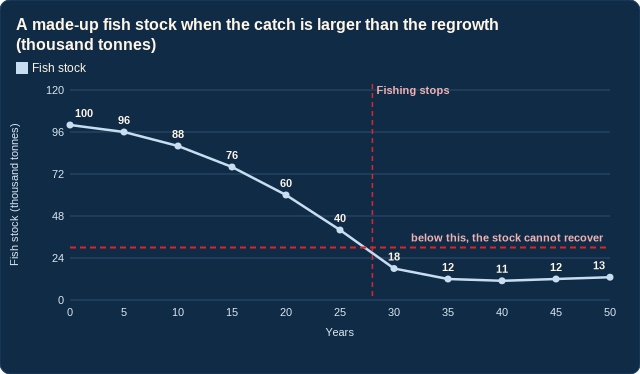
Line graph of a made-up fish stock falling from 100 to 18 thousand tonnes over 30 years, below a dashed line marking the level it cannot recover from; after fishing stops it stays near 12Line graph of a made-up fish stock falling from 100 to 18 thousand tonnes over 30 years, below a dashed line marking the level it cannot recover from; after fishing stops it stays near 12
Once the stock falls below the dashed line, stopping fishing is not enough.

Another example: Peru's anchovy fishery, once the largest in the world, collapsed in 1972 after years of heavy fishing, when a warm El Niño year hit the weakened stock.

See how examiners mark answers

Answer exam-style questions with model answers. Learn exactly what earns marks and what doesn't.

Try Exam Vault FreeYour first topic is free to keep • No credit card required

The best-known collapse is the cod fishery off Newfoundland, on Canada's Atlantic coast.

Why the cod collapsed

  • Factory trawlers (from the 1950s) caught far more cod than small boats ever had.
  • Bottom trawling dragged nets over the sea floor, damaging the cod's habitat.
  • Quotas were set too high, because scientists overestimated the stock.
  • Many young fish were caught before they could breed.
  • In 1992 Canada banned cod fishing; about 30 000 people lost their jobs.
Remember it as: Too many boats, too high quotas, too young fish.
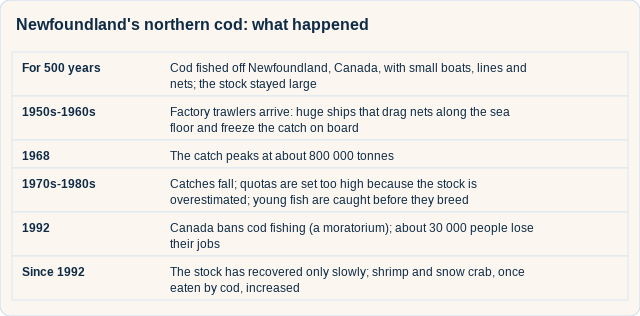
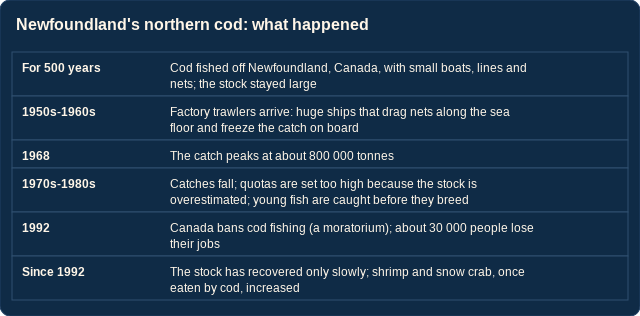
Timeline of Newfoundland's northern cod: 500 years of small-boat fishing, factory trawlers from the 1950s, a peak catch of about 800 000 tonnes in 1968, falling catches, the 1992 ban and a slow recoveryTimeline of Newfoundland's northern cod: 500 years of small-boat fishing, factory trawlers from the 1950s, a peak catch of about 800 000 tonnes in 1968, falling catches, the 1992 ban and a slow recovery
From the peak catch to the ban took less than 25 years.
A link to law and economics: The cod were a shared resource: each boat gained from catching more, while the cost of a smaller stock was shared by all. Quotas, a law, failed because they were set on a stock that was overestimated.
Harm that lasts: A collapse harms nature, people and the economy, and it can last for decades.

The points to remember

  • Environmental: the food web changed; prey such as shrimp and snow crab increased.
  • Social: fishing towns lost their way of life, and young people moved away.
  • Economic: boats and fish plants closed; the government paid income support.
  • Slow recovery: too few adults to breed, and a changed food web.
  • The lesson: catch no more than regrows, and manage for the long term.

Environmental

  • Cod almost gone; shrimp and snow crab, once eaten by cod, increased.

Social

  • About 30 000 jobs lost; families left their fishing towns.

Economic

  • Boats and fish plants closed; the government paid income support.
Name it and give details: A named example with details scores; a general answer does not. For the cod: factory trawlers, overestimated stock, the 1992 ban, a changed food web.

Study smarter, not longer

Most students waste 40% of study time on topics they already know. Our AI tracks your progress and optimizes every minute.

Try Smart Study FreeYour first topic is free to keep • No credit card required
How this comes up: Paper 2, Section B (b): with reference to a named example, explain [7]. Details of a real case earn the marks.
IB-style questionExplain[7 marks]

Some ecosystems have collapsed because people used their resources too heavily.

With reference to a named example, explain how the unsustainable use of a natural resource can lead to the collapse of an ecosystem.

Model answer plan

See the answer broken into clear points, with guidance on how each point earns marks.

Claim your free topic

IB Exam Questions on Ecosystem collapse

Practice with IB-style questions filtered to Topic 1.3.7. Get instant AI feedback on every answer.

Practice Topic 1.3.7 QuestionsBrowse All ESS HL Topics

How Ecosystem collapse Appears in IB Exams

Examiners use specific command terms when asking about this topic. Here's what to expect:

  • Define

    Say exactly what the key terms in Ecosystem collapse mean.

    AO1
  • Describe

    Say what the processes or features in Ecosystem collapse are like, with the details that matter.

    AO2
  • Explain

    Give reasons WHY — cause and effect within Ecosystem collapse.

    AO3
  • Evaluate

    Weigh strengths AND limitations of approaches in Ecosystem collapse.

    AO3
  • Discuss

    Present arguments FOR and AGAINST with a balanced conclusion.

    AO3

See the full IB Command Terms guide

Related ESS HL Topics

Continue learning with these related topics from the same unit:

1.1.1Perspectives1.1.2What shapes a perspective1.1.3Values1.1.4Where values show
View all ESS HL topics
Practice with flashcardsSpaced repetition flashcards for Ecosystem collapseImprove your exam techniqueCommand terms, paper structure, and mark-scheme tips for ESS HL
Previous1.3.6Sustainable developmentNextGDP and Green GDP1.3.8

3 exam-style questions ready for you

Students who practice on Aimnova improve their scores by 15% on average. Get instant feedback that shows exactly how to improve your answers.

Practice Now — FreeView All ESS HL Topics