aımnova
DashboardMy LearningCrash CoursesStudy Plan

Aimnova site navigation

Stay in the loop

Get the latest study resources and updates

New features, study tips and exam insights — straight to your inbox.

IB Diploma

  • IB Past Papers
  • IB Study Notes
  • IB Question Bank
  • IB Mock Exams
  • IB Revision

IB Subjects

  • IB Math AA
  • IB Math AI
  • IB Economics
  • IB Business Management
  • IB Physics
  • IB Biology
  • View all IB subjects→

IB Past Papers

  • IB Math AA HL Past Papers
  • IB Math AA SL Past Papers
  • IB Math AI HL Past Papers
  • IB Math AI SL Past Papers
  • IB Economics HL Past Papers
  • IB Economics SL Past Papers
  • IB ESS Past Papers
  • View all past papers→

Study Resources

  • Study Notes
  • Question Bank
  • Mock Exams
  • Crash Courses
  • Flashcards
  • Revision Guide
  • Exam Skills
  • Command Terms
  • Grade Calculator
  • Exam Timetable 2027

Aimnova

  • Features
  • Pricing
  • For Teachers
  • For Schools
  • For Parents
  • About Us
  • Blog
  • Contact
aımnova

IB study, practice and feedback built around the real exam.

TermsPrivacyCookies·© 2026 Aimnova. All rights reserved.d9e1c61

Aimnova is not affiliated with or endorsed by the International Baccalaureate Organization (IB).

NotesESS HLTopic 1.3GDP and Green GDP
Back to ESS HL Topics
1.3.86 min read

GDP and Green GDP (ESS HL)

IB Environmental Systems and Societies · Unit 1

Smart study tools

Turn reading into results

Move beyond passive notes. Answer exam-style questions, get AI feedback, and build the skills that earn top marks.

Get Started Free

Contents

  1. 1GDP and Green GDP at Higher Level
  2. 2What GDP measures
  3. 3What GDP leaves out
  4. 4Green GDP
  5. 5Measuring happiness instead
  6. 6Exam-style question
GDP and Green GDP at Higher Level: The same measures as SL. At HL, weigh GDP, Green GDP and a happiness index as tools of environmental economics: what each values, and what each leaves out.

Practise this as you read

  • Explain why GDP neglects the value of nature.
  • Discuss a happiness index in place of GDP: for, against, judgement.

Free preview

This is the free notes preview

You're reading the free notes. Aimnova Pro unlocks the full study experience — and you can try it with your first topic free to keep:

  • FlashcardsLock in vocabulary and key terms with spaced repetition.
  • Practice questionsAnswer exam-style questions and get instant AI marking.
  • Mock exams & past-paper vaultSit full mocks and see exactly how examiners award marks.
  • Personalised study planA daily plan built around your exam date and weak areas.
Start Studying Free Full access to Aimnova Pro · cancel anytime
The usual scoreboard: GDP is the most common measure of how a country's economy is developing.

The points to remember

  • GDP = the money value of all final goods and services produced and sold in a country in a period.
  • GDP per person = GDP divided by the population.
  • A rising GDP is usually taken as economic progress.
  • Average annual increase from a graph = the % increase divided by the number of years.
  • GDP counts only what is bought and sold.
Remember it as: GDP counts the money, not the forest.

In Ireland: GDP jumped by about 26% in 2015, mostly because large foreign companies moved their assets there, not because people produced much more. GDP can mislead.

Reading growth from a graph: An index of 100 in 2000 and 340 in 2020 is a 240% increase. Divide by 20 years: about 12% a year. Always give the unit, %.

Never wonder what to study next

Get a personalized daily plan based on your exam date, progress, and weak areas. We'll tell you exactly what to review each day.

Try Free Study PlanYour first topic is free to keep • No credit card required
What the scoreboard misses: GDP neglects the value of natural systems, so chasing GDP growth can lead to unsustainable development.

The points to remember

  • Nature's services are free, so GDP gives them no value: clean air, pollination, flood protection.
  • Using up a resource adds to GDP; the natural capital lost is never subtracted.
  • Money spent cleaning up pollution or disasters adds to GDP.
  • GDP ignores inequality, health and well-being.
  • So focusing on GDP growth can cause unsustainable development.
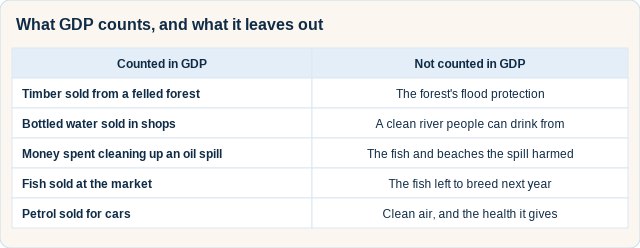
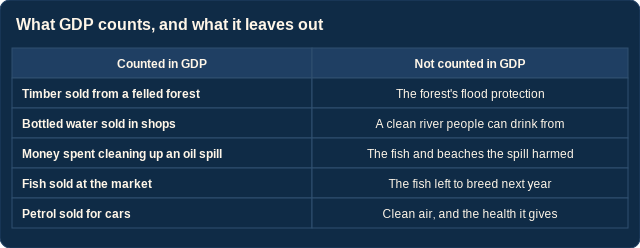
Table: timber, bottled water, oil-spill clean-up, fish and petrol are counted in GDP; flood protection, a clean river, the harmed fish and beaches, the fish left to breed and clean air are notTable: timber, bottled water, oil-spill clean-up, fish and petrol are counted in GDP; flood protection, a clean river, the harmed fish and beaches, the fish left to breed and clean air are not
Everything on the right has value, but GDP gives it none.

Real case: after the Deepwater Horizon oil spill in the Gulf of Mexico (2010), the billions spent on the clean-up counted towards GDP, while the lost fish and damaged coast did not.

GDP, minus the damage: Green GDP measures environmental costs and subtracts them from GDP.

The points to remember

  • Green GDP = GDP minus environmental costs.
  • The costs subtracted: resources used up and pollution damage.
  • If Green GDP grows slower than GDP, growth is running nature down.
  • Strength: it shows the hidden cost of growth.
  • Limit: giving nature a money value is hard and often disputed.
Remember it as: Green GDP = GDP minus the damage.
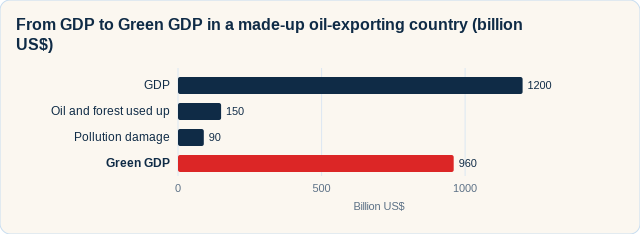
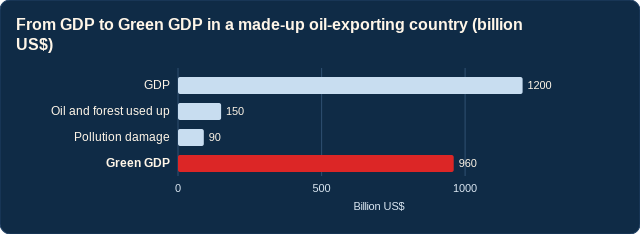
Bar chart for a made-up oil-exporting country: GDP 1200 billion US dollars, minus 150 for oil and forest used up and 90 for pollution damage, gives a Green GDP of 960Bar chart for a made-up oil-exporting country: GDP 1200 billion US dollars, minus 150 for oil and forest used up and 90 for pollution damage, gives a Green GDP of 960
1200 - 150 - 90 = 960: a fifth of GDP was paid for by nature.

Real case: China's first Green GDP report (2006) put the cost of its pollution at about 3% of GDP. The project was then dropped, partly because regions did not want their growth to look smaller.

Stop wasting time on topics you know

Our AI identifies your weak areas and focuses your study time where it matters. No more overstudying easy topics.

Try Smart Study FreeYour first topic is free to keep • No credit card required
Measuring happiness instead: Some countries measure progress by people's well-being, not only by money.

The points to remember

  • Bhutan uses Gross National Happiness (GNH), not GDP, to guide its development.
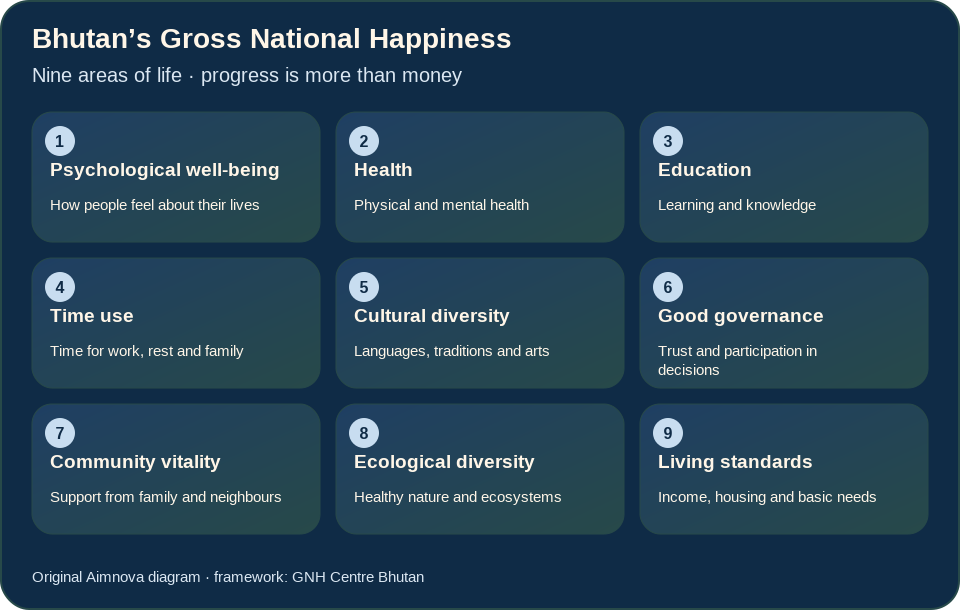
  • GNH is measured in nine domains, from health and education to ecological diversity.
  • For: it values environment, society and economy together, raising living standards without using up what future generations need.
  • For: it fits the SDGs, planetary boundaries and doughnut economics, and involves communities.
  • Against: seven of the nine domains are social, so nature and the economy count for less.
  • Against: many domains are personal feelings, hard to measure, and nine are hard to balance.
  • Against: values change with globalisation, and growth is still needed to raise living standards.
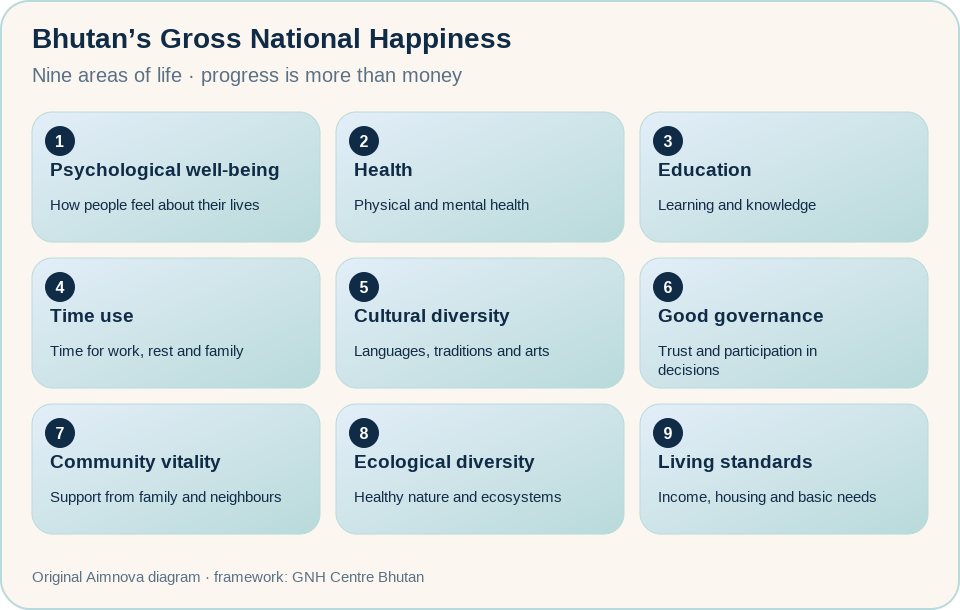
Nine cards showing the areas of life assessed by Bhutan’s Gross National Happiness framework.Nine cards showing the areas of life assessed by Bhutan’s Gross National Happiness framework.
Original Aimnova diagram. Framework source: GNH Centre Bhutan — gnhcentrebhutan.org/the-9-domains-of-gnh/

In New Zealand: the 2019 'Wellbeing Budget' set spending by measures of well-being, such as mental health and child poverty, not only by growth.

Three words to know: The SDGs; planetary boundaries; doughnut economics.
How this comes up: Paper 1: discuss an index such as GNH in place of GDP to promote sustainable development [6].
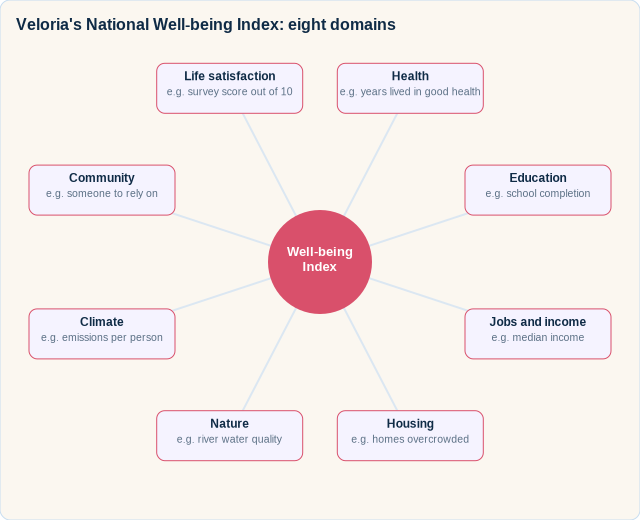
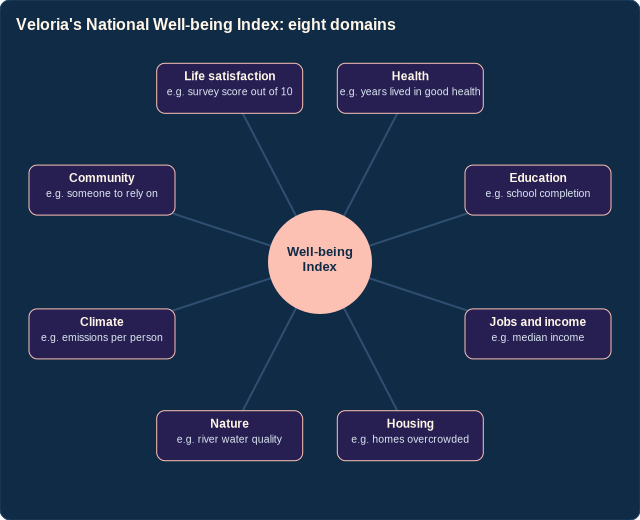
Diagram of Veloria's National Well-being Index linked to eight domains: health, education, jobs and income, housing, nature, climate, community and life satisfactionDiagram of Veloria's National Well-being Index linked to eight domains: health, education, jobs and income, housing, nature, climate, community and life satisfaction
Figure 1

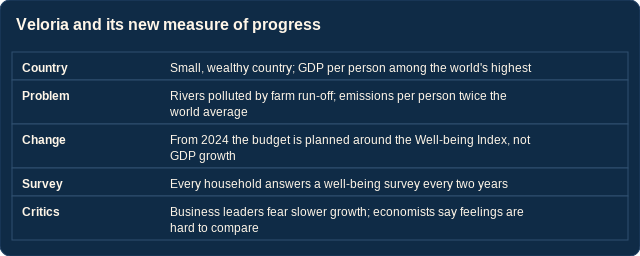
Figure 2 gives the facts about the country.
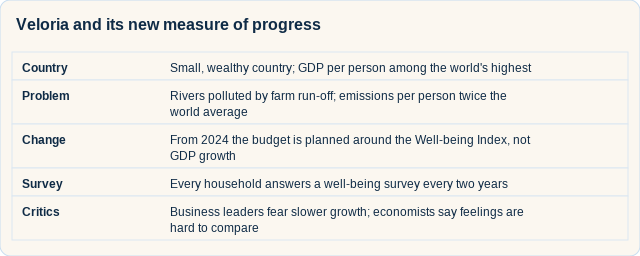
Fact file on Veloria: a small wealthy country with polluted rivers and high emissions, planning its budget around a Well-being Index from 2024, with criticsFact file on Veloria: a small wealthy country with polluted rivers and high emissions, planning its budget around a Well-being Index from 2024, with critics
Figure 2
IB-style questionDiscuss[6 marks]

Figure 1 shows the eight domains of Veloria's National Well-being Index. Figure 2 gives information about Veloria.

Discuss the use of the National Well-being Index in place of GDP as a tool to promote sustainable development in Veloria.

Model answer plan

See the answer broken into clear points, with guidance on how each point earns marks.

Claim your free topic

Try an IB Exam Question — Free AI Feedback

Test yourself on GDP and Green GDP. Write your answer and get instant AI feedback — just like a real IB examiner.

A government reports that GDP per person grew by 6% last year and calls this proof of sustainable development.

two limitations of using GDP per person as a measure of sustainable development.
[2 marks]

Related ESS HL Topics

Continue learning with these related topics from the same unit:

1.1.1Perspectives1.1.2What shapes a perspective1.1.3Values1.1.4Where values show
View all ESS HL topics
Practice with flashcardsSpaced repetition flashcards for GDP and Green GDPImprove your exam techniqueCommand terms, paper structure, and mark-scheme tips for ESS HL
Previous1.3.7Ecosystem collapseNextEnvironmental justice1.3.9

8 exam-style questions ready for you

Students who practice on Aimnova improve their scores by 15% on average. Get instant feedback that shows exactly how to improve your answers.

Practice Now — FreeView All ESS HL Topics