Frameworks and models at Higher Level: The same ideas as SL. At HL, ask whose values each model carries, and which choices it hides.
Practise this as you read
- Link each use or limitation to the model shown.
- Judge how useful a model is, not just list points.
Free preview
This is the free notes preview
You're reading the free notes. Aimnova Pro unlocks the full study experience — and you can try it with your first topic free to keep:
- FlashcardsLock in vocabulary and key terms with spaced repetition.
- Practice questionsAnswer exam-style questions and get instant AI marking.
- Mock exams & past-paper vaultSit full mocks and see exactly how examiners award marks.
- Personalised study planA daily plan built around your exam date and weak areas.
Tools for thinking: Frameworks and models help us understand sustainability. Each one is a simplified version of reality.
The points to remember
- A model is a simplified version of reality: a diagram, a graph, a number or a computer program.
- A framework is a set of goals or principles that guides what people do.
- There is a range of them for sustainability; each shows a different part.
- Because every model is simplified, each has uses and limitations.
| Model or framework | What it shows | Page |
|---|---|---|
| Strong and weak models | How the three pillars fit together | 1.3.2 |
| Ecological, carbon and water footprints | How much of the Earth a population uses | 1.3.13-1.3.15 |
| Sustainable Development Goals (SDGs) | 17 goals for people and the planet | 1.3.18 |
| Planetary boundaries | Nine limits of Earth systems we should not cross | 1.3.19 |
| Doughnut economics | Meet everyone's needs within the planet's limits | 1.3.20 |
| Circular economy | Keep materials in use; design out waste | 1.3.21 |
Real example: in 2020, Amsterdam became one of the first cities to use the doughnut model to plan its future: meeting every resident's needs without using more than the planet can provide.
Remember it as: Every model is a map, not the land.
Know your predicted grade
Take timed mock exams and get detailed feedback on every answer. See exactly where you're losing marks.
Why use a model at all? Because the real world is too complex to take in at once.
What models are good for
- Simplify a complex system so people can understand it.
- Communicate: one picture or number reaches the public and decision-makers.
- Compare places, and track change over time.
- Set targets and give common ground for policies.
- Show limits and warn of danger before it happens.
- Work at many scales: a school, a city, a country, the planet.
For example: the planetary boundaries model sets science-based limits, and alerts the public and governments that more than climate is at risk.
Say what it is used for: Name the use, then link it to the model: 'it is simple, so the public understand it' earns more than 'it is useful'.
Simplifying is a model's strength and its weakness.
Where models fall short
- Oversimplified: they leave out detail, so they can mislead.
- Built on assumptions and data that may be missing or uncertain.
- A global model may not fit local places; some are top-down.
- They reflect the values of whoever made them.
- Many give broad principles, not specific policies; many are a work in progress.
- So use several models together, and check what each leaves out.
For example: the SDGs were agreed by governments, so they can be top-down and may ignore local needs; for some goals, many countries lack the data to check progress.
A model is not reality: A model shows what its makers chose to include. Always ask: what does it leave out, at what scale, and who made it?
Get feedback like a real examiner
Submit your answers and get instant feedback — what you did well, what's missing, and exactly what to write to score full marks.
How this comes up: Paper 1: a model or framework is shown; state one use and one limitation [2]. Paper 2 asks you to evaluate a model [4] or discuss how useful models are [9].
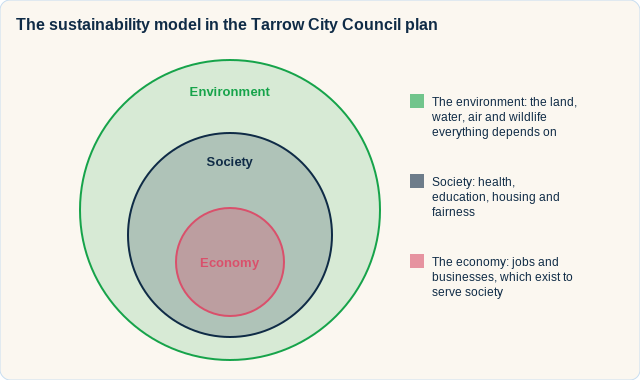
Figure 1 shows the sustainability model used in the Tarrow City Council plan.
State one use and one limitation of this model.
Model answer plan
See the answer broken into clear points, with guidance on how each point earns marks.
The longer questions
- Evaluate a model [4]: two uses, two limitations, then a one-line judgement.
- How useful are models? [9]: name several models, weigh uses against limits, then conclude.