aimnova.
DashboardMy LearningPaper MasteryStudy Plan

Aimnova site navigation

Stay in the loop

Get the latest study resources and updates

New features, study tips and exam insights — straight to your inbox.

IB Diploma

  • IB Past Papers
  • IB Study Notes
  • IB Question Bank
  • IB Mock Exams
  • IB Revision

IB Subjects

  • IB Math AA
  • IB Math AI
  • IB Economics
  • IB Business Management
  • IB Physics
  • IB Biology
  • View all IB subjects→

IB Past Papers

  • IB Math AA HL Past Papers
  • IB Math AA SL Past Papers
  • IB Math AI HL Past Papers
  • IB Math AI SL Past Papers
  • IB Economics HL Past Papers
  • IB Economics SL Past Papers
  • IB ESS Past Papers
  • View all past papers→

Study Resources

  • Study Notes
  • Question Bank
  • Mock Exams
  • Flashcards
  • Revision Guide
  • Exam Skills
  • Command Terms
  • Grade Calculator
  • Exam Timetable 2026

Aimnova

  • Features
  • Pricing
  • For Teachers
  • For Schools
  • For Parents
  • About Us
  • Blog
  • Contact
aimnova.

AI-powered study platform for smarter revision, past-paper analysis and examiner-style feedback.

TermsPrivacyCookies·© 2026 Aimnova. All rights reserved.880cc0a

Aimnova is not affiliated with or endorsed by the International Baccalaureate Organization (IB).

NotesESS HLTopic 1.3UN Sustainable Development Goals
Back to ESS HL Topics
1.3.184 min read

UN Sustainable Development Goals (ESS HL)

IB Environmental Systems and Societies • Unit 1

Smart study tools

Turn reading into results

Move beyond passive notes. Answer real exam questions, get AI feedback, and build the skills that earn top marks.

Get Started Free

Contents

  • The SDGs at Higher Level
  • The SDGs and the SDG model
  • Uses and limitations of the SDGs
  • Exam-style question
The SDGs at Higher Level: The same 17 goals as SL. At HL, link them to environmental justice and to the HL lenses: law, economics and ethics.

Practise this as you read

  • Link each piece of evidence to the goal's own words.
  • Weigh the uses of the SDGs against their limitations.

Free preview

This is the free notes preview

You're reading the free notes. Aimnova Pro unlocks the full study experience — and you can try it with your first topic free to keep:

  • FlashcardsLock in vocabulary and key terms with spaced repetition.
  • Practice questionsAnswer exam-style questions and get instant AI marking.
  • Mock exams & past-paper vaultSit full mocks and see exactly how examiners award marks.
  • Personalised study planA daily plan built around your exam date and weak areas.
Start Studying Free Full access to Aimnova Pro · cancel anytime
One to-do list for the world: The SDGs are social and environmental goals and targets. They guide action on sustainability and environmental justice.

The points to remember

  • 17 goals, agreed by all UN member countries in 2015, to reach by 2030.
  • Each goal has targets; indicators measure progress towards each target.
  • They are social and environmental goals: poverty, inequality, climate, nature, prosperity, peace and justice.
  • They apply to every country, rich and poor.
  • They guide action on sustainability and environmental justice.
Remember it as: 17 goals, 169 targets, one deadline: 2030.

A target says what to reach; an indicator shows how far a country has got.
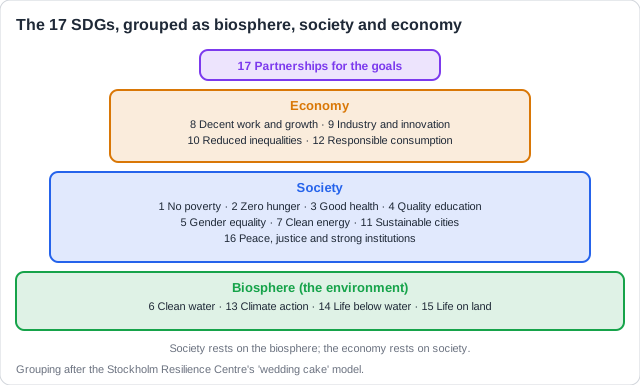
The 17 SDGs in three layers: biosphere goals 6, 13, 14 and 15 at the base; society goals 1 to 5, 7, 11 and 16 in the middle; economy goals 8, 9, 10 and 12 on top; goal 17, partnerships, above them all
The SDG model: society rests on the biosphere, and the economy rests on society.

Real example, SDG 6 (Clean water and sanitation): India's Clean India mission built more than 100 million household toilets between 2014 and 2019.

Never wonder what to study next

Get a personalized daily plan based on your exam date, progress, and weak areas. We'll tell you exactly what to review each day.

Try Free Study PlanYour first topic is free to keep • No credit card required

The SDGs are a model: a simplified plan for a complex world. So they have uses and limitations.

The points to remember

  • Use: a common ground for policymaking: every government works to the same goals.
  • Use: they relate to both developed and developing countries, not only poorer ones.
  • Use: they galvanise the world into tackling economic and social inequality.
  • Limitation: the goals do not go far enough: SDG 8 still aims for economic growth.
  • Limitation: top down and bureaucratic: set by governments, with little say for local people.
  • Limitation: they tend to ignore local contexts: one target does not fit every country.
  • Limitation: lacking in supportive data: many countries cannot measure their indicators.
Remember it as: Uses: same goals, every country, a fairer world. Limits: too little, top down, one size, no data.

Real example: many low-income countries lack the surveys to report their indicators, so gaps in the data hide where progress is slowest.

Goals can pull against each other: Faster growth (SDG 8) can mean more emissions (SDG 13). Say which goal gains and which loses.
How this comes up: Paper 1: a fact file on a place and the words of one SDG. Outline the evidence of progress towards the goal [1].
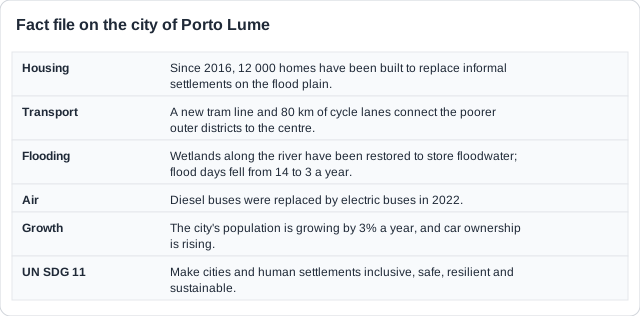
Fact file on Porto Lume: 12 000 homes built to replace flood-plain settlements; a tram line and 80 km of cycle lanes to the poorer districts; wetlands restored, flood days down from 14 to 3 a year; electric buses since 2022; population and car ownership rising; and the text of SDG 11
Figure 1
IB-style questionOutline[1 mark]

Figure 1 is a fact file on the city of Porto Lume and gives the text of UN SDG 11.

Using the information in Figure 1, outline the evidence that Porto Lume is making progress towards SDG 11.

Model answer plan

See the mark-by-mark plan — for / against / judgement, with marking guidance — in study mode.

Claim your free topic

Try an IB Exam Question — Free AI Feedback

Test yourself on UN Sustainable Development Goals. Write your answer and get instant AI feedback — just like a real IB examiner.

A poster in a school corridor shows 17 coloured squares, one for each UN Sustainable Development Goal.

what the Sustainable Development Goals (SDGs) are.
[1 mark]

Key Terms

Agenda 2030
The United Nations plan of action for people, planet, and prosperity, containing the 17 Sustainable Development Goals.
Climate action
SDG 13 — urgent action to combat climate change and its impacts.
Life on land
SDG 15 — protect, restore, and promote sustainable use of terrestrial ecosystems and halt biodiversity loss.
Millennium Development Goals (MDGs)
Eight international development goals established in 2000, which were succeeded by the SDGs in 2015.
Sustainable Development Goals (SDGs)
A collection of 17 global goals adopted by the United Nations in 2015 to end poverty, protect the planet, and ensure prosperity for all by 2030.
Triple bottom line
A framework that considers three dimensions of sustainability: social (people), environmental (planet), and economic (profit).

Related ESS HL Topics

Continue learning with these related topics from the same unit:

1.1.1Perspectives
1.1.2What shapes a perspective
1.1.3Values
1.1.4Where values show
View all ESS HL topics

Practice with flashcards

Spaced repetition flashcards for UN Sustainable Development Goals

Improve your exam technique

Command terms, paper structure, and mark-scheme tips for ESS HL

Previous
1.3.17Sustainability frameworks and models
Next
Planetary boundaries1.3.19

14 practice questions on UN Sustainable Development Goals

Students who practiced this topic on Aimnova scored 82% on average. Try free practice questions and get instant AI feedback.

Try 3 Free QuestionsView All ESS HL Topics