Citizen science at Higher Level: The same ideas as SL. At HL, ask who controls the data, who is left out, and how volunteers' results reach decisions.
Practise this as you read
- Give two advantages with a reason each.
- Weigh the size of the data against its errors.
Free preview
This is the free notes preview
You're reading the free notes. Aimnova Pro unlocks the full study experience — and you can try it with your first topic free to keep:
- FlashcardsLock in vocabulary and key terms with spaced repetition.
- Practice questionsAnswer exam-style questions and get instant AI marking.
- Mock exams & past-paper vaultSit full mocks and see exactly how examiners award marks.
- Personalised study planA daily plan built around your exam date and weak areas.
Science by everyone: In citizen science, ordinary people collect real scientific data, following a method set by scientists.
The points to remember
- Citizen science: members of the public collect data for scientific research.
- Anyone can take part; most are volunteers.
- Everyone follows the same method (protocol), so all the data can be combined.
- The data is usually shared openly (open access).
- Also called community science or crowdsourced science.
Remember it as: Many eyes, one method, shared data.
Real example: in 2018, about 20,000 households in Flanders, Belgium, hung small tubes outside a window for a month to measure nitrogen dioxide. The project, CurieuzeNeuzen, mapped air pollution street by street.
What volunteers do: Count birds or insects; photograph species with a phone app; use simple kits to test water; hang air sensors; use a Lincoln index; or score a stream's health with a water quality index.
Learn what examiners really want
See exactly what to write to score full marks. Our AI shows you model answers and the key phrases examiners look for.
Citizen science is one piece of a much bigger research effort.
The points to remember
- It monitors Earth systems: air, water, wildlife, weather and climate.
- It checks whether resources are used sustainably: fish, water, forests.
- Its data is useful for local problems: a polluted stream, dirty air near a school.
- Pooled data is used in research on global issues, such as climate change.
- It is part of scientific research: scientists design the method, check the data and publish.
Local to global: in the UK, volunteers for Nature's Calendar record the date of the first oak leaves and the first frogspawn each spring. Their records show spring arriving earlier, evidence of climate change.
From a volunteer's record to research: Nature's Calendar
- Volunteers record the date they see the first oak leaves and the first frogspawn each spring.
- A shared database pools the dates from gardens, parks and schools across the UK.
- Scientists check the records and compare them with dates going back over 250 years.
- Use: the results show how climate change is shifting the seasons.
Why use volunteers?: Citizen science collects far more data, in far more places, than scientists could alone.
The points to remember
- Lots of data from many places, collected cheaply by volunteers.
- It reaches places not otherwise monitored (no money or experts there).
- Local people know the area and are there to monitor often.
- It raises awareness and engagement: people feel they can make a difference.
- Data is shared, and it can push the authorities to act or to fund more research.
Remember it as: More data, more places, more people who care.
For example: CurieuzeNeuzen measured air at 20,000 addresses, where Flanders had only a few dozen official monitoring stations.
Not 'more accurate': Citizen science gives more data, not more accurate data. 'The data is more accurate' is wrong: volunteers are usually less precise than trained scientists.
Never wonder what to study next
Get a personalized daily plan based on your exam date, progress, and weak areas. We'll tell you exactly what to review each day.
Volunteer data has real weaknesses. Most can be reduced.
The limits to remember
- Errors: untrained volunteers may misidentify species, vary the method or disturb wildlife.
- Bias: people record interesting species and visit favourite places.
- Gaps: times are inconsistent and motivation fades.
- Complex measurements (e.g. some chemicals) are hard for volunteers to do reliably.
- Data could be manipulated by groups with an interest in the result.
- Reduce it: one simple protocol, training, expert checks of photos and records.
| Limitation | How to reduce it |
|---|---|
| Untrained volunteers make mistakes | Training and a simple, shared method |
| Only interesting species recorded | A checklist: record everything seen |
| Everyone visits the same places | Scientists assign sites to cover the area |
| Wrong identifications | Experts check photos before data is used |
So: CurieuzeNeuzen placed some tubes beside official monitors to check the volunteers' readings, which made the whole dataset more trustworthy.
How this comes up: Paper 1: a table of air pollution readings, then 'suggest two advantages of using citizen science' [2].
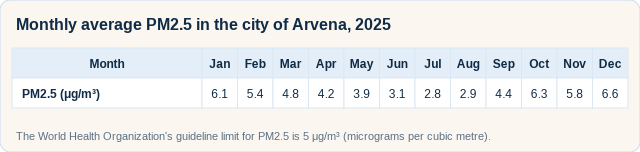
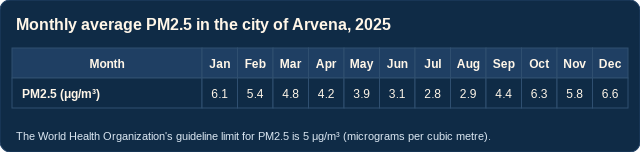
Figure 1 shows monthly average PM2.5 in the city of Arvena in 2025. The city has only one official air-quality monitor.
Suggest two advantages of using citizen science to monitor air pollution in Arvena.
Model answer plan
See the answer broken into clear points, with guidance on how each point earns marks.
The same topic in Paper 2: A [9] asks how far citizen science can accurately assess sustainability: argue both sides with named examples, then conclude.