Inequality and access at Higher Level: The same ideas as SL, with different examples. At HL, link unequal access to the law (rights to water), to economics (who can pay) and to ethics (what a fair share is).
Practise this as you read
- Explain how an inequality limits access to water, food or energy.
- Explain how unequal access can lead to conflict.
Free preview
This is the free notes preview
You're reading the free notes. Aimnova Pro unlocks the full study experience — and you can try it with your first topic free to keep:
- FlashcardsLock in vocabulary and key terms with spaced repetition.
- Practice questionsAnswer exam-style questions and get instant AI marking.
- Mock exams & past-paper vaultSit full mocks and see exactly how examiners award marks.
- Personalised study planA daily plan built around your exam date and weak areas.
Not everyone gets a fair share: Who you are, and how much you earn, affects whether you have clean water, enough food and electricity.
The points to remember
- Inequalities in income, race, gender and cultural identity lead to unequal access to water, food and energy.
- They exist within a society (rich and poor districts) and between societies (rich and poor countries).
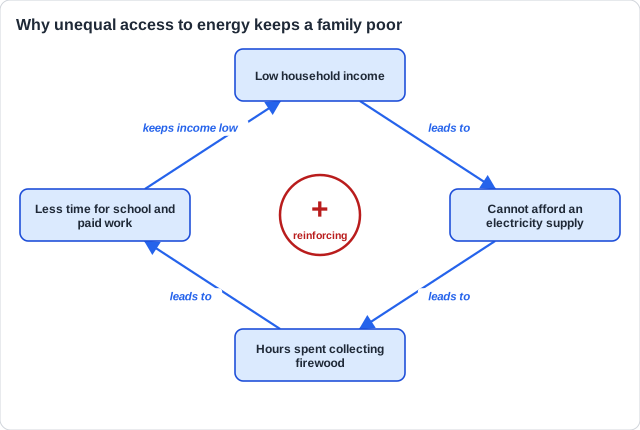
- Income: poor households cannot afford an electricity supply, clean water or enough food.
- Privatization: a private company owns the water supply and sets prices; the poor may be priced out.
- Gender: women and girls often fetch water and fuel, losing time for school and paid work.
- Race and cultural identity: minority and indigenous groups are often the last to be connected.
Remember it as: Income, race, gender, culture: four reasons some go without.
Example: in 2014 Flint, Michigan, USA, a mostly Black city where many people are poor, switched its water source to save money. Lead from old pipes got into the tap water, and residents' complaints were ignored for over a year. Richer, whiter towns nearby kept safe water.
Memorize terms 3x faster
Smart flashcards show you cards right before you forget them. Perfect for definitions and key concepts.
Water
- Families not on the piped network buy water from sellers, often paying more per litre than richer homes.
Food
- Poor families spend most of their income on food, so a price rise means eating less.
Energy
- Hundreds of millions of people, most in sub-Saharan Africa, have no electricity at home.
Unequal access does not fix itself. It keeps poor households poor, a reinforcing loop (1.2).
Race and cultural identity: In many countries, indigenous and minority communities are the last to be connected to water and power networks.
When some people have far more of a resource than others, conflict can follow.
How unequal access leads to conflict
- Water, food, fertile land, fossil fuels and ores are unevenly spread around the world.
- A resource shared across borders, such as a river, can set countries against each other.
- A country may even invade another, or armed groups fight, to control a resource.
- Price rises for food, water or fuel can lead to protests and riots.
- Within a country, groups clash over who owns a resource, and over its price and rules.
- Inequality grows from inside (population growth, overuse) or outside (climate change, war): drought is argued to be one cause of Syria's 2011 war.
Between countries
- Oil and gas reserves matter to national security, and have fed many conflicts in the Middle East.
Within a country
- 2008: food prices rose worldwide, and protests and riots broke out in many poorer countries.
Always say how it leads to conflict: Describing who has more and who has less is only half an answer. Link each point to the conflict it causes.
Know your predicted grade
Take timed mock exams and get detailed feedback on every answer. See exactly where you're losing marks.
How this comes up: Paper 2, Section B (b): explain how the unequal distribution of resources can lead to conflict [7].
Some regions have large deposits of metal ores, such as cobalt and tin, while others have almost none.
Explain how the unequal distribution of mineral resources can lead to conflict.
Model answer plan
See the mark-by-mark plan — for / against / judgement, with marking guidance — in study mode.