Environmental justice at Higher Level: The same idea as SL, with different examples. At HL, link justice to the law (who has rights), to economics (who pays) and to ethics (what is fair).
Practise this as you read
- Explain why an example is unjust: who is harmed, who benefits.
- Discuss how justice and climate action can support each other.
Free preview
This is the free notes preview
You're reading the free notes. Aimnova Pro unlocks the full study experience — and you can try it with your first topic free to keep:
- FlashcardsLock in vocabulary and key terms with spaced repetition.
- Practice questionsAnswer exam-style questions and get instant AI marking.
- Mock exams & past-paper vaultSit full mocks and see exactly how examiners award marks.
- Personalised study planA daily plan built around your exam date and weak areas.
A fair share of a clean world: environmental justice asks who suffers from pollution and who gets the benefit of nature's resources.
The points to remember
- Environmental justice: every person has the right to a pollution-free environment.
- Everyone should also have equitable (fair) access to natural resources: water, land, food and energy.
- This holds regardless of race, gender, income (socio-economic status) or nationality.
- Environmental injustice: one group suffers the harm while another gets the benefit.
- The group harmed usually has less money and less power to object or to move away.
Remember it as: Who gains? Who pays? Who decides?
Example: along the Mississippi River in Louisiana, USA, a stretch known as 'Cancer Alley' is lined with petrochemical plants. Most people living beside them are Black and on low incomes, and they breathe some of the most polluted air in the country.
Practice with exam-style questions
Answer exam-style questions and get AI feedback that shows you exactly what examiners want to see in a full-marks response.
Learn one local and one global example of environmental injustice.
The points to remember
- Know one local example (one town or area) and one global example (between countries).
- For each: who is harmed, who benefits, and why it is unfair.
- Name the unfair factor: race, gender, income or nationality.
Local: the Maasai of Loliondo, Tanzania
- Maasai have grazed this land for generations.
- In 2022 the government marked out their grazing land for a hunting and tourism reserve.
- Herders were forced off the land; the income goes to others. The unfair factor: cultural identity and power.
Global: climate change and Tuvalu
- Tuvalu, a Pacific island nation only a few metres above the sea, releases a tiny share of greenhouse gases.
- Rising seas caused mainly by rich countries' emissions threaten its land and fresh water.
- The unfair factor: nationality. Those who caused least suffer most.
More examples to recognise: The Deepwater Horizon oil spill in the Gulf of Mexico (2010) and landfills built in low-income areas are two more examples.
Environmental injustice is not an accident. It follows who has money and power.
Why it happens, and how to make it fair
- Polluting sites go where land is cheap and people have least power to object.
- Poorer people often cannot afford to move away from the harm.
- Rich countries can export harm to poorer countries with weaker laws.
- Fairer: give affected people a voice in decisions.
- Fairer: share costs and benefits, and compensate those harmed.
- Fairer: enforce the same rules everywhere and protect the most vulnerable.
- Justice is part of sustainability: a practice that harms one group is not socially sustainable.
Example: flood defences that protect a poor coastal district, not only the wealthy centre, spread the benefit of adapting to climate change fairly.
Link it to sustainability: When you judge a practice, ask who is harmed as well as what is harmed. Unfair harm to one group is a social cost.
Feeling unprepared for exams?
Get a clear study plan, practice with real questions, and know exactly where you stand before exam day. No more guessing.
How this comes up: Paper 2: a graph links a city's districts to income. Discuss how pursuing environmental justice could also address climate change [5].
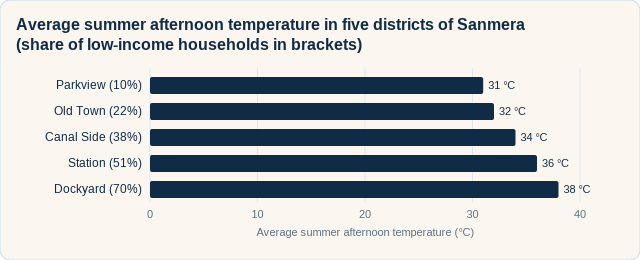
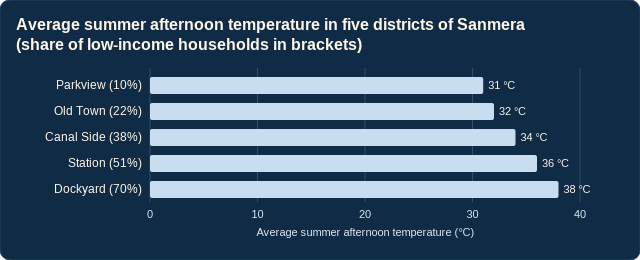
Figure 1 shows the average summer afternoon temperature in five districts of Sanmera, with the share of low-income households in each.
Discuss how the pursuit of environmental justice in Sanmera could also address climate change.
Model answer plan
See the answer broken into clear points, with guidance on how each point earns marks.