Operating scales at Higher Level: The same six scales as SL, with climate action as the example. At HL, link the scales to law: local, national and international laws each work at a different scale.
Practise this as you read
- Name the operating scale of an action.
- Weigh global against local action, using evidence.
Free preview
This is the free notes preview
You're reading the free notes. Aimnova Pro unlocks the full study experience — and you can try it with your first topic free to keep:
- FlashcardsLock in vocabulary and key terms with spaced repetition.
- Practice questionsAnswer exam-style questions and get instant AI marking.
- Mock exams & past-paper vaultSit full mocks and see exactly how examiners award marks.
- Personalised study planA daily plan built around your exam date and weak areas.
From one person to the whole planet: Sustainability and environmental justice can be applied at every operating scale, from one person to the world.
The points to remember
- Individual: how a person decides to live and work.
- Business: how a company makes, sells and uses things.
- Community: a religious, cultural, political or indigenous group.
- City: its transport, housing, waste and green space.
- Country: its policies, laws and economic system.
- Global: agreements between countries, such as the UN Sustainable Development Goals.
Remember it as: Me, my firm, my community, my city, my country, my planet.
Example: cutting greenhouse gas emissions at all six scales.
Individual
Cycles to work and eats less meat.
Business
A company runs its offices on renewable power.
Community
Indigenous forest guardians stop illegal logging.
City
Copenhagen builds cycle lanes across the city.
Country
The UK's Climate Change Act (2008) sets legal targets.
Global
The Paris Agreement (2015) and SDG 13, climate action.
Justice has scales too: Who fetches the water is a question for a household; where a landfill goes is one for a city; who suffers from climate change is a global one.
Never wonder what to study next
Get a personalized daily plan based on your exam date, progress, and weak areas. We'll tell you exactly what to review each day.
Is an environmental problem better tackled globally or locally? Both have strengths.
Global or local?
- Global works when a problem crosses borders: climate, oceans, shared rivers, the loss of species.
- Global works when demand from abroad drives the damage: timber, wildlife parts, metals.
- Global brings shared money and experts, and stops everyone overusing a shared resource.
- Local works when the harm is local: a polluted river, dead trees near a smelter.
- Local is where rules are enforced on the ground, with local support and knowledge.
- Global deals are slow and hard to agree, and can ignore local needs.
- The usual verdict: agree globally, act locally.
Global
- The Paris Agreement (2015): nearly every country set targets to cut greenhouse gases.
- A global deal avoids the tragedy of the commons.
- Protecting species and habitats is a duty shared by everyone, not only the country where they live.
Local
- Each country, city and business must make the cuts itself.
- Villages that manage their own fishing grounds often protect them best.
A conclusion needs support: 'Global is better' on its own is not a conclusion. Say why, using the evidence, e.g. 'agree globally, act locally, because...'.
How this comes up: The last question on Paper 1: using the resource booklet, is it better to act at a global or a local level [6]?
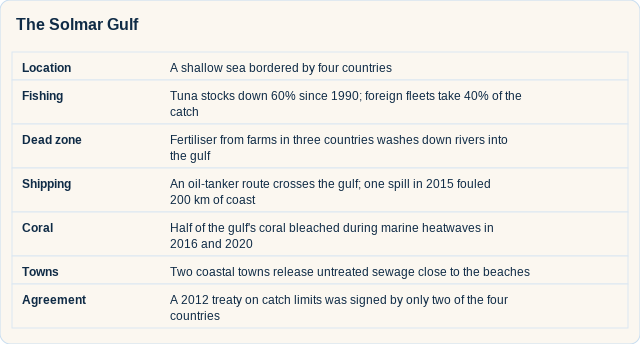
Figure 1 gives information about the Solmar Gulf.
Using all the information in Figure 1, to what extent might it be better to consider environmental issues at a global, rather than a local, level when planning for sustainable development in the Solmar Gulf?
Model answer plan
See the answer broken into clear points, with guidance on how each point earns marks.