aımnova
DashboardMy LearningPaper MasteryStudy Plan

Aimnova site navigation

Stay in the loop

Get the latest study resources and updates

New features, study tips and exam insights — straight to your inbox.

IB Diploma

  • IB Past Papers
  • IB Study Notes
  • IB Question Bank
  • IB Mock Exams
  • IB Revision

IB Subjects

  • IB Math AA
  • IB Math AI
  • IB Economics
  • IB Business Management
  • IB Physics
  • IB Biology
  • View all IB subjects→

IB Past Papers

  • IB Math AA HL Past Papers
  • IB Math AA SL Past Papers
  • IB Math AI HL Past Papers
  • IB Math AI SL Past Papers
  • IB Economics HL Past Papers
  • IB Economics SL Past Papers
  • IB ESS Past Papers
  • View all past papers→

Study Resources

  • Study Notes
  • Question Bank
  • Mock Exams
  • Flashcards
  • Revision Guide
  • Exam Skills
  • Command Terms
  • Grade Calculator
  • Exam Timetable 2026

Aimnova

  • Features
  • Pricing
  • For Teachers
  • For Schools
  • For Parents
  • About Us
  • Blog
  • Contact
aımnova

IB study, practice and feedback built around the real exam.

TermsPrivacyCookies·© 2026 Aimnova. All rights reserved.1b845d5

Aimnova is not affiliated with or endorsed by the International Baccalaureate Organization (IB).

NotesEnglish A: Lang & LitTopic 2.4Text type: the comic strip
Back to English A: Lang & Lit Topics
2.4.34 min read

Text type: the comic strip

IB English A: Language and Literature · Unit 2

Your first topic is free to keep

Know exactly what to write for full marks

Practice with exam questions and get AI feedback that shows you the perfect answer — what examiners want to see.

Start Free

Contents

  1. 1What it is
  2. 2Try it yourself
The gist: A comic strip tells a story in panels — images and words together — and the sequence, plus the gap between panels, does a lot of the work.

Three little boxes, and you laugh.Panel 1: a cat eyes a full glass on a table.Panel 2: the cat, paw raised, stares at its owner.Panel 3: the glass on the floor, the cat gone.

No words needed. The sequence and what happens between panels tell the joke. That's the comic strip — analyse how images, words and order build meaning.

What to look for

1

Panels in sequence

Boxes read in order; the story moves panel to panel.

2

The gutter (the gap)

The space between panels — you fill in what happens, and the timing lands the joke.

3

Speech and thought bubbles

Words come as dialogue or thoughts; shape and size show tone and volume.

4

Exaggeration and visual gags

Big eyes, sweat drops, a final twist panel — cartoon shorthand for feeling.

The key move: Ask ‘how do the panels and their order build the meaning or joke?’ In a comic, sequence and the gap between panels matter as much as any single image.

Free preview

This is the free notes preview

You're reading the free notes. Aimnova Pro unlocks the full study experience — and you can try it with your first topic free to keep:

  • FlashcardsLock in vocabulary and key terms with spaced repetition.
  • Practice questionsAnswer exam-style questions and get instant AI marking.
  • Mock exams & past-paper vaultSit full mocks and see exactly how examiners award marks.
  • Personalised study planA daily plan built around your exam date and weak areas.
Start Studying Free Full access to Aimnova Pro · cancel anytime
Why it matters in the exam: A comic strip can appear in Paper 1. A strong answer analyses how images, words and sequence work together — the panel order, the final twist, the exaggeration — not just describing each box.
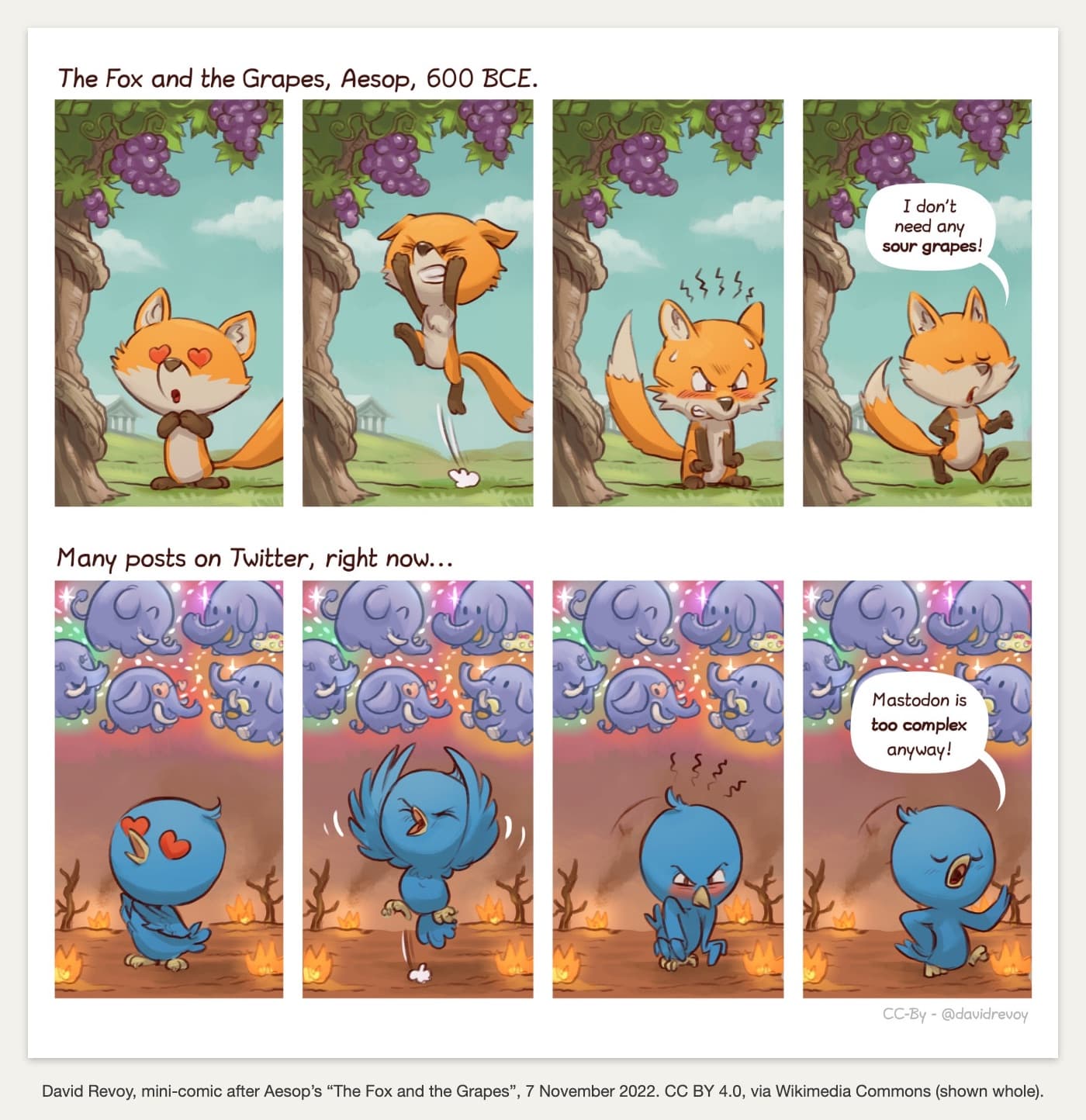
A two-row comic strip, four panels in each row. Top row, titled ‘The Fox and the Grapes, Aesop, 600 BCE.’: a fox gazes up at grapes with heart-shaped eyes; it leaps for them, eyes squeezed shut; it stands below, scowling and blushing, jagged lines over its head; it walks away, nose in the air, saying ‘I don't need any sour grapes!’. Bottom row, titled ‘Many posts on Twitter, right now…’: a blue bird on burning ground gazes up with heart eyes at a cloud of purple elephants; it leaps, wings flapping; it scowls, blushing, jagged lines over its head; it walks away saying ‘Mastodon is too complex anyway!’. Signed ‘CC-By - @davidrevoy’.
Comic strip: David Revoy, mini-comic after Aesop's “The Fox and the Grapes”, 7 November 2022 (CC BY 4.0 via Wikimedia Commons, shown whole with a credit line added)
IB-style questionAnalyse[6 marks]

Analyse how this comic strip uses its panels and their timing to make its point.

Model answer plan

See the mark-by-mark plan — for / against / judgement, with marking guidance — in study mode.

Claim your free topic
Watch out: Don't just describe each panel one by one. The meaning lives in the order and the gaps — how one panel sets up the next, and how the last one lands.

IB Exam Questions on Text type: the comic strip

Practice with IB-style questions filtered to Topic 2.4.3. Get instant AI feedback on every answer.

Practice Topic 2.4.3 QuestionsBrowse All English A: Lang & Lit Topics

How Text type: the comic strip Appears in IB Exams

Examiners use specific command terms when asking about this topic. Here's what to expect:

  • Define

    Give the precise meaning of key terms related to Text type: the comic strip.

    AO1
  • Describe

    Give a detailed account of processes or features in Text type: the comic strip.

    AO2
  • Explain

    Give reasons WHY — cause and effect within Text type: the comic strip.

    AO3
  • Evaluate

    Weigh strengths AND limitations of approaches in Text type: the comic strip.

    AO3
  • Discuss

    Present arguments FOR and AGAINST with a balanced conclusion.

    AO3

See the full IB Command Terms guide

Related English A: Lang & Lit Topics

Continue learning with these related topics from the same unit:

2.1.1Text type: the advertisement2.1.2Text type: the poster2.1.3Text type: the brochure or leaflet2.1.4Text type: the campaign material
View all English A: Lang & Lit topics
Improve your exam techniqueCommand terms, paper structure, and mark-scheme tips for English A: Lang & Lit
Previous2.4.2Text type: the political cartoonNextText type: the photograph2.4.4

4 questions to test your understanding

Reading is just the start. Students who tested themselves scored 82% on average — try IB-style questions with AI feedback.

Start FreeView All English A: Lang & Lit Topics