The big idea: Rapid prototyping makes a physical prototype quickly from a CAD model, so users and the team can handle it and give feedback while changes are still cheap.
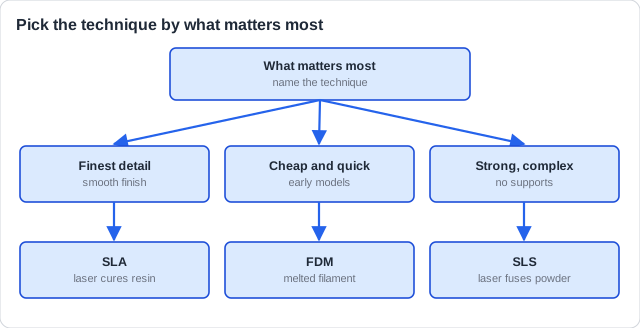
The guide names three techniques: SLA, FDM and SLS.
What happens inside each machine — because every difference that matters follows from the mechanism.
Interactive diagram
Explore the labelled diagram, charts and maps for this topic in full study mode.
Free preview
This is the free notes preview
You're reading the free notes. Aimnova Pro unlocks the full study experience — and you can try it with your first topic free to keep:
- FlashcardsLock in vocabulary and key terms with spaced repetition.
- Practice questionsAnswer exam-style questions and get instant AI marking.
- Mock exams & past-paper vaultSit full mocks and see exactly how examiners award marks.
- Personalised study planA daily plan built around your exam date and weak areas.
SLA — stereolithography
A laser traces each layer on the surface of a vat of liquid photopolymer, curing it solid. Best finish and finest detail of the three, so it is the choice for appearance models. Against: brittle parts that degrade in sunlight, supports that leave marks, and messy washing and post-curing.
FDM — fused deposition modelling
A heated nozzle melts thermoplastic filament and draws each layer. Cheapest and most available — this is the desktop 3D printer — and it uses real engineering thermoplastics. Against: visible layer lines, the roughest finish, and parts noticeably weaker across the layers than along them.
SLS — selective laser sintering
A laser fuses polymer powder inside a heated bed. The unfused powder supports the part, so no support structures are needed — which allows geometries the others cannot make — and parts are strong and near-isotropic, good enough to use as real components. Against: expensive machine, grainy matt finish, powder handling.
Why SLS needs no supports: The part is built inside a bed of loose powder. An overhang rests on powder that is already there, so nothing has to be printed to hold it up — and nothing has to be cut off afterwards.
Stop wasting time on topics you know
Our AI identifies your weak areas and focuses your study time where it matters. No more overstudying easy topics.
Advantages
- A physical part in hours, straight from CAD
- Users can handle it, so feedback is real
- Complex internal geometry that machining cannot produce
- No tooling, so a change costs nothing but another print
Disadvantages
- Materials are limited compared with production processes
- Properties differ from the production material, so tests can mislead
- Surface finish usually needs work before it can be shown
- Slow and costly per part at any real quantity
The trap: Treating a 3D-printed part as equivalent to the production part. An FDM prototype is weaker across its layers than an injection-moulded one is in any direction — so a printed part that survives a test proves less than it appears to.
Four more points the papers reward
Complex shapes in one piece
Layers can build shapes no mould could make, such as a hollow guitar body or a lattice shoe sole, in a single part.
Preview the build first
Printer software shows the build layer by layer before it starts, so errors are caught and material is not wasted on a failed print.
Printable plastics
FDM uses thermoplastics such as PLA, ABS and TPU: they soften when heated and set again as they cool.
Files travel
One CAD file can be printed by teams in different countries, which speeds up feedback, but the design data must be protected when it is shared.
How this is tested — choosing a rapid prototyping technique and justifying it by its properties. It comes up two ways:
Paper 1 — multiple choice
- Identify a technique from a description of the machine.
- Pick the technique that suits a stated requirement.
Paper 2 — analysing a product
- Explain why a designer chose a named technique for a product.
- Evaluate rapid prototyping against a traditional workshop model.
The trap: Answering with the acronym alone. The mark is in the property — no supports, best finish, cheapest, strongest — and why that property matters here.
A designer needs two prototypes of a drone arm: one to photograph for a funding pitch next week, and one to fly-test. Justify a rapid prototyping technique for each.
Model answer plan
See the answer broken into clear points, with guidance on how each point earns marks.