aımnova
DashboardMy LearningCrash CoursesStudy Plan

Aimnova site navigation

Stay in the loop

Get the latest study resources and updates

New features, study tips and exam insights — straight to your inbox.

IB Diploma

  • IB Past Papers
  • IB Study Notes
  • IB Question Bank
  • IB Mock Exams
  • IB Revision

IB Subjects

  • IB Math AA
  • IB Math AI
  • IB Economics
  • IB Business Management
  • IB Physics
  • IB Biology
  • View all IB subjects→

IB Past Papers

  • IB Math AA HL Past Papers
  • IB Math AA SL Past Papers
  • IB Math AI HL Past Papers
  • IB Math AI SL Past Papers
  • IB Economics HL Past Papers
  • IB Economics SL Past Papers
  • IB ESS Past Papers
  • View all past papers→

Study Resources

  • Study Notes
  • Question Bank
  • Mock Exams
  • Crash Courses
  • Flashcards
  • Revision Guide
  • Exam Skills
  • Command Terms
  • Grade Calculator
  • Exam Timetable 2026

Aimnova

  • Features
  • Pricing
  • For Teachers
  • For Schools
  • For Parents
  • About Us
  • Blog
  • Contact
aımnova

IB study, practice and feedback built around the real exam.

TermsPrivacyCookies·© 2026 Aimnova. All rights reserved.06bfe1b

Aimnova is not affiliated with or endorsed by the International Baccalaureate Organization (IB).

NotesBiologyTopic 4.6Changes due to water movement in plant tissue bathed in hypotonic and those bathed in hypertonic solutions
Back to Biology Topics
4.6.44 min read

Changes due to water movement in plant tissue bathed in hypotonic and those bathed in hypertonic solutions

IB Biology · Unit 4

AI-powered feedback

Stop guessing — know where you lost marks

Get instant, examiner-style feedback on every answer. See exactly how to improve and what the markscheme expects.

Try It Free

Contents

  1. 1The practical, step by step
  2. 2Making the results reliable
  3. 3Exam-style question (step by step)
The big idea: Plant tissue gains mass and length in hypotonic solutions and loses them in hypertonic ones. The concentration that causes no change is isotonic to the tissue.
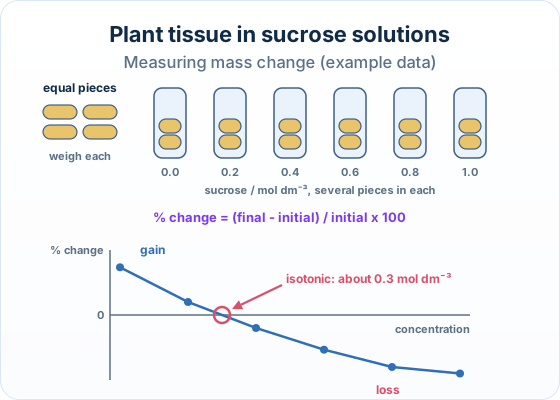
Equal pieces of tissue weighed, placed in a range of sucrose solutions, reweighed, and the percentage change plotted against concentration; the line crosses zero at the isotonic point
The zero crossing gives the isotonic concentration.

The points to remember

  • The independent variable is the solute concentration; the dependent variable is the change in mass (or length).
  • Pieces of the same size and shape have the same surface area for water to cross.
  • Use percentage change, because the pieces start with slightly different masses.
  • Gain = water moved in (hypotonic); loss = water moved out (hypertonic).
  • Read the isotonic concentration where the line crosses 0 %.
Remember it as: Zero change = isotonic.

Real example: potato chips. A potato chip left in pure water becomes firmer and heavier; one left in strong salt solution becomes soft and lighter. Somewhere in between is a solution that leaves its mass unchanged: it is isotonic to the potato.

Free preview

This is the free notes preview

You're reading the free notes. Aimnova Pro unlocks the full study experience — and you can try it with your first topic free to keep:

  • FlashcardsLock in vocabulary and key terms with spaced repetition.
  • Practice questionsAnswer exam-style questions and get instant AI marking.
  • Mock exams & past-paper vaultSit full mocks and see exactly how examiners award marks.
  • Personalised study planA daily plan built around your exam date and weak areas.
Start Studying Free Full access to Aimnova Pro · cancel anytime
Making the results reliable: Control everything except the solute concentration, repeat each concentration, and show the spread.
What you doWhy
Same size and shape of piecesSame surface area, so the same rate of water movement
Same time, same temperatureBoth affect how much water moves
Blot each piece the same waySurface water would add to the mass
Several pieces per concentrationA mean is more reliable than one piece
Percentage changePieces with different starting masses can be compared
Standard deviation
How spread out the repeat results are around the mean.
Standard error
How reliable the mean is: it gets smaller as more repeats are done. You do not need to remember the formula.
Error bars
Lines above and below a mean showing its standard deviation or standard error.
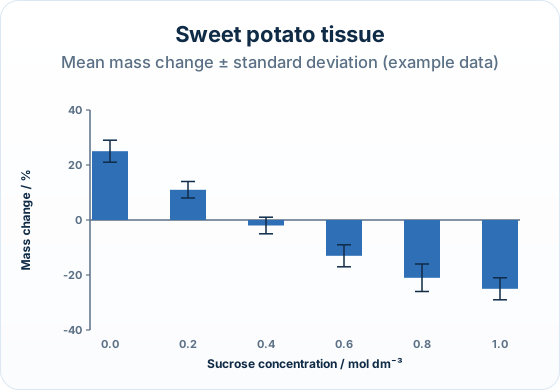
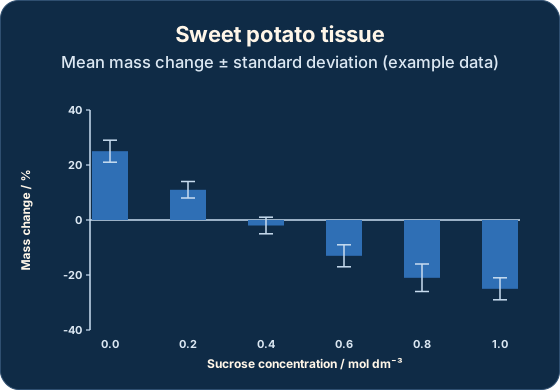
A bar chart of mean percentage mass change against sucrose concentration, with error barsA bar chart of mean percentage mass change against sucrose concentration, with error bars
Error bars show the spread of the repeats.
Reading error bars: If the error bars of two means overlap, the difference between them may not be significant. If they do not overlap, the difference is more likely to be real.

Study smarter, not longer

Most students waste 40% of study time on topics they already know. Our AI tracks your progress and optimizes every minute.

Try Smart Study FreeYour first topic is free to keep • No credit card required
How it is asked: Paper 1 data questions on this practical: name the variables, explain the control of size and shape, give a reason for percentages, identify the type of graph, estimate the isotonic concentration and compare two concentrations on a box-and-whisker plot.
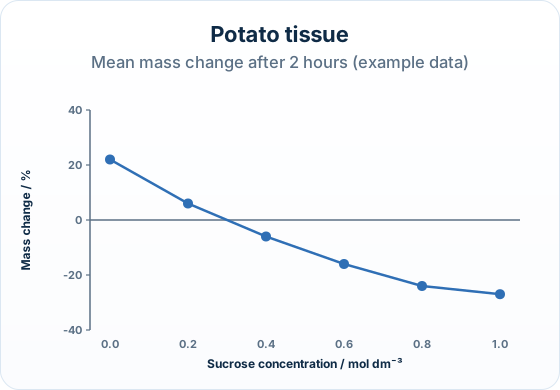
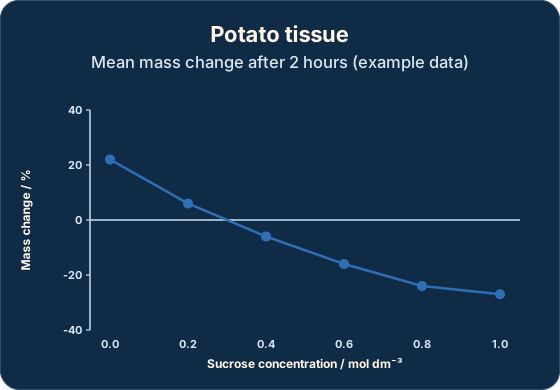
Mean percentage mass change of potato tissue against sucrose concentration, crossing zero at 0.3Mean percentage mass change of potato tissue against sucrose concentration, crossing zero at 0.3
Example data for the question.
IB-style questionEstimate[2 marks]

Using the graph of mean mass change, estimate the sucrose concentration that is isotonic to the tissue, and explain how you found it.

Model answer plan

See the answer broken into clear points, with guidance on how each point earns marks.

Claim your free topic
Box-and-whisker words: On a box-and-whisker plot the line in the box is the median, not the mean, and the lines are whiskers, not error bars.

IB Exam Questions on Changes due to water movement in plant tissue bathed in hypotonic and those bathed in hypertonic solutions

Practice with IB-style questions filtered to Topic 4.6.4. Get instant AI feedback on every answer.

Practice Topic 4.6.4 QuestionsBrowse All Biology Topics

How Changes due to water movement in plant tissue bathed in hypotonic and those bathed in hypertonic solutions Appears in IB Exams

Examiners use specific command terms when asking about this topic. Here's what to expect:

  • Define

    Give the precise meaning of key terms related to Changes due to water movement in plant tissue bathed in hypotonic and those bathed in hypertonic solutions.

    AO1
  • Describe

    Give a detailed account of processes or features in Changes due to water movement in plant tissue bathed in hypotonic and those bathed in hypertonic solutions.

    AO2
  • Explain

    Give reasons WHY — cause and effect within Changes due to water movement in plant tissue bathed in hypotonic and those bathed in hypertonic solutions.

    AO3
  • Evaluate

    Weigh strengths AND limitations of approaches in Changes due to water movement in plant tissue bathed in hypotonic and those bathed in hypertonic solutions.

    AO3
  • Discuss

    Present arguments FOR and AGAINST with a balanced conclusion.

    AO3

See the full IB Command Terms guide

Related Biology Topics

Continue learning with these related topics from the same unit:

4.1.1DNA replication as production of exact copies of DNA with identical base sequences4.1.2Semi-conservative nature of DNA replication and role of complementary base pairing4.1.3Role of helicase and DNA polymerase in DNA replication4.1.4Polymerase chain reaction and gel electrophoresis as tools for amplifying and separating DNA
View all Biology topics
Improve your exam techniqueCommand terms, paper structure, and mark-scheme tips for Biology
Previous4.6.3Water movement by osmosis into or out of cellsNextEffects of water movement on cells that lack a cell wall4.6.5

18 exam-style questions ready for you

Students who practice on Aimnova improve their scores by 15% on average. Get instant feedback that shows exactly how to improve your answers.

Practice Now — FreeView All Biology Topics