The big idea: Often a scientist starts with far too little DNA to study — a single hair, a drop of blood, or a trace of cells.
How PCR solves it
- PCR (the polymerase chain reaction) makes millions of copies of a chosen piece of DNA
- It runs automatically, inside a machine called a thermal cycler
- It works by repeating a three-step cycle over and over
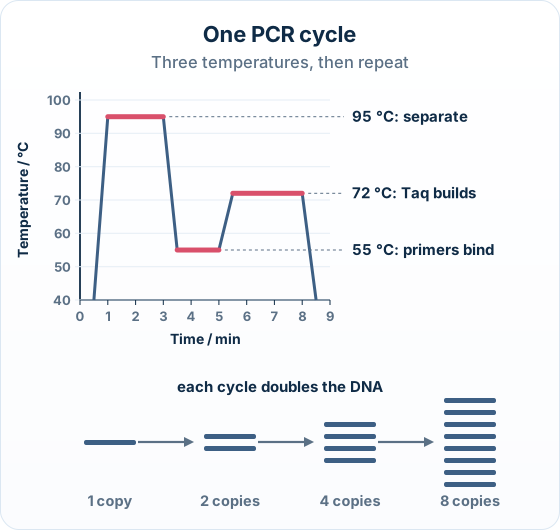
- The amount of DNA roughly doubles every cycle, so after about 30 cycles a tiny sample becomes enough to analyse
- PCR (polymerase chain reaction)
- A laboratory technique that makes many copies of (amplifies) a specific length of DNA.
- Amplify
- To make many copies of a piece of DNA, so a tiny sample becomes a large, usable amount.
- Thermal cycler
- The machine that runs PCR by repeatedly heating and cooling the sample through the cycle's temperatures.
- Primer
- A short single strand of DNA that binds to a matching sequence and marks where copying should begin.
- Taq polymerase
- The heat-stable enzyme used in PCR; it adds DNA nucleotides to build the new complementary strand.
Why PCR is so powerful: Because the DNA roughly doubles each cycle, the increase is exponential: 1 → 2 → 4 → 8 → 16 …
Just 30 cycles turns one copy into over a billion — which is why PCR can work from a vanishingly small starting sample.
Free preview
This is the free notes preview
You're reading the free notes. Aimnova Pro unlocks the full study experience — and you can try it with your first topic free to keep:
- FlashcardsLock in vocabulary and key terms with spaced repetition.
- Practice questionsAnswer exam-style questions and get instant AI marking.
- Mock exams & past-paper vaultSit full mocks and see exactly how examiners award marks.
- Personalised study planA daily plan built around your exam date and weak areas.
Each PCR cycle has three steps, and the key to the whole technique is that the temperature is changed at each step for a specific reason.
Why it is asked: Get the temperatures the wrong way round and PCR fails, so questions often ask you to explain why each temperature is needed.
One cycle = three temperatures
Denaturation (~95 °C)
Very high heat breaks the hydrogen bonds holding the two strands together, so the double helix separates into two single strands.
Annealing (~55 °C)
Cooling lets short primers bind (anneal) to their matching sequence on each single strand, marking the start point for copying.
Extension (~72 °C)
At Taq polymerase's optimum temperature, the enzyme adds nucleotides to each primer, building a new complementary strand.
| Step of one PCR cycle | Temperature (approx.) | What happens — and why that temperature |
|---|---|---|
| 1. Denaturation | ~95 °C (very hot) | The high heat breaks the hydrogen bonds, separating the double helix into two single strands so each can be copied. |
| 2. Annealing | ~55 °C (cooler) | Cooling lets short primers bind (anneal) to their matching sequence on each single strand, marking where copying starts. |
| 3. Extension (elongation) | ~72 °C (warm) | This is the optimum temperature for Taq polymerase, which adds free DNA nucleotides to the primer to build a new complementary strand. |
Why Taq polymerase — not an ordinary one: The denaturation step reaches about 95 °C. An ordinary enzyme would be denatured (its shape destroyed) at that temperature and would stop working.
Taq is heat-stable: Taq polymerase is heat-stable (thermostable) — it survives the high heat without denaturing, so the same enzyme keeps working every cycle and does not need to be replaced.
Taq comes from Thermus aquaticus, a bacterium that lives in hot springs, so its enzymes naturally tolerate high temperatures.
| Feature of Taq polymerase | Why it matters in PCR |
|---|---|
| It is heat-stable (thermostable) | It is not denatured by the ~95 °C denaturation step, so the same enzyme keeps working cycle after cycle. |
| It comes from a heat-loving bacterium | Taq is from Thermus aquaticus, which lives in hot springs, so its enzymes naturally tolerate high temperatures. |
| Its optimum is ~72 °C | It works fastest at the warm extension step, exactly where new strands are built. |
| A normal (human) polymerase would NOT work | An ordinary DNA polymerase would be denatured at 95 °C and would have to be replaced every cycle. |
Once PCR has made plenty of DNA, scientists often want to see and compare the fragments. They do this with gel electrophoresis, which sorts fragments by size.
Gel electrophoresis — sorting by size
Load and switch on
DNA samples are loaded into wells at one end of a jelly-like gel, and an electric current is switched on.
DNA moves
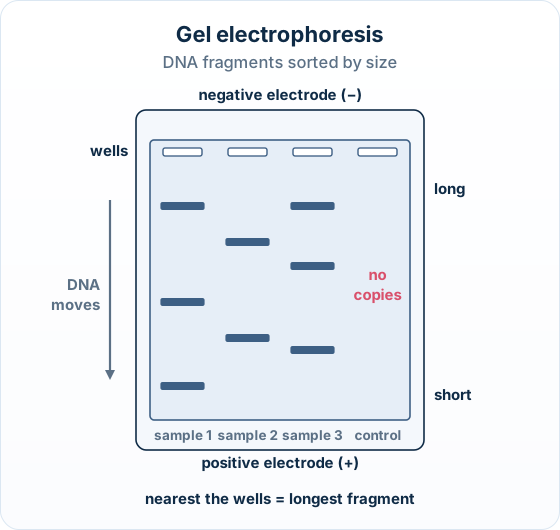
DNA carries a negative charge, so it is pulled through the gel towards the positive electrode.
The gel sieves
The gel acts like a sieve: smaller fragments move further, while larger fragments are held back near the wells.
Bands
The result is a pattern of bands sorted by size.
| Feature of gel electrophoresis | What it does |
|---|---|
| DNA fragments are loaded into wells | Each well (lane) holds one sample's mixture of DNA fragments. |
| An electric field is applied | DNA is negatively charged, so it is pulled through the gel towards the positive electrode. |
| The gel acts as a sieve | Smaller fragments slip through the gel mesh easily; larger fragments are held back. |
| Fragments separate by size | Smaller fragments travel further; larger fragments stay nearer the wells — forming a pattern of bands. |
PCR
- Makes copies of a DNA piece (amplifies it)
- Repeats a three-step thermal cycle
- Needs heat-stable Taq polymerase + primers
- DNA roughly doubles each cycle
Gel electrophoresis
- Separates DNA fragments to compare them
- Uses an electric field across a gel
- Sorts by size (smaller travels further)
- Produces a pattern of bands
An easy way to remember: PCR copies; the gel sorts.
Temperatures in order: Hot splits (95 °C denatures), cool sticks (55 °C anneals primers), warm builds (72 °C Taq extends).
On a gel: small = fast = far.
Practice with exam-style questions
Answer exam-style questions and get AI feedback that shows you exactly what examiners want to see in a full-marks response.
The big idea: Questions often show a temperature graph of PCR or a gel. Each one is read the same way every time.
The points to remember
- On a PCR graph: the highest step (about 95 °C) separates the strands.
- The lowest step (about 55 °C) lets primers bind; the middle step (about 72 °C) is where Taq builds.
- On a gel: DNA is negative, so every fragment moves towards the positive electrode.
- Smaller fragments travel further; the band nearest the wells is the longest fragment.
- A lane with no template DNA shows no band of copied DNA; fewer cycles give fainter bands.
Remember it as: Hot splits, cool sticks, warm builds. Small runs far.
Real example: the first PCR. Kary Mullis worked out PCR in 1983 and shared the 1993 Nobel Prize in Chemistry for it. Today a thermal cycler runs 30 cycles in about two hours.
Two traps: DNA never moves towards the negative electrode: it is negatively charged.
A faint band means less DNA, not smaller fragments: size is shown by how far a band travelled.
How this skill is assessed: Data questions often show a PCR gel. Each part rewards reading the bands carefully.
| Question | What to give |
|---|---|
| Explain why the temperature is changed at each step of a cycle | A separate reason for the hot, cool and warm steps |
| A reason Taq polymerase is suitable for PCR (1 mark) | It is heat-stable and is not denatured at ~95 °C |
| State the no-DNA control | The lane with no band |
| Predict how the gel would change | Read the bands carefully |
Exam-style question — explain the PCR temperatures
Explain why the temperature is changed at each of the three steps of a PCR cycle. [3]
How to score all three marks
- Denaturation (high temperature). Heating to about 95 °C breaks the hydrogen bonds, separating the double helix into two single strands so each can act as a template.
- Annealing (lower temperature). Cooling to about 55 °C lets the primers bind (anneal) to their complementary sequences on the single strands, marking where copying begins.
- Extension (intermediate temperature). About 72 °C is the optimum for Taq polymerase, which adds nucleotides to the primer to build a new complementary strand.
Final answer
High heat (~95 °C) separates the strands by breaking hydrogen bonds; a cooler step (~55 °C) lets primers anneal; and ~72 °C is Taq's optimum so it can extend the new strand.
Why this scores full marks: Each step is given a distinct reason tied to its temperature — strands separating, primers binding, Taq extending.
A 3-mark 'explain' wants the cause linked to the effect at each step, not just the temperatures listed.
| Step of one PCR cycle | Temperature (approx.) | What happens — and why that temperature |
|---|---|---|
| 1. Denaturation | ~95 °C (very hot) | The high heat breaks the hydrogen bonds, separating the double helix into two single strands so each can be copied. |
| 2. Annealing | ~55 °C (cooler) | Cooling lets short primers bind (anneal) to their matching sequence on each single strand, marking where copying starts. |
| 3. Extension (elongation) | ~72 °C (warm) | This is the optimum temperature for Taq polymerase, which adds free DNA nucleotides to the primer to build a new complementary strand. |