The big idea: Whether water moves into or out of a cell depends on how concentrated the solution outside is compared with the inside.
Osmolarity
- Measures that concentration
- It is the total amount of dissolved solute particles in a solution
Tonicity
- The comparison between two solutions
- It tells you which way water will move by osmosis
- The three tonicities are hypotonic, isotonic and hypertonic
- Solute
- A substance (such as salt or sugar) that is dissolved in a liquid.
- Osmolarity
- The total concentration of solute particles in a solution. A higher osmolarity means more solute particles per unit volume — a more concentrated solution.
- Osmosis
- The net movement of water across a partially permeable membrane, from a more dilute solution (lower osmolarity) toward a more concentrated one (higher osmolarity).
- Hypotonic solution
- A solution with a LOWER osmolarity than the cell (more dilute). Water moves into the cell.
- Isotonic solution
- A solution with the SAME osmolarity as the cell. There is no net movement of water.
- Hypertonic solution
- A solution with a HIGHER osmolarity than the cell (more concentrated). Water moves out of the cell.
Tonicity is always a comparison: A solution is never 'hypertonic' on its own — it is hypertonic to something else.
The prefixes are relative: hypo- = less (lower osmolarity), iso- = equal, hyper- = more (higher osmolarity).
Always ask: more or less concentrated than what?
Free preview
This is the free notes preview
You're reading the free notes. Aimnova Pro unlocks the full study experience — and you can try it with your first topic free to keep:
- FlashcardsLock in vocabulary and key terms with spaced repetition.
- Practice questionsAnswer exam-style questions and get instant AI marking.
- Mock exams & past-paper vaultSit full mocks and see exactly how examiners award marks.
- Personalised study planA daily plan built around your exam date and weak areas.
Osmolarity matters because water always moves by osmosis toward the solution with the higher osmolarity — toward the side that is more concentrated in solute.
So once you know the tonicity of the outside solution, you can predict exactly which way water will move and what the cell will do.
The one rule to remember: Water moves toward the higher osmolarity (toward the more concentrated solution).
Put another way, water moves from the less concentrated solution to the more concentrated one.
Tonicity compares the solution to the cell: hypotonic (dilute) → water enters; isotonic (equal) → no net movement; hypertonic (concentrated) → water leaves.
Interactive diagram
Explore the labelled diagram, charts and maps for this topic in full study mode.
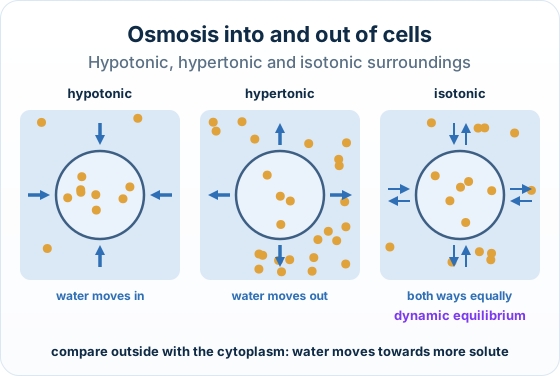
Hypotonic outside → cell swells: If the outside solution is hypotonic (lower osmolarity, more dilute than the cell), the inside of the cell is the more concentrated side.
Water moves into the cell, so the cell gains water and swells — and without a wall it may burst.
Hypertonic outside → cell shrinks: If the outside solution is hypertonic (higher osmolarity, more concentrated than the cell), the outside is now the more concentrated side.
Water moves out of the cell, so the cell loses water and shrinks.
Isotonic outside → dynamic equilibrium: If the outside solution is isotonic (equal osmolarity), neither side is more concentrated.
Water still crosses the membrane, but it moves equally both ways, so there is no net movement: a dynamic equilibrium. The cell stays the same size.
Hypotonic outside
- Outside has lower osmolarity (more dilute)
- The cell is the more concentrated side
- Water moves INTO the cell
- Cell swells (may burst)
Hypertonic outside
- Outside has higher osmolarity (more concentrated)
- The outside is the more concentrated side
- Water moves OUT of the cell
- Cell shrinks
| Solution outside the cell | Osmolarity vs the cell | Net water movement | Effect on the cell |
|---|---|---|---|
| Hypotonic | LOWER osmolarity (more dilute than the cell) | Water moves INTO the cell | Cell gains water and swells (may burst) |
| Isotonic | EQUAL osmolarity (same as the cell) | No NET movement of water | Cell stays the same |
| Hypertonic | HIGHER osmolarity (more concentrated than the cell) | Water moves OUT of the cell | Cell loses water and shrinks |
An easy way to remember: Hyper = high solute → water hurries out of the cell (it shrinks).
Hypo = low solute outside → water heads in (the cell swells).
Water always chases the salt — it moves toward the higher osmolarity.
Know your predicted grade
Take timed mock exams and get detailed feedback on every answer. See exactly where you're losing marks.
The big idea: Compare the solution outside with the cytoplasm. Water moves by osmosis towards the one with the higher solute concentration.
The points to remember
- Hypotonic surroundings: water moves into the cell.
- Hypertonic surroundings: water moves out of the cell.
- Isotonic surroundings: water moves in and out equally.
- Isotonic is a dynamic equilibrium: water still moves, but there is no net movement.
Remember it as: Water chases the solute.
Real example: red blood cells in plasma. Blood plasma is normally isotonic to red blood cells. Water moves in and out of the cells all the time, but equally, so the cells keep their shape.
How it is asked: Predicting which way water moves for a cell in a given solution, defining osmolarity (the total concentration of solute particles), and explaining isotonic as a dynamic equilibrium.
A cell is placed in a solution that is hypertonic to its cytoplasm. Predict, with a reason, the direction of net water movement.
Model answer plan
See the answer broken into clear points, with guidance on how each point earns marks.
Isotonic is not 'no movement': In an isotonic solution water still crosses the membrane: say 'no net movement' or 'dynamic equilibrium'.