The big idea: DNA replication copies one DNA molecule to make two. Both have exactly the same base sequence as the original.
The points to remember
- Replication turns one DNA molecule into two molecules.
- Both new molecules have the same base sequence as the original: they are exact copies.
- The base sequence carries the genetic information, so both copies carry the same genes.
- Replication happens before a cell divides, so each new cell can get a complete copy.
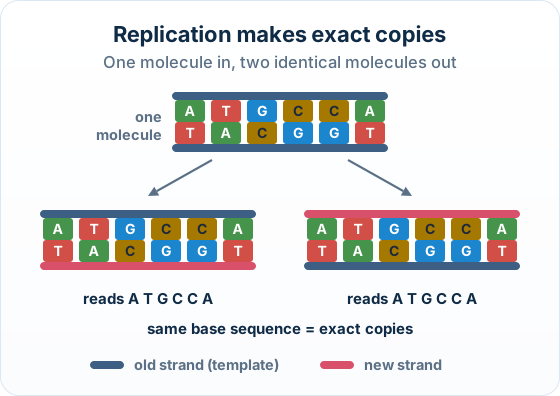
Remember it as: One molecule in, two out, the same sequence in both.
Real example: E. coli. In the best conditions the gut bacterium E. coli divides about every 20 minutes. Before each division it copies its whole chromosome, about 4.6 million base pairs, so both new cells carry the same genes.
Free preview
This is the free notes preview
You're reading the free notes. Aimnova Pro unlocks the full study experience — and you can try it with your first topic free to keep:
- FlashcardsLock in vocabulary and key terms with spaced repetition.
- Practice questionsAnswer exam-style questions and get instant AI marking.
- Mock exams & past-paper vaultSit full mocks and see exactly how examiners award marks.
- Personalised study planA daily plan built around your exam date and weak areas.
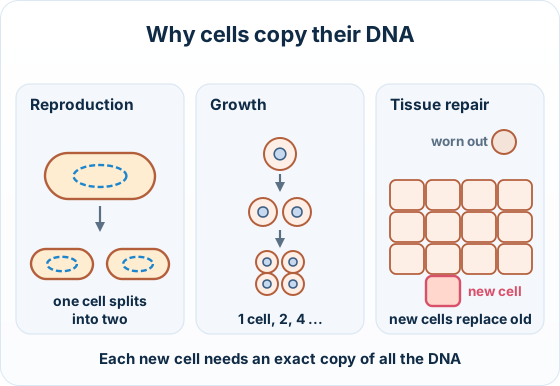
Why copy at all?: Every time a cell divides, each new cell needs a complete, exact copy of the DNA. Cells divide for three reasons.
Reproduction
- A bacterium copies its DNA, then splits into two new organisms.
- Cells that make sex cells copy their DNA first too.
Growth
- A fertilized egg divides again and again.
- A human body has trillions of cells, all from one.
Tissue replacement
- Worn-out or damaged cells are replaced.
- Skin, gut lining and blood are renewed all the time.
Real example: a grazed knee. When you graze your knee, skin cells at the edge of the wound divide to fill the gap. Each new cell gets an exact copy of the DNA, so it makes the same proteins as the skin cells it replaces.
Do not mix them up: Replication copies the DNA. Cell division comes after it and shares the two copies between the two new cells.
Study smarter, not longer
Most students waste 40% of study time on topics they already know. Our AI tracks your progress and optimizes every minute.
How it is asked: A short 'outline why DNA is replicated' or 'state what is the same about the copies', often as the first part of a longer replication question.
Outline why DNA replication is needed in a multicellular organism such as a human.
Model answer plan
See the answer broken into clear points, with guidance on how each point earns marks.